Término del glosario: Estrella
Descripción: Una estrella es una bola de plasma —núcleos atómicos separados de sus electrones— que se mantiene unida gracias a su propia gravedad y cuyo colapso se evita gracias a la presión interna resultante de los procesos de fusión nuclear que tienen lugar en las regiones centrales de la estrella. Los astrónomos, en un ligero abuso de la terminología física, suelen utilizar los términos «gas» y «plasma» indistintamente y, por lo tanto, también se refieren a las estrellas como bolas de gas. En la atmósfera de una estrella, el plasma puede estar solo parcialmente ionizado e incluso contener algunos átomos (dependiendo de la temperatura de la estrella).
La estrella más cercana a la Tierra es el Sol.
En un sentido más general, se entiende que el término «estrella» incluye a las protoestrellas, en las que aún no ha comenzado la fusión nuclear, y a los remanentes estelares, como las estrellas de neutrones o las enanas blancas, que son dos de las posibilidades (dependiendo de la masa) en las que se convierten las estrellas una vez que han agotado el combustible para su fusión nuclear. Estos remanentes estelares no son simplemente bolas de plasma: una enana blanca puede cristalizarse en un tipo inusual de sólido tras enfriarse durante miles de millones de años, y las estrellas de neutrones guardan un gran parecido con núcleos atómicos gigantes.
Ya sea a simple vista o con telescopios de luz visible, las estrellas son los objetos más evidentes del cielo nocturno. En el cosmos, suelen encontrarse dentro de galaxias, y cada estrella suele ir acompañada de uno o más planetas. El estudio de cómo se forman y evolucionan las estrellas es una importante rama de la astrofísica.
Términos relacionados:
Ver este término en otros idiomas
Estado del término y la definición: La definición original de este término en inglés ha sido aprobada por unastrónomo o astrónoma investigadora y un docente La traducción de este término y su definición aún están pendientes de aprobación
El Glosario multilingüe de la OAE es un proyecto de la Oficina de Astronomía para la Educación de la UAI (OAE) en colaboración con la Oficina de Divulgación de Astronomía de la UAI (OAO). Los términos y definiciones fueron seleccionados, redactados y revisados gracias al esfuerzo colectivo de la OAE, los Centros y Nodos de la OAE, los Coordinadores Nacionales de Educación Astronómica (NAECs) y otros voluntarios. Puedes encontrar una lista completa de créditos aquí. Todos los términos del glosario y sus definiciones se publican bajo la licencia Creative Commons CC BY-4.0 y deben atribuirse a la "IAU OAE".
Si detectas algún error de contenido o de traducción en este término del glosario o en ladefinición, ponte en contacto con nosotros.
Contenidos relacionados
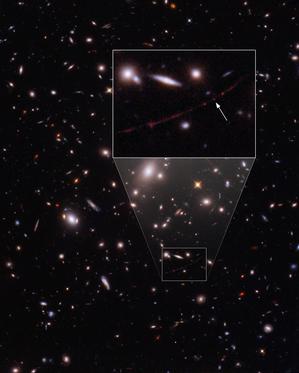
A gravitational lens magnifies one of the first stars
Pie de foto: This image zooms in on a star formed within the first billion years after the birth of the Universe (at a redshift of 6.2). The Hubble Space Telescope detected this light using a technique called gravitational lensing. A massive galaxy cluster between the observer and the imaged star creates a distorted and warped image of the parent galaxy and reveals its features.
Crédito: NASA, ESA, B. Welch (JHU), D. Coe (STScI), A. Pagan (STScI)
enlace de crédito
License: CC-BY-4.0 Creative Commons Reconocimiento 4.0 Internacional (CC BY 4.0) íconos
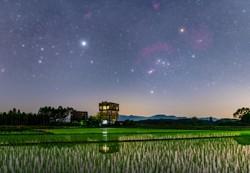
Watchtower and Paddy Fields Under the Starry Sky
Pie de foto: Winner in the 2022 IAU OAE Astrophotography Contest, category Still images of celestial patterns.
This image, taken in April 2022, shows the sky over a plantation field around a century-old watchtower guarding a village in the province of Guangdong, China. Throughout the ages, the sky has been used as a tool for navigation and also as a calendar. By watching the apparent movement of the stars, it is possible to follow the passing of time, thereby understanding the change of the seasons which in turn helps to plan out the best timings of agricultural work.
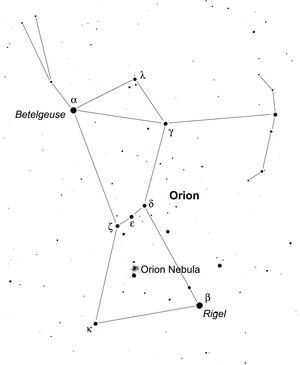
The most prominent constellations in this image are Orion and Canis Major, the Great Dog. Commonly associated with a giant hunter in Greek mythology, Orion is followed by his hound in the shape of the constellation Canis Major.
In China, the seven bright stars of the constellation Orion are paradoxically called Three Stars (Shen) and this is one of the 28 Lunar Mansions. The Babylonian pre-zodiac, the so-called “Path of the Moon”, had 17 constellations and included Orion (therein named “True Shepherd of the Heavens”). This is not really surprising because, even in the system of the 88 modern constellations, the Moon sometimes stands in the constellation Orion. The modern constellation boundaries were defined in the 1920s in such a way that the area of Orion ends a half degree south of the ecliptic, in order to avoid the Sun entering it. Still, the Moon and the planets do occasionally. Therefore, Orion is part of the Zodiac (a stripe 5 to 10 degrees around the ecliptic), part of the path of the Moon and, of course, also used by many cultural calendars all over the world.
Sirius, the bright star in the left half of the photograph, is the brightest star in the night sky, and has been used by many indigenous cultures to determine their calendars; the Egyptians awaited the Nile flood with Sirius’s heliacal rise, while the Romans connected its reappearance after its invisibility in daylight with the hottest summer time. In Old China, Sirius was considered a single-star asterism called The Wolf. The adjacent area was called The Market for Soldiers and the area in the southern part of Canis Major was imagined as the Bow with an Arrow.
The reddish bright star in the top right corner is Betelgeuse, a red supergiant and one of the largest stars that can be seen with the naked eye. Orion’s Great Nebula below Orion’s Belt should be mentioned, but also the fainter huge red arc that is called Barnard’s Loop is clearly shown in this photograph. This galactic nebula and the circular red nebula around Orion’s not-so-bright head are both parts of star-forming regions, while the red nebula to the upper left of Orion is the Rosette Nebula in the unrecognisable constellation of Monoceros.
Crédito: Likai Lin/IAU OAE
License: CC-BY-4.0 Creative Commons Reconocimiento 4.0 Internacional (CC BY 4.0) íconos
Actividades relacionadas
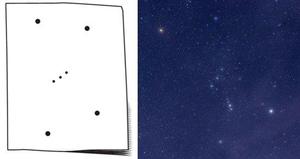
What is a Constellation?
astroEDU educational activity (links to astroEDU website) Description: Investigate three dimensional objects and perspective using constellations
License: CC-BY-4.0 Creative Commons Reconocimiento 4.0 Internacional (CC BY 4.0) íconos
Etiquetas:
Hands-on
Rango de edades:
6-8
, 8-10
Nivel educativo:
Primaria
Áreas de aprendizaje:
Modelización
, Aprendizaje basado en la investigación estructurada
Costos:
Coste medio
Duración:
1 hora y 30 minutos
Tamaño del grupo:
Grupo
Competencias:
Analizar e interpretar datos
, Plantear preguntas
, Elaborar explicaciones
, Desarrollar y utilizar modelos
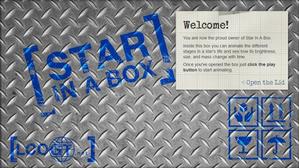
Star in a Box: Advanced
astroEDU educational activity (links to astroEDU website) Description: Explore the life-cycle of stars with Star in a Box activity.
License: CC-BY-4.0 Creative Commons Reconocimiento 4.0 Internacional (CC BY 4.0) íconos
Etiquetas:
Hands-on
, Interactive
, Software
Rango de edades:
10-12
, 12-14
, 14-16
, 16-19
Nivel educativo:
Educación secundaria
Áreas de aprendizaje:
Basado en la tecnología
Costos:
Bajo coste
Tamaño del grupo:
Grupo
Competencias:
Comunicar información
, Elaborar explicaciones
Star in a Box: High School
astroEDU educational activity (links to astroEDU website) Description: Explore the life-cycle of stars with Star in a Box activity.
License: CC-BY-4.0 Creative Commons Reconocimiento 4.0 Internacional (CC BY 4.0) íconos
Etiquetas:
Hands-on
, Interactive
, Software
Rango de edades:
10-12
, 12-14
, 14-16
, 16-19
Nivel educativo:
Educación secundaria
Áreas de aprendizaje:
Basado en la tecnología
Costos:
Bajo coste
Tamaño del grupo:
Grupo
Competencias:
Comunicar información
, Elaborar explicaciones
Star Hats
astroEDU educational activity (links to astroEDU website) Description: Make your star hat, learning about the stars
License: CC-BY-4.0 Creative Commons Reconocimiento 4.0 Internacional (CC BY 4.0) íconos
Etiquetas:
Art
, Creativity
, Hands-on
Rango de edades:
4-6
Nivel educativo:
Educación infantil
Áreas de aprendizaje:
Centrado en las bellas artes
, Clase interactiva
Costos:
Bajo coste
Duración:
30 minutos
Tamaño del grupo:
Individual
Competencias:
Plantear preguntas
, Comunicar información
How Light Pollution Affects the Stars: Magnitude Readers
astroEDU educational activity (links to astroEDU website) Description: Build a Magnitude Reader to explore the magnitude of stars.
License: CC-BY-4.0 Creative Commons Reconocimiento 4.0 Internacional (CC BY 4.0) íconos
Etiquetas:
Hands-on
, Dark skies
, ecology
Rango de edades:
10-12
, 12-14
, 14-16
, 16-19
Nivel educativo:
Educación secundaria
Áreas de aprendizaje:
Modelización
, Basado en la observación
Costos:
Coste medio
Duración:
1 hora
Tamaño del grupo:
Grupo
Competencias:
Plantear preguntas
, Planificar y llevar a cabo investigaciones








