Termo do glossário: Estrela
Descrição: Uma estrela é uma bola de plasma - núcleos atômicos separados de seus elétrons - que é mantida unida por sua própria gravidade e impedida de entrar em colapso pela pressão interna que é consequência dos processos de fusão nuclear nas regiões centrais da estrela. Os astrônomos, em um leve abuso da nomenclatura física, costumam usar "gás" e "plasma" de forma equivalente e, portanto, também se referem às estrelas como bolas de gás. Na atmosfera de uma estrela, o plasma pode estar apenas parcialmente ionizado e (dependendo da temperatura da estrela) até mesmo conter alguns átomos.
A estrela mais próxima da Terra é o Sol.
Em um sentido mais geral, a palavra "estrela" inclui protoestrelas, onde a fusão nuclear ainda não começou, e remanescentes estelares, como estrelas de nêutrons ou anãs brancas, que são duas possibilidades (dependendo da massa) de transformação das estrelas depois de esgotado o combustível para a fusão nuclear. Esses remanescentes estelares não são simplesmente bolas de plasma - uma anã branca pode se cristalizar em um tipo incomum de sólido depois de se resfriar por bilhões de anos, e as estrelas de nêutrons têm uma grande semelhança com núcleos atômicos gigantescos.
Sejam elas observadas a olho nu ou por meio de telescópios de luz visível, as estrelas são os objetos mais evidentes no céu noturno. No cosmos, elas são normalmente encontradas dentro de galáxias, cada estrela geralmente acompanhada por um ou mais planetas. O estudo de como as estrelas se formam e evoluem é um importante subcampo da astrofísica.
Termos relacionados:
Ver este termo em outros idiomas
Status do termo e da definição: A definição original deste termo em inglês foi aprovada por um astrônomo(a) pesquisador(a) e um(a) professor(a) A tradução deste termo e de sua definição ainda aguarda aprovação
O Glossário Multilíngue da OAE é um projeto do Escritório da IAU de Astronomia para a Educação (OAE) em colaboração com o Escritório da IAU para Divulgação da Astronomia (OAO). Os termos e definições foram selecionados, escritos e revisados por meio de um esforço coletivo da OAE, dos Centros e Nós da OAE, dos Coordenadores Nacionais de Educação em Astronomia (NAECs) da OAE e de outros voluntários. Você pode encontrar uma lista completa dos créditos aqui. Todos os termos do glossário e suas definições são disponibilizados sob uma licença Creative Commons CC BY-4.0 e devem ser creditados à "IAU OAE".
Se você notar algum erro factual ou de tradução neste termo do glossário ou em sua definição, por favor entre em contato.
Mídia relacionada
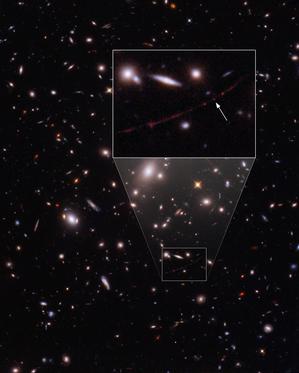
Uma lente gravitacional amplia uma das primeiras estrelas
Legenda: Esta imagem amplia uma estrela formada no primeiro bilhão de anos após o nascimento do Universo (com um desvio para o vermelho, redshift, de 6,2). O Telescópio Espacial Hubble detectou essa luz utilizando uma técnica chamada lente gravitacional. Um massivo aglomerado de galáxias entre o observador e a estrela fotografada cria uma imagem distorcida e deformada da galáxia-mãe e revela suas características.
Crédito: NASA, ESA, B. Welch (JHU), D. Coe (STScI), A. Pagan (STScI)
link do crédito
License: CC-BY-4.0 Creative Commons Attribution 4.0 International (CC BY 4.0) ícones
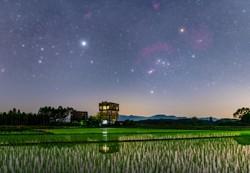
Watchtower and Paddy Fields Under the Starry Sky
Legenda: Winner in the 2022 IAU OAE Astrophotography Contest, category Still images of celestial patterns.
This image, taken in April 2022, shows the sky over a plantation field around a century-old watchtower guarding a village in the province of Guangdong, China. Throughout the ages, the sky has been used as a tool for navigation and also as a calendar. By watching the apparent movement of the stars, it is possible to follow the passing of time, thereby understanding the change of the seasons which in turn helps to plan out the best timings of agricultural work.
The most prominent constellations in this image are Orion and Canis Major, the Great Dog. Commonly associated with a giant hunter in Greek mythology, Orion is followed by his hound in the shape of the constellation Canis Major.
In China, the seven bright stars of the constellation Orion are paradoxically called Three Stars (Shen) and this is one of the 28 Lunar Mansions. The Babylonian pre-zodiac, the so-called “Path of the Moon”, had 17 constellations and included Orion (therein named “True Shepherd of the Heavens”). This is not really surprising because, even in the system of the 88 modern constellations, the Moon sometimes stands in the constellation Orion. The modern constellation boundaries were defined in the 1920s in such a way that the area of Orion ends a half degree south of the ecliptic, in order to avoid the Sun entering it. Still, the Moon and the planets do occasionally. Therefore, Orion is part of the Zodiac (a stripe 5 to 10 degrees around the ecliptic), part of the path of the Moon and, of course, also used by many cultural calendars all over the world.
Sirius, the bright star in the left half of the photograph, is the brightest star in the night sky, and has been used by many indigenous cultures to determine their calendars; the Egyptians awaited the Nile flood with Sirius’s heliacal rise, while the Romans connected its reappearance after its invisibility in daylight with the hottest summer time. In Old China, Sirius was considered a single-star asterism called The Wolf. The adjacent area was called The Market for Soldiers and the area in the southern part of Canis Major was imagined as the Bow with an Arrow.
The reddish bright star in the top right corner is Betelgeuse, a red supergiant and one of the largest stars that can be seen with the naked eye. Orion’s Great Nebula below Orion’s Belt should be mentioned, but also the fainter huge red arc that is called Barnard’s Loop is clearly shown in this photograph. This galactic nebula and the circular red nebula around Orion’s not-so-bright head are both parts of star-forming regions, while the red nebula to the upper left of Orion is the Rosette Nebula in the unrecognisable constellation of Monoceros.
Crédito: Likai Lin/IAU OAE
License: CC-BY-4.0 Creative Commons Attribution 4.0 International (CC BY 4.0) ícones
Atividades relacionadas
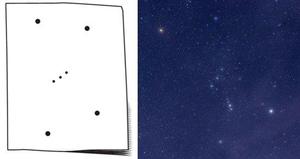
What is a Constellation?
astroEDU educational activity (links to astroEDU website) Description: Investigate three dimensional objects and perspective using constellations
License: CC-BY-4.0 Creative Commons Attribution 4.0 International (CC BY 4.0) ícones
Tags:
Hands-on
Faixas etárias:
6-8
, 8-10
Nível de ensino:
Básico
Áreas de aprendizagem:
Modelagem
, Aprendizagem por investigação estruturada
Custos:
Custo médio
Duração:
1 hour 30 mins
Tamanho do grupo:
Grupo
Habilidades:
Analisar e interpretar dados
, Fazer perguntas
, Construir explicações
, Desenvolver e usar modelos
Star in a Box: Advanced
astroEDU educational activity (links to astroEDU website) Description: Explore the life-cycle of stars with Star in a Box activity.
License: CC-BY-4.0 Creative Commons Attribution 4.0 International (CC BY 4.0) ícones
Tags:
Hands-on
, Interactive
, Software
Faixas etárias:
10-12
, 12-14
, 14-16
, 16-19
Nível de ensino:
Ensino fundamental
Áreas de aprendizagem:
Baseado em tecnologia
Custos:
Baixo custo
Tamanho do grupo:
Grupo
Habilidades:
Comunicar informações
, Construir explicações
Star in a Box: High School
astroEDU educational activity (links to astroEDU website) Description: Explore the life-cycle of stars with Star in a Box activity.
License: CC-BY-4.0 Creative Commons Attribution 4.0 International (CC BY 4.0) ícones
Tags:
Hands-on
, Interactive
, Software
Faixas etárias:
10-12
, 12-14
, 14-16
, 16-19
Nível de ensino:
Ensino fundamental
Áreas de aprendizagem:
Baseado em tecnologia
Custos:
Baixo custo
Tamanho do grupo:
Grupo
Habilidades:
Comunicar informações
, Construir explicações
Star Hats
astroEDU educational activity (links to astroEDU website) Description: Make your star hat, learning about the stars
License: CC-BY-4.0 Creative Commons Attribution 4.0 International (CC BY 4.0) ícones
Tags:
Art
, Creativity
, Hands-on
Faixas etárias:
4-6
Nível de ensino:
Pré-escola
Áreas de aprendizagem:
Com foco em belas-artes
, Aula interativa
Custos:
Baixo custo
Duração:
30 mins
Tamanho do grupo:
Individual
Habilidades:
Fazer perguntas
, Comunicar informações
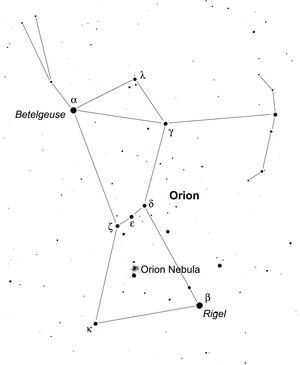
How Light Pollution Affects the Stars: Magnitude Readers
astroEDU educational activity (links to astroEDU website) Description: Build a Magnitude Reader to explore the magnitude of stars.
License: CC-BY-4.0 Creative Commons Attribution 4.0 International (CC BY 4.0) ícones
Tags:
Hands-on
, Dark skies
, ecology
Faixas etárias:
10-12
, 12-14
, 14-16
, 16-19
Nível de ensino:
Ensino fundamental
Áreas de aprendizagem:
Modelagem
, Baseado em observação
Custos:
Custo médio
Duração:
1 hour
Tamanho do grupo:
Grupo
Habilidades:
Fazer perguntas
, Planejar e realizar pesquisas