Término del glosario: Estudio Astronómico
Descripción: Un estudio o sondeo astronómico es una colección de datos astronómicos obtenidos mediante observaciones de todo el cielo o de una región del mismo. Estos estudios suelen contener información sobre la posición de los objetos astronómicos que catalogan en un momento determinado, así como sobre su brillo, color y otras propiedades. Los grandes sondeos astronómicos cartografían el cielo tanto para proporcionar datos para la investigación astronómica como para ayudar a seleccionar objetivos para grandes telescopios.
El diseño de un sondeo astronómico dependerá de sus objetivos científicos; por ejemplo, puede apuntar a todo el cielo, a grandes partes del cielo o sólo a áreas más pequeñas. Los sondeos que cubren áreas pequeñas o sondeos de "haz de lápiz" pueden concentrar más tiempo observando una parte del cielo y, por tanto, pueden detectar objetos más débiles que algunos sondeos más amplios.
Los sondeos astronómicos pueden cubrir partes específicas del espectro electromagnético, como las ondas de radio o el infrarrojo, o pueden combinar datos de diferentes rangos de longitudes de onda.
Algunos sondeos astronómicos realizan observaciones repetidas de la misma parte del cielo, lo que permite el estudio científico del movimiento de los objetos a través del cielo y del cambio de brillo de los objetos astronómicos o la aparición de objetos transitorios como las supernovas. Midiendo el cambio anual de las posiciones, los astrónomos también pueden calcular la distancia de los objetos utilizando el paralaje. Otro tipo de sondeo astronómico es el sondeo espectroscópico, que mide los espectros de miles (o millones) de estrellas, galaxias y otros objetos astronómicos.
Términos relacionados:
- Brillo
- Color
- Astronomía infrarroja
- Astronomía óptica
- Paralaje
- Radioastronomía
- Mapa celeste
- Espectro
- Supernova
Ver este término en otros idiomas
Estado del término y la definición: La definición original de este término en inglés ha sido aprobada por unastrónomo o astrónoma investigadora y un docente La traducción de este término y su definición aún están pendientes de aprobación
El Glosario multilingüe de la OAE es un proyecto de la Oficina de Astronomía para la Educación de la UAI (OAE) en colaboración con la Oficina de Divulgación de Astronomía de la UAI (OAO). Los términos y definiciones fueron seleccionados, redactados y revisados gracias al esfuerzo colectivo de la OAE, los Centros y Nodos de la OAE, los Coordinadores Nacionales de Educación Astronómica (NAECs) y otros voluntarios. Puedes encontrar una lista completa de créditos aquí. Todos los términos del glosario y sus definiciones se publican bajo la licencia Creative Commons CC BY-4.0 y deben atribuirse a la "IAU OAE".
Si detectas algún error de contenido o de traducción en este término del glosario o en ladefinición, ponte en contacto con nosotros.
En otros idiomas
- Árabe: المسح الفلكي
- Alemán: Durchmusterung
- Inglés: Astronomical Survey
- Francés: Relevé astronomique
- Italiano: indagine astronomica
- Japonés: サーベイ観測 (enlace externo)
- Portugués de Brasil: Levantamento Astronômico
- Chino simplificado: 天文巡天
- Chino tradicional: 天文巡天
Contenidos relacionados
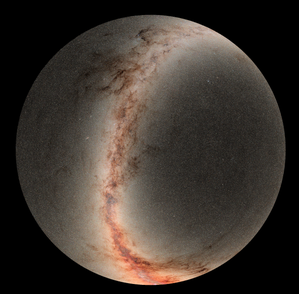
Pan-STARRS Survey: Mosaic of the Northern Sky
Pie de foto: This circular mosaic was created from thousands of sky images taken by the Pan-STARRS Observatory, a 1.8-meter telescope located on the volcano Haleakalā on Maui, Hawai`i. The centre of the circle marks the north celestial pole, while the outer boundary corresponds to a declination of −30 degrees — the southern limit of the survey from that location. Each part of this image was visited multiple times during the survey with each location imaged in five different colors with multiple images per color to catch objects changing in brightness and to find moving objects such as asteroids. This dataset is a powerful example of an astronomical survey, in which the sky is systematically photographed to build large, uniform catalogs of celestial objects.
The wide, bright band running roughly from top to bottom is the Milky Way, with the Galactic centre appearing near the lower edge where the glow is strongest. Across the image are hundreds of millions of detected sources, most of them stars within our own galaxy, along with many distant galaxies in the background. Surveys like Pan-STARRS are essential for studying the structure of the Milky Way and for discovering new objects across vast areas of the sky.
Crédito: Richard White (STScI), Pan-STARRS1 Science Consortium
enlace de crédito
License: PD Dominio público íconos
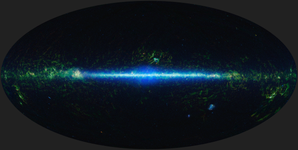
WISE Survey Capturing the Whole Sky in Infrared Light
Pie de foto: This image presents the entire sky mapped in infrared light from space by the WISE satellite. While dust in the plane of the Milky Way blocks visible light, obscuring the heart of our Galaxy, infrared light passes through the dust. The most prominent feature is the broad, bright band running horizontally through the centre — this is the plane of our Milky Way galaxy. Numerous brighter knots and patches appear above and below the band, marking regions of active star formation and nearby galaxies.
Such a dataset is a classic example of an astronomical survey, in which large portions of the sky is scanned to build a comprehensive catalogue of cosmic sources. The WISE satellite operated in space, allowing it to study parts of the infrared spectrum blocked by Earth's atmosphere.
Crédito: NASA/JPL-Caltech
enlace de crédito
License: PD Dominio público íconos