Terme du glossaire : Télescope infrarouge
Description : Un télescope infrarouge observe la lumière infrarouge et est utilisé pour l'astronomie infrarouge. Les télescopes infrarouges peuvent être situés au sol ou dans l'espace. Les observatoires situés sur Terre sont limités dans ce qu'ils peuvent observer par l'absorption atmosphérique et le rayonnement infrarouge émis par l'atmosphère terrestre, le télescope lui-même et son environnement. Les télescopes infrarouges spatiaux n'ont pas à faire face à l'absorption atmosphérique ou au rayonnement infrarouge de leur environnement immédiat et peuvent être protégés du soleil et refroidis, ce qui réduit le rayonnement infrarouge émis par le télescope.
Termes associés :
Voir ce terme dans d'autres langues
Statut du terme et de sa définition : La définition initiale de ce terme en anglais a été aprouvée par un·e spécialiste de la recherche en astronomie et un·e spécialiste de l’éducation La traduction de ce terme et de sa définition n'ont pas encore été aprouvées
Le glossaire multilangue de l'OAE est un projet du Bureau de l'IAU de l'Astronomie pour l'Education (OAE) en collaboration avec le Bureau de l'IAU de diffusion de l'Astronomie (OAO). Les termes et définitions ont été choisis, écrits et relues grâce à un effort collectif de l'OAE, les Centres et les Noeuds de l'OAE, les Coordinateurs Nationaux de l'Astronomie pour l'Education de l'OAE(NAECs) et d'autres volontaires. La liste complète des crédits pour ce projet est disponible ici . Tous les termes du glossaire et leur définition sont déposés sous licence Creative Commons CC BY-4.0 et doivent être créditées au nom de "IAU OAE".
Si vous constatez une erreur dans ce terme ou sa définition, veuillez nous contacter .
Dans d'autres langues
- Arabe: تلسكوب الأشعة تحت الحمراء
- Allemand: Infrarotteleskop
- Anglais: Infrared Telescope
- Espagnol: Telescopio infrarrojo
- Italien: Telescopio a infrarossi
- Portugais brésilien: Telescópio infravermelho
- Chinois simplifié: 红外望远镜
- Chinois traditionnel: 紅外望遠鏡
Media associé

The Pillars of Creation in comparison
Légende : The 'Pillars of Creation' are a renowned astronomical feature situated within the Eagle Nebula in the Serpens constellation. The illustration provides a direct comparison between images captured by the Hubble Space Telescope (HST) and the James Webb Space Telescope (JWST), showcasing the pillars, which span several light years in diameter, in both visible light (also known as optical light) and infrared light. On the left are the pillars as seen by Hubble in visual light, taken in 2014. It displays dark pillars against an opaque background, with only a handful of visible stars. Conversely, the counterpart on the right is Webb’s near-infrared view published in 2022, penetrating the dust and revealing numerous stars of varying sizes.
Their distance from Earth is approximately 6,500 to 7,000 light years. Within these pillars, new stars are constantly forming, making them a subject of extensive study by astronomers. Composed mostly of cool molecular hydrogen and small amounts of interstellar dust, they are subject to erosion by the intense ultraviolet radiation emitted by nearby massive and newborn stars, a process known as photoevaporation.
Crédit : NASA, ESA, CSA, STScI
Lien vers les crédits
License: CC-BY-2.0 Creative Commons (CC) Attribution 2.0 Générique Icônes
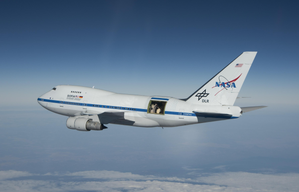
SOFIA: Unveiling the Infrared Universe from the Skies
Légende : This image shows the Stratospheric Observatory for Infrared Astronomy (SOFIA) telescope. This telescope which operated from 2010 to 2022 was mounted in a modified Boeing 747 aircraft with a section of the rear fuselage removed to allow the telescope to observe the sky and with other modifications that allow it to fly at a higher altitude than a standard 747.
Many molecules which are common in the Earth's atmosphere (such as water, carbon dioxide and methane) absorb radiation at infrared wavelengths. This interferes with infrared observations made from the ground. SOFIA flew at an altitude that puts it above most of the water vapour in the Earth's atmosphere, greatly reducing the impact of absorption by water molecules on its observations.
Crédit : NASA photo / Jim Ross
Lien vers les crédits
License: PD Domaine Public Icônes
Ceci pourrait vous intéresser également






.png)


- Ressources
- Moteur de recherche des ressources pédagogiques
- Parcourir les ressources pédagogiques par Sujet
- Parcourir les images
- AstroEdu - Activités en classe
- Grandes Idées - Littéracie en astronomie
- Glossaire
- Rapports de l'OAE
- L'astronomie pour l'Education à travers le monde
- Sélection de ressources externes