Terme du glossaire : Formation de planètes
Description : Lorsqu'un nuage de gaz cosmique s'effondre pour former une étoile, cette étoile naissante est entourée d'un disque tourbillonnant de gaz et de poussières. Il s'agit d'un disque protoplanétaire, où se forment les planètes : les particules de poussière recouvertes de glace se collent les unes aux autres, formant des amas légèrement plus grands, qui continuent de croître. Des questions restent en suspens sur la manière dont se déroulent les étapes suivantes : Quel est, par exemple, le rôle des mouvements turbulents du gaz dans le rapprochement de ces amas ? Finalement, des "corps planétésimaux" de plus d'un kilomètre se forment. Certains d'entre eux sont rassemblés par leur propre gravité pour former des planètes plus grandes, tandis que d'autres restent sur place pour former les premiers astéroïdes. Certaines protoplanètes parviennent à attirer de grandes quantités de gaz vers elles pour devenir des géantes gazeuses. D'autres protoplanètes, situées dans des régions froides loin de l'étoile centrale, accumuleront de grandes quantités de matériaux gelés en même temps que du gaz, devenant ainsi des géantes de glace. D'autres, avec moins de gaz, deviennent des planètes telluriques.
Termes associés :
Voir ce terme dans d'autres langues
Statut du terme et de sa définition : La définition initiale de ce terme en anglais a été aprouvée par un·e spécialiste de la recherche en astronomie et un·e spécialiste de l’éducation La traduction de ce terme et de sa définition n'ont pas encore été aprouvées
Le glossaire multilangue de l'OAE est un projet du Bureau de l'IAU de l'Astronomie pour l'Education (OAE) en collaboration avec le Bureau de l'IAU de diffusion de l'Astronomie (OAO). Les termes et définitions ont été choisis, écrits et relues grâce à un effort collectif de l'OAE, les Centres et les Noeuds de l'OAE, les Coordinateurs Nationaux de l'Astronomie pour l'Education de l'OAE(NAECs) et d'autres volontaires. La liste complète des crédits pour ce projet est disponible ici . Tous les termes du glossaire et leur définition sont déposés sous licence Creative Commons CC BY-4.0 et doivent être créditées au nom de "IAU OAE".
Si vous constatez une erreur dans ce terme ou sa définition, veuillez nous contacter .
Dans d'autres langues
- Arabe: تكوُّن الكواكب
- Allemand: Planetenentstehung
- Anglais: Planet Formation
- Espagnol: Formación de planetas
- Perse: شکل گیری سیارهها
- Italien: Formazione dei pianeti
- Portugais brésilien: Formação planetária
- Chinois simplifié: 行星形成
- Chinois traditionnel: 行星形成
Media associé
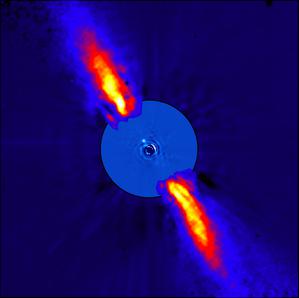
beta Pictoris b
Légende : Ce composite de deux images montre la planète beta Pictoris b et un disque de matière, tous deux en orbite autour de la jeune étoile beta Pictoris. Les deux images sont prises en lumière infrarouge. L'image intérieure est l'une des premières images prises d'une planète autour d'une autre étoile (une exoplanète). Cette image a été réalisée à l'aide d'une technique appelée optique adaptative qui supprime l'effet de flou de l'atmosphère terrestre qui étale la lumière d'une étoile. La lumière de l'étoile est alors suffisamment concentrée pour être cachée derrière un cercle de blocage (ici en noir) appelé coronographe. Les ondulations autour de ce cercle sont des artefacts du processus d'imagerie. Beta Pictoris b, une planète géante gazeuse dont la masse est environ douze fois supérieure à celle de Jupiter, apparaît comme un point au-dessus et à gauche du cercle noir.
L'image extérieure montre l'émission thermique du disque de matière chaude entourant la jeune étoile Beta Pictoris. par la tranche, il apparaît sous forme d'une ligne. Ce disque de gaz et de poussière a fourni la matière nécessaire à la formation de beta Pictoris b.
Crédit : ESO/A.-M. Lagrange et al.
Lien vers les crédits
License: CC-BY-4.0 Creative Commons (CC) Attribution 4.0 International (CC BY 4.0) Icônes
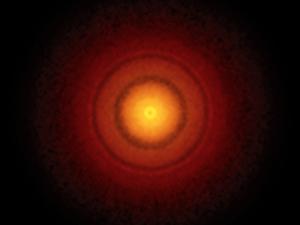
Planet formation around the star TW Hydrae
Légende : This image shows the disk around the young star TW Hydrae. This star is only about 10 million years old, young enough that planets are still forming in a disk of gas and dust around it. This image was created using an array of submillimetre telescopes, each of which looks like a satellite dish. The signals from these telescopes were combined by a central processing computer to make this image. The lighter and darker patches show areas of the disk where there is more or less dust respectively. The dark rings and bright rings are evidence that the dust in the disk has been shepherded into some orbits and away from others. This is likely because there is one or more planets that are still forming hidden in the disk.
The whole image shows the disk around TW Hydrae out to a distance of about 70 astronomical units frm the central star. The two outer dark rings are separated from the central star by approximately the average distance between the Sun and Uranus and the average distance between the Sun and Pluto. The inner central hole appears to have been carved out by a planet orbiting TW Hydrae at a distance similar to the distance between the Earth and the Sun.
Crédit : S. Andrews (Harvard-Smithsonian CfA); B. Saxton (NRAO/AUI/NSF); ALMA (ESO/NAOJ/NRAO)
Lien vers les crédits
License: CC-BY-4.0 Creative Commons (CC) Attribution 4.0 International (CC BY 4.0) Icônes

The planet PDS 70b inside a protoplanetary disk
Légende : An image of the planet PDS 70b. The young star PDS 70b has a protoplanetary disk surrounding it. Disks like these contains gas, fine sandy particles that astronomers refer to as dust and also larger bodies ranging from objects the size of pebbles to protoplanets (planets that are still forming).
This image was taken in infrared light using adaptive optics. Adaptive optics is a technique that uses flexible mirrors and computer analysis to remove the blurring effect of the Earth's atmosphere. This allows astronomers to search regions close to stars like PDS 70 that would otherwise be swamped by light from the star spread out by the Earth's atmosphere. In the center is a black circle. This is caused by a coronograph, a small circle that blocks out light from the parent star. This is surrounded by a bright oval, infrared light emitted from the material in the protoplanetary disk. To the right of the black circle covering the star is a bright dot. This is PDS 70b, a giant planet that is still forming .
Crédit : ESO/ A. Müller, MPIA
Lien vers les crédits
License: CC-BY-4.0 Creative Commons (CC) Attribution 4.0 International (CC BY 4.0) Icônes
Diagrammes associés
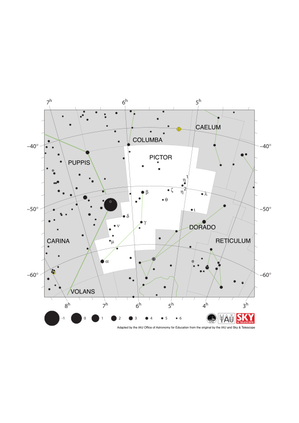
Pictor Constellation Map
Légende : The constellation Pictor with its bright stars and surrounding constellations. Pictor is surrounded by (going clockwise from the top): Columba, Caelum, Dorado, Volans, Carina and Puppis. Pictor is notable for its second brightest star, Beta Pictoris. This young star hosts a large disk of dusty material left over from the planet formation process along with two planets, one of which Beta Pictoris b was one of the first planets to be directly imaged by astronomers.
Pictor is a southern constellation and thus the whole constellation is visible at some point in the year throughout the southern hemisphere. The whole constellation is also visible from some equatorial regions of the northern hemisphere with parts of the constellation visible to the remaining northern equatorial regions and some northern hemisphere temperate zones. Pictor is best viewed in the northern hemisphere winter and southern hemisphere summer.
The y-axis of this diagram is in degrees of declination with north as up and the x-axis is in hours of right ascension with east to the left. The sizes of the stars marked here relate to the star's apparent magnitude, a measure of its apparent brightness. The larger dots represent brighter stars. The Greek letters mark the brightest stars in the constellation. These are ranked by brightness with the brightest star being labeled alpha, the second brightest beta, etc., although this ordering is not always followed exactly. The dotted boundary lines mark the IAU's boundaries of the constellations and the solid green lines mark one of the common forms used to represent the figures of the constellations. Neither the constellation boundaries, nor the lines joining the stars appear on the sky.
Crédit : Adapted by the IAU Office of Astronomy for Education from the original by the IAU and Sky & Telescope
License: CC-BY-4.0 Creative Commons (CC) Attribution 4.0 International (CC BY 4.0) Icônes
Activités associées
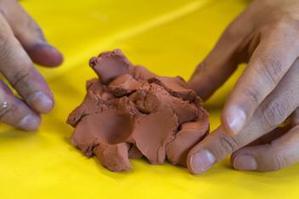
Creating Asteroids
astroEDU educational activity (links to astroEDU website) Description: Have fun, building asteroids using clay!
License: CC-BY-4.0 Creative Commons (CC) Attribution 4.0 International (CC BY 4.0) Icônes
Mots clés :
Hands-on
, Model
Tranches d'âge :
4-6
, 6-8
, 8-10
Niveau scolaire :
Maternelle
, Primaire
Domaines d'apprentissage :
Modélisation
, Apprentissage par enquête
Coûts :
Moyen
Durée :
1h 30m
Taille du groupe :
Par groupe
Compétences :
Communiquer des informations
, Développer et utiliser des modèles









- Ressources
- Moteur de recherche des ressources pédagogiques
- Parcourir les ressources pédagogiques par Sujet
- Parcourir les images
- AstroEdu - Activités en classe
- Grandes Idées - Littéracie en astronomie
- Glossaire
- Rapports de l'OAE
- L'astronomie pour l'Education à travers le monde
- Sélection de ressources externes