词条 行星形成
描述: 当宇宙气体云坍缩形成恒星时,这颗新生恒星被一个由气体和尘埃组成的漩涡盘所包围。这就是行星形成的原行星盘:被冰覆盖的尘埃粒子会相互粘连,形成稍大的团块,并继续增大。至于接下来会发生什么,还有一些问题还尚未解决:例如,湍流气体运动在拉近这些团块之间的距离方面起着什么作用?但最终结果是,尘埃粒子会形成大小超过一公里的所谓 "小行星"。其中一些被自身的引力拉到一起,形成更大的行星,另一些则留下来,成为第一颗小行星。一些原行星设法将大量气体吸向它们,成为气态巨行星。还有一些原行星位于远离中心恒星的寒冷区域,它们会与气体一起吸积大量的冰冻物质,成为冰巨行星。其他一些气体较少的原行星则会成为陆地行星。
相关词条
用其他语言查看该词条
词条和定义状态: 该术语的英文原始定义已通过天文研究人员和教师的审核 该术语及其定义的译文仍待审核
OAE多语言词汇表是由国际天文学联合会(IAU) 天文教育办公室(OAE) 和 国际天文学联合会(IAU) 天文推广办公室(OAO)合作的项目。. 术语和定义由 OAE中心, OAE 国家天文教育协调员(NAECs) 以及其他志愿者共同选择、撰写和审阅。您可以在 找到完整的致谢列表。所有词汇表术语及其定义均根据 Creative Commons CC BY-4.0许可证发布 且版权归属于 “IAU OAE”。
如果您发现此词汇术语或定义中的事实或翻译错误, 请向 发邮件 联系.
其他语言版本
- 阿拉伯语: تكوُّن الكواكب
- 德语: Planetenentstehung
- 英语: Planet Formation
- 西班牙语: Formación de planetas
- 波斯语: شکل گیری سیارهها
- 法语: Formation de planètes
- 意大利语: Formazione dei pianeti
- 巴西葡萄牙语: Formação planetária
- 繁体中文: 行星形成
相关媒体
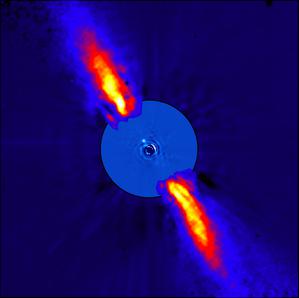
老人增四b
图注: 这幅图像由两张照片合成,显示了系外行星老人增四b和一个物质盘,它们都围绕年轻恒星老人增四运行。这两张照片都是在红外波段拍摄的。围绕太阳之外的恒星运行的行星称为“系外行星”,内侧图像即为首批被拍摄到的系外行星照片之一。这张照片是利用一种叫做“自适应光学”的技术拍摄的,该技术可以消除地球大气引起的模糊效应,从而使星光不再散开。然后,星光被高度集中,并由一个叫做“星冕仪”的遮挡圈(此处显示为黑圈)遮挡,其周围的波纹是成像过程中的伪影。老人增四b是一颗气态巨行星,质量约为木星的12倍,在黑圈左上方显示为一个小点。
外侧图像显示的是年轻恒星老人增四周围温暖物质盘的热辐射。我们的视线处于这个物质盘的侧面,因此它显示为一条线。这个由气体和尘埃组成的物质盘提供了形成老人增四b的物质。
来源: ESO/A.-M. Lagrange et al.
来源链接
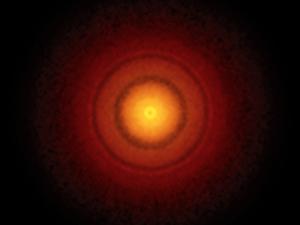
恒星长蛇座TW周围行星的形成
图注: 这幅图像显示的是年轻恒星长蛇座TW周围的物质盘。这颗恒星足够年轻,的年龄只有大约一千万年,因此其周围的气体和尘埃盘中仍在形成行星。这幅图像是利用亚毫米望远镜阵列制作的,其中每台望远镜看起来都像一个碟形天线。这些望远镜接收到的信号由一台中央处理计算机合成,从而生成了这幅图像。其明暗程度表示的是物质盘上尘埃的多少。图中的暗环和亮环表明物质盘中的尘埃被带入了某些轨道,并远离了其他轨道。这可能是因为物质盘中隐藏着一颗或多颗仍处在形成过程中的行星。
整幅图像显示的环绕长蛇座TW的物质盘延伸到了距离中心恒星约70个天文单位处。外侧的两个暗环与中心恒星的距离大致相当于太阳与天王星之间的平均距离以及太阳与冥王星之间的平均距离。内侧中央的洞似乎是由一颗环绕长蛇座TW运行的行星雕刻出的,其与中心恒星的距离大致相当于地球与太阳之间的距离。
来源: S. Andrews (Harvard-Smithsonian CfA); B. Saxton (NRAO/AUI/NSF); ALMA (ESO/NAOJ/NRAO)
来源链接

The planet PDS 70b inside a protoplanetary disk
图注: An image of the planet PDS 70b. The young star PDS 70b has a protoplanetary disk surrounding it. Disks like these contains gas, fine sandy particles that astronomers refer to as dust and also larger bodies ranging from objects the size of pebbles to protoplanets (planets that are still forming).
This image was taken in infrared light using adaptive optics. Adaptive optics is a technique that uses flexible mirrors and computer analysis to remove the blurring effect of the Earth's atmosphere. This allows astronomers to search regions close to stars like PDS 70 that would otherwise be swamped by light from the star spread out by the Earth's atmosphere. In the center is a black circle. This is caused by a coronograph, a small circle that blocks out light from the parent star. This is surrounded by a bright oval, infrared light emitted from the material in the protoplanetary disk. To the right of the black circle covering the star is a bright dot. This is PDS 70b, a giant planet that is still forming .
来源: ESO/ A. Müller, MPIA
来源链接
相关图表
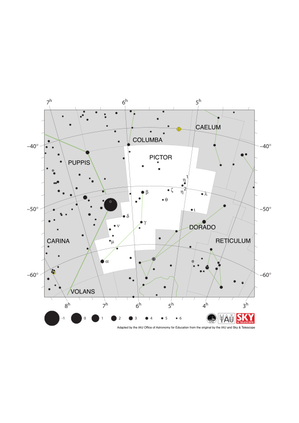
Pictor Constellation Map
图注: The constellation Pictor with its bright stars and surrounding constellations. Pictor is surrounded by (going clockwise from the top): Columba, Caelum, Dorado, Volans, Carina and Puppis. Pictor is notable for its second brightest star, Beta Pictoris. This young star hosts a large disk of dusty material left over from the planet formation process along with two planets, one of which Beta Pictoris b was one of the first planets to be directly imaged by astronomers.
Pictor is a southern constellation and thus the whole constellation is visible at some point in the year throughout the southern hemisphere. The whole constellation is also visible from some equatorial regions of the northern hemisphere with parts of the constellation visible to the remaining northern equatorial regions and some northern hemisphere temperate zones. Pictor is best viewed in the northern hemisphere winter and southern hemisphere summer.
The y-axis of this diagram is in degrees of declination with north as up and the x-axis is in hours of right ascension with east to the left. The sizes of the stars marked here relate to the star's apparent magnitude, a measure of its apparent brightness. The larger dots represent brighter stars. The Greek letters mark the brightest stars in the constellation. These are ranked by brightness with the brightest star being labeled alpha, the second brightest beta, etc., although this ordering is not always followed exactly. The dotted boundary lines mark the IAU's boundaries of the constellations and the solid green lines mark one of the common forms used to represent the figures of the constellations. Neither the constellation boundaries, nor the lines joining the stars appear on the sky.
来源: Adapted by the IAU Office of Astronomy for Education from the original by the IAU and Sky & Telescope
相关活动

Creating Asteroids
astroEDU educational activity (links to astroEDU website) Description: Have fun, building asteroids using clay!
License: CC-BY-4.0 知识共享许可协议 署名 4.0 国际 (CC BY 4.0) 图标
标签:
Hands-on
, Model
年龄段:
4-6
, 6-8
, 8-10
受教育等级:
学前
, Primary
学习领域:
建模
, 结构化探究式学习
费用:
中等成本
时间跨度:
1 小时 30 分钟
组别大小:
小组
技能:
传达信息
, 开发和使用模型