Termo do glossário: Cinturão de asteroides
Descrição: O cinturão de asteroides está localizado em uma região entre os planetas Marte e Júpiter; em órbita nessa região estão o planeta anão Ceres e um grande número de asteroides, majoritariamente pequenos, que consistem principalmente de rochas e alguns minerais. O cinturão de asteroides foi descrito como o principal cinturão de asteroides para distingui-lo de outros corpos pequenos encontrados no Sistema Solar, ou seja, os objetos próximos da Terra e o grupo Trojan.
Termos relacionados:
Ver este termo em outros idiomas
Status do termo e da definição: A definição original deste termo em inglês foi aprovada por um astrônomo(a) pesquisador(a) e um(a) professor(a) A tradução deste termo e de sua definição ainda aguarda aprovação
O Glossário Multilíngue da OAE é um projeto do Escritório da IAU de Astronomia para a Educação (OAE) em colaboração com o Escritório da IAU para Divulgação da Astronomia (OAO). Os termos e definições foram selecionados, escritos e revisados por meio de um esforço coletivo da OAE, dos Centros e Nós da OAE, dos Coordenadores Nacionais de Educação em Astronomia (NAECs) da OAE e de outros voluntários. Você pode encontrar uma lista completa dos créditos aqui. Todos os termos do glossário e suas definições são disponibilizados sob uma licença Creative Commons CC BY-4.0 e devem ser creditados à "IAU OAE".
Se você notar algum erro factual ou de tradução neste termo do glossário ou em sua definição, por favor entre em contato.
Em outros idiomas
- Árabe: حزام الكويكبات
- Alemão: Asteroidengürtel
- Inglês: Asteroid Belt
- Espanhol: Cinturón de Asteroides
- Francês: Ceinture d'astéroïdes
- Hindi: क्षुद्रग्रह घेरा (ऐस्टरौएड बेल्ट)
- Italiano: Fascia degli asteroidi
- Japonês: 小惑星帯 (link externo)
- Coreano: 소행성대
- Marathi: लघुग्रहांचा पट्टा
- Chinês Simplificado: 小行星带
- Chinês Tradicional: 小行星帶
Mídia relacionada
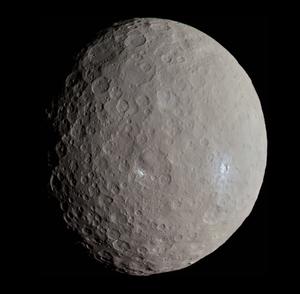
Ceres
Legenda: Imagem em cores reais do asteroide Ceres adquirida pela sonda espacial Dawn em maio de 2015, a uma distância de 13641 km. A proeminente e brilhante cratera à direita é Haulani. O ponto brilhante menor à sua esquerda está exposto no piso da cratera de Oxo. A ejeção desses impactos parece ter exposto material brilhante, provavelmente gelo de água.
Crédito: NASA / JPL-Caltech / UCLA / MPS / DLR / IDA / Justin Cowart
License: CC-BY-2.0 Creative Commons Attribution 2.0 Generic ícones
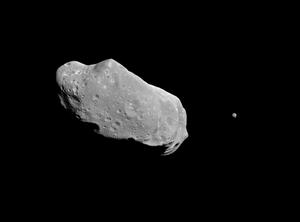
Ida e Dactyl
Legenda: Esta imagem do asteroide Ida com seu satélite Dactyl foi tirada pela sonda espacial Galileo em agosto de 1993 a uma distância de 10.870 quilômetros (6.755 milhas). Ida é um asteroide irregular e repleto de crateras localizado no cinturão principal de asteroides entre Marte e Júpiter. Esta imagem é a prova de que asteróides como o Ida, com 56 km de diâmetro, podem possuir suas próprias luas.
Crédito: NASA/JPL
link do crédito
License: PD Domínio Público ícones