Termo do glossário: Planeta
Descrição: Um planeta é definido pela União Astronômica Internacional como um corpo celeste em órbita ao redor de uma estrela ou do remanescente de uma estrela, que é grande o suficiente para ter uma forma quase redonda devido à sua própria força gravitacional, mas não é maciço o suficiente para que ocorra fusão termonuclear em seu núcleo. Ele também deve ser grande o suficiente para que sua gravidade remova outros objetos que passem perto de sua órbita ao redor da estrela. Portanto, são corpos frios (em comparação com as estrelas) que brilham na faixa visível apenas pela luz refletida de suas estrelas, mas emitem luz em comprimentos de onda infravermelhos. Em nosso Sistema Solar, oito planetas orbitam ao redor do Sol. Os planetas podem ser basicamente objetos rochosos, como os planetas internos - Mercúrio, Vênus, Terra e Marte - ou principalmente líquidos e gasosos com um pequeno núcleo sólido, como os planetas externos - Júpiter, Saturno, Urano e Netuno. Os planetas fora do Sistema Solar são chamados de planetas extrassolares ou exoplanetas.
Termos relacionados:
- Terra
- Exoplaneta
- Gigante gasoso
- Planeta gigante
- Gigante Gelado
- União Astronômica Internacional
- Júpiter
- Marte
- Mercúrio
- Netuno
- Fusão nuclear
- Planetas Externos
- Saturno
- Sistema solar
- Planeta terrestre
- Urano
- Vênus
Ver este termo em outros idiomas
Status do termo e da definição: A definição original deste termo em inglês foi aprovada por um astrônomo(a) pesquisador(a) e um(a) professor(a) A tradução deste termo e de sua definição ainda aguarda aprovação
O Glossário Multilíngue da OAE é um projeto do Escritório da IAU de Astronomia para a Educação (OAE) em colaboração com o Escritório da IAU para Divulgação da Astronomia (OAO). Os termos e definições foram selecionados, escritos e revisados por meio de um esforço coletivo da OAE, dos Centros e Nós da OAE, dos Coordenadores Nacionais de Educação em Astronomia (NAECs) da OAE e de outros voluntários. Você pode encontrar uma lista completa dos créditos aqui. Todos os termos do glossário e suas definições são disponibilizados sob uma licença Creative Commons CC BY-4.0 e devem ser creditados à "IAU OAE".
Se você notar algum erro factual ou de tradução neste termo do glossário ou em sua definição, por favor entre em contato.
Mídia relacionada
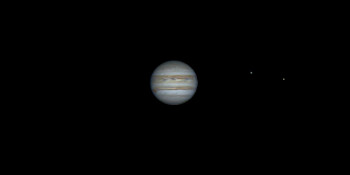
Jupiter's Rotation, by Vishal Sharma, India
Legenda: Third place in the 2021 IAU OAE Astrophotography Contest, category Galilean moons: Jupiter’s Rotation, by Vishal Sharma, India.
This time-lapse beautifully shows the rotation of Jupiter and the passage of two Galilean moons on the right side of the frame. Jupiter completes one rotation in just under 10 hours and we see as the Great Red Spot makes its way from left to right. The two moons travel a noticeable fraction of their orbit in this short time. This image was taken in 2020 in the North of India.
Crédito: Vishal Sharma/IAU OAE
License: CC-BY-4.0 Creative Commons Attribution 4.0 International (CC BY 4.0) ícones
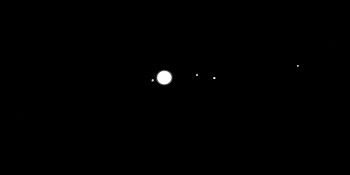
Jupiter Moons Movie2, by Nicolas Hurez, Paul-Antoine Matrangolo, and Carl Pennypacker, United States of America
Legenda: Second place in the 2021 IAU OAE Astrophotography Contest, category Galilean moons.
This sequence shows the orbit of the four Galilean moons around the planet Jupiter. Almost two entire orbits of the innermost moon, Io, can be seen, with the other moons (Europa and Ganymede, but in particular Callisto) being further away, orbiting noticeably slower. The images were obtained in 2018 with the Las Cumbres Global Observatory at different locations on Earth, allowing a continuous sequence of images over approximately half a week without gaps during the day. With clear skies and over the course of several nights, the motion of the Galilean moons can also be observed with binoculars (ideally steady your elbows on a surface).
Crédito: Nicolas Hurez, Paul-Antoine Matrangolo and Carl Pennypacker/IAU OAE
License: CC-BY-4.0 Creative Commons Attribution 4.0 International (CC BY 4.0) ícones
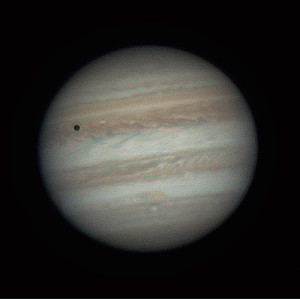
Jupiter, Io and its shadow, by Ralf Burkart, Germany
Legenda: First place in the 2021 IAU OAE Astrophotography Contest, category Galilean moons.
This time-lapse of Jupiter taken in 2017 from Germany beautifully illustrates the transit of one of the Galilean moons, Io, in front of Jupiter. As this is simply a moon casting a shadow on a planet it is equivalent to a lunar eclipse on Earth observed from further away. While the shadow of the moon is clearly visible from the beginning, it might be difficult to spot the moon itself against the background of the beautiful atmospheric bands of Jupiter the first time the video is seen. Watching it repeatedly allows appreciating the rapid motion and rotation in this fantastic observation.
Crédito: Ralf Burkart/IAU OAE
License: CC-BY-4.0 Creative Commons Attribution 4.0 International (CC BY 4.0) ícones
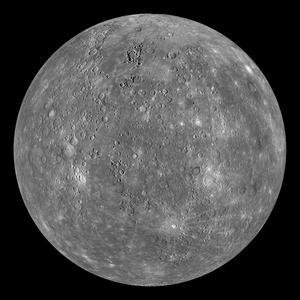
Mercúrio
Legenda: Esta imagem é uma composição de um mosaico de fotos da superfície do planeta Mercúrio obtidas pela sonda espacial MESSENGER (Mercury Surface, Space Environment, Geochemistry and Ranging). A MESSENGER foi lançada pela NASA em 2004 e explorou Mercúrio de 2011 a 2015.
Crédito: NASA/Laboratório de Física Aplicada da Universidade Johns Hopkins/Instituição Carnegie de Washington
link do crédito
License: PD Domínio Público ícones
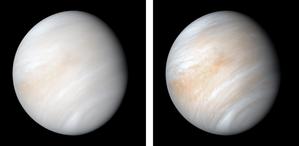
Vênus em luz visível
Legenda: Esta foto, tirada pela sonda Mariner 10 da NASA, mostra como o planeta Vênus aparece a olho nu. Vênus está envolto em uma espessa atmosfera de nuvens, dominada por dióxido de carbono, que nunca revela sua superfície quente.
Crédito: NASA/JPL-Caltech
link do crédito
License: PD Domínio Público ícones
Atividades relacionadas
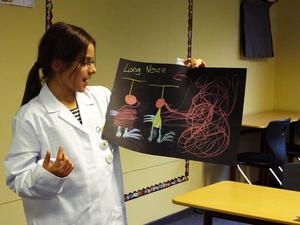
Design Your Alien
astroEDU educational activity (links to astroEDU website) Description: Design an alien life form suited for an extra-terrestrial world.
License: CC-BY-4.0 Creative Commons Attribution 4.0 International (CC BY 4.0) ícones
Tags:
Life
, Environment
, Extra-terrestrial
, Art
, Creativity
, Hands-on
, Alien
Faixas etárias:
8-10
, 10-12
Nível de ensino:
Básico
, Médio