Termo do glossário: Galáxia
Descrição: Uma galáxia é um sistema de estrelas e outros componentes materiais, como matéria escura, gás e poeira, que está gravitacionalmente ligado e geralmente separado de seus vizinhos por centenas de milhares de anos-luz. As galáxias têm várias formas e tamanhos diferentes. As menores galáxias podem ter alguns milhares de estrelas, enquanto as maiores podem ter dezenas de trilhões. "A Galáxia" ou "Galáxia" com letra maiúscula geralmente se refere à nossa galáxia natal, a Via Láctea, que tem cerca de 100 a 400 bilhões de estrelas.
Termos relacionados:
- Matéria Escura
- Disco Galaxy
- Poeira
- Galáxia anã
- Galáxia Elíptica
- Bojo Galáctico
- Centro Galáctico
- Disco Galáctico
- Halo Galáctico
- Aglomerado de galáxias
- Gás
- Fuso Horário de Greenwich (GMT)
- Galáxia Irregular
- Via Láctea
- Galáxia espiral
- Estrela
- Barra Galáctica
- Galáxia Lenticular
Ver este termo em outros idiomas
Status do termo e da definição: A definição original deste termo em inglês foi aprovada por um astrônomo(a) pesquisador(a) e um(a) professor(a) A tradução deste termo e de sua definição ainda aguarda aprovação
O Glossário Multilíngue da OAE é um projeto do Escritório da IAU de Astronomia para a Educação (OAE) em colaboração com o Escritório da IAU para Divulgação da Astronomia (OAO). Os termos e definições foram selecionados, escritos e revisados por meio de um esforço coletivo da OAE, dos Centros e Nós da OAE, dos Coordenadores Nacionais de Educação em Astronomia (NAECs) da OAE e de outros voluntários. Você pode encontrar uma lista completa dos créditos aqui. Todos os termos do glossário e suas definições são disponibilizados sob uma licença Creative Commons CC BY-4.0 e devem ser creditados à "IAU OAE".
Se você notar algum erro factual ou de tradução neste termo do glossário ou em sua definição, por favor entre em contato.
Mídia relacionada
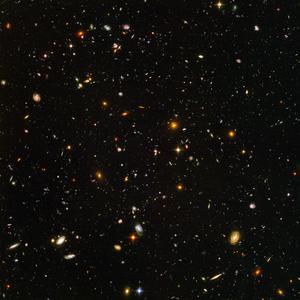
Hubble Ultra Deep Field
Legenda: This awe-inspiring image referred to as the Hubble Ultra-Deep Field (HUDF), was obtained using the Hubble Space Telescope (HST), by combining 800 exposures from 400 orbits of the HST, which equates to 11.3 days of total exposure time.
The image shows nearly 10,000 galaxies and was taken in the direction of a patch of sky with the least amount of stars from the Milky Way galaxy in the field of view. The region of sky that the HST observed corresponds to 1/10 the angular size of the Full Moon, which is roughly equal to approximately a 1 millimeter-sized object placed 1 meter away.
Every object in the image, except for the bright points with the crosshairs, are galaxies. As a consequence of the speed of light being a constant in a vacuum, the more distant an object, the further back in time we are observing. Therefore, the light from some of the galaxies in the HUDF image is from when the Universe as only a few hundred million years old. The HUDF image takes us through on a journey through space, and also in time.
Crédito: NASA, ESA, and S. Beckwith (STScI) and the HUDF Team
link do crédito
License: CC-BY-4.0 Creative Commons Attribution 4.0 International (CC BY 4.0) ícones
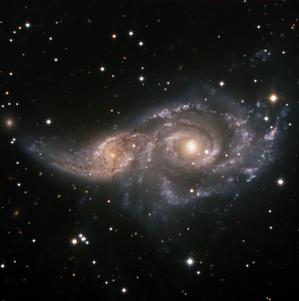
Fusão de galáxias espirais
Legenda: Esta imagem mostra duas galáxias espirais em interação, localizadas a aproximadamente 150 milhões de anos-luz de distância. As duas galáxias espirais estão envolvidas nesta dança, criando distorções visíveis em seus braços espirais devido à atração gravitacional. O que começa como um abraço nesta imagem terminará na fusão dessas duas galáxias em uma única galáxia, provavelmente elíptica.
Crédito: ESO
link do crédito
License: CC-BY-4.0 Creative Commons Attribution 4.0 International (CC BY 4.0) ícones
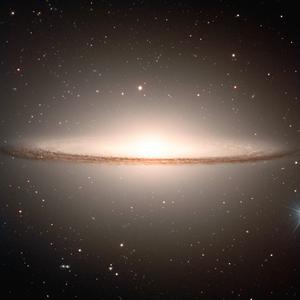
Galáxia do Sombrero
Legenda: Esta proeminente galáxia M 104 é frequentemente chamada de galáxia Sombrero devido à sua semelhança com o chapéu mexicano. Este aspecto é criado pelo disco fino visto quase de perfil, que parece iluminado pelo bojo dominante. Tanto o disco quanto o bojo possuem estrelas, mas as estrelas do bojo tendem a ser mais antigas, enquanto o disco também abriga grandes quantidades de poeira e gás, criando regiões sobreadas. A M 104 está localizada na constelação de Virgem, a aproximadamente 50 anos-luz de distância. Embora alguns dos pontos visíveis na imagem sejam estrelas em primeiro plano e outros galáxias ao fundo, a maioria são, na verdade, aglomerados globulares, aglomerados densos e massivos de estrelas, associados à Galáxia Sombrero.
Crédito: ESO/P. Barthel
link do crédito
License: CC-BY-4.0 Creative Commons Attribution 4.0 International (CC BY 4.0) ícones

A Galáxia Lenticular NGC 2787
Legenda: A galáxia lenticular NGC 2787. Esta galáxia é uma galáxia em disco, mas não possui a estrutura grande e dominante dos braços espirais observada nos discos das galáxias espirais. Seu núcleo é muito brilhante em comparação com o núcleo de uma galáxia espiral. Anéis finos de poeira podem ser vistos no disco da galáxia.
Crédito: NASA/ESA e a Equipe do Hubble Heritage
link do crédito
License: CC-BY-4.0 Creative Commons Attribution 4.0 International (CC BY 4.0) ícones
Diagramas relacionados
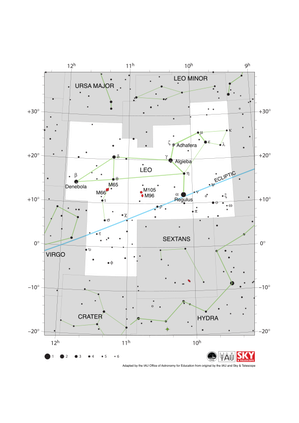
Leo Constellation Map
Legenda: The zodiac constellation Leo and its surrounding constellations. Starting from the top of the diagram and going clockwise, these are Leo Minor, Cancer, Sextans, Hydra, Crater, Virgo and Ursa Major. The brightest star in Leo, Regulus, lies almost exactly on the ecliptic (shown here as a blue line): the path the Sun appears to take across the sky over the course of a year. The Sun spends the period from mid August to mid September in Leo. The other planets in the Solar System can often be found in Leo.
Leo spans the celestial equator and is thus part of it is visible at some time in the year from all of planet Earth with some of the constellation obscured for the most arctic and antarctic regions of the world. Leo is most visible in the evenings in the northern hemisphere spring and southern hemisphere autumn.
Several objects can be seen in Leo, including M65 and M66 – two galaxies in the Leo Triplet, a trio of galaxies including NGC 3628, not listed here. In addition, M96, a spiral galaxy, can be seen as a fuzzy object using a small telescope, and Messier 105, an elliptical galaxy. Each of these objects are labelled on the map as red ellipses.
The y-axis of this diagram is in degrees of declination with north as up and the x-axis is in hours of right ascension with east to the left. The sizes of the stars marked here relate to the star's apparent magnitude, a measure of its apparent brightness. The larger dots represent brighter stars. The Greek letters mark the brightest stars in the constellation. These are ranked by brightness with the brightest star being labelled alpha, the second brightest beta, etc., although this ordering is not always followed exactly. The dotted boundary lines mark the IAU's boundaries of the constellations and the solid green lines mark one of the common forms used to represent the figures of the constellations. Neither the constellation boundaries, nor the line marking the ecliptic, nor the lines joining the stars appear on the sky.
Crédito: Adapted by the IAU Office of Astronomy for Education from the original by IAU/Sky & Telescope
License: CC-BY-4.0 Creative Commons Attribution 4.0 International (CC BY 4.0) ícones
Atividades relacionadas

Glitter Your Milky Way
astroEDU educational activity (links to astroEDU website) Description: Explore the Milky Way and characteristics of galaxies using glitter drawing.
License: CC-BY-4.0 Creative Commons Attribution 4.0 International (CC BY 4.0) ícones
Tags:
Art
, Creativity
, Hands-on
, Handcraft
Faixas etárias:
6-8
, 8-10
Nível de ensino:
Ensino fundamental
, Básico
Áreas de aprendizagem:
Com foco em belas-artes
Custos:
Custo médio
Tamanho do grupo:
Grupo
Habilidades:
Comunicar informações
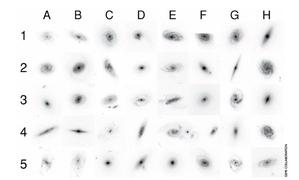
Coma Cluster of Galaxies
astroEDU educational activity (links to astroEDU website) Description: The basics of galaxy classification, using Hubble Space Telescope images.
License: CC-BY-4.0 Creative Commons Attribution 4.0 International (CC BY 4.0) ícones
Tags:
Coma Cluster
Faixas etárias:
14-16
, 16-19
, 19+
Nível de ensino:
Médio
, Universidade
Áreas de aprendizagem:
Aprendizagem por descoberta guiada
Custos:
Baixo custo
Duração:
1 hour
Tamanho do grupo:
Grupo
Habilidades:
Analisar e interpretar dados
, Comunicar informações
, Construir explicações
, Planejar e realizar pesquisas
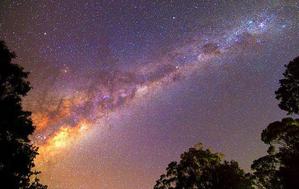
Living in the Milky Way
astroEDU educational activity (links to astroEDU website) Description: Build a model of the Milky Way to discover what our galaxy contains.
License: CC-BY-4.0 Creative Commons Attribution 4.0 International (CC BY 4.0) ícones
Tags:
Hands-on
, Model
Faixas etárias:
6-8
, 8-10
Nível de ensino:
Básico
Áreas de aprendizagem:
Resolução de problemas
, Aprendizagem por investigação estruturada
Custos:
Custo médio
Duração:
1 hour 30 mins
Tamanho do grupo:
Grupo
Habilidades:
Fazer perguntas
, Comunicar informações
, Desenvolver e usar modelos

3D Universe: the Milky Way and friends
astroEDU educational activity (links to astroEDU website) Description: Use tactile models printed in 3D to explore our galactic neighborhood.
License: CC-BY-4.0 Creative Commons Attribution 4.0 International (CC BY 4.0) ícones
Faixas etárias:
10-12
, 12-14
, 14-16
, 16-19
, 19+
Nível de ensino:
Ensino fundamental
, Médio
, Universidade
Áreas de aprendizagem:
Aprendizagem por descoberta guiada
, Aula interativa
, Modelagem
Custos:
Custo médio
Duração:
1 hour
Tamanho do grupo:
Grupo
Habilidades:
Analisar e interpretar dados
, Desenvolver e usar modelos