Glossary term: Meteorite
Description: A meteorite is a solid cosmic body that falls to the surface of the Earth or another celestial body after passing through that body's atmosphere. An object is only described as a meteorite after it has passed through the Earth or other celestial body's atmosphere. While in interplanetary space and while it is passing through the atmosphere it is known as a meteoroid. The shock wave the meteoroid causes in the atmosphere emits light and may be observed as a meteor.
Meteorites are usually made of stone, iron-stone, or iron, with stone being the most common when we look at types of meteorites that are linked to the sighting of a meteor. However, stony meteorites often look like terrestrial rocks so can be overlooked and iron meteorites are the most common type of meteorite found on the ground. Most meteorites are found in Antarctica or deserts as this is where they are easiest to spot.
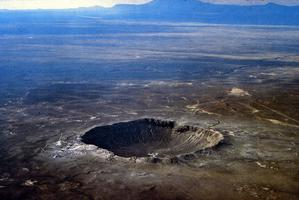
Most of the found meteorites range from a few grams to several kilograms in mass and are roughly between 30 micrometers and 1 meter in size, although meteorites larger than one metre have been found. The largest known one is Hoba, which is more than 60 tons and lies in Namibia. Some meteorites can be large enough to produce an impact crater. Meteorites are named after the area where they fell.
Related Terms:
See this term in other languages
Term and definition status: This term and its definition have been approved by a research astronomer and a teacher
The OAE Multilingual Glossary is a project of the IAU Office of Astronomy for Education (OAE) in collaboration with the IAU Office of Astronomy Outreach (OAO). The terms and definitions were chosen, written and reviewed by a collective effort from the OAE, the OAE Centers and Nodes, the OAE National Astronomy Education Coordinators (NAECs) and other volunteers. You can find a full list of credits here. All glossary terms and their definitions are released under a Creative Commons CC BY-4.0 license and should be credited to "IAU OAE".
If you notice a factual error in this glossary definition then please get in touch.
In Other Languages
- Arabic: النيزك
- German: Meteoriten
- Spanish: Meteorito
- French: Météorites
- Italian: Meteorite
- Japanese: 隕石 (external link)
- Nepali: उल्कापिण्ड
- Brazilian Portuguese: Meteoritos
- Simplified Chinese: 陨石
- Traditional Chinese: 隕石
Related Media

Iron Meteorite
Caption: This iron meteorite was originally found in Harriman, Tennessee, USA and is now held in the collection of the Smithsonian Natural History Museum, Washington DC, USA. The total mass of the meteorite was about 30kg. Here we see the interior after the meteorite was cut into pieces.
Iron meteorites are largely composed of an iron-nickel. They also often have a crystalline structure which manifests here as a series of crossing shiny straight lines known as a Widmanstätten pattern. This is thought to have formed as the meteoroid (the object that would eventually fall through the Earth's atmosphere as a meteor and land on the ground as a meteorite) cooled very slowly in the vacuum of space in the early solar system. This led to the growth of this crystalline structure.
Credit: Chuck Sutherland
credit link
License: PD Public Domain icons
Related Activities
Meteoroids, Meteors and Meteorites
astroEDU educational activity (links to astroEDU website) Description: Unveiling the mystery of "shooting stars": meteors, meteorites and meteroids
License: CC-BY-4.0 Creative Commons Attribution 4.0 International (CC BY 4.0) icons
Tags:
Geology
Age Ranges:
6-8
, 8-10
, 10-12
, 12-14
Education Level:
Middle School
, Primary
Areas of Learning:
Interactive Lecture
Costs:
Low Cost
Duration:
1 hour 30 mins
Group Size:
Group
Skills:
Analysing and interpreting data
, Asking questions
, Communicating information
, Engaging in argument from evidence