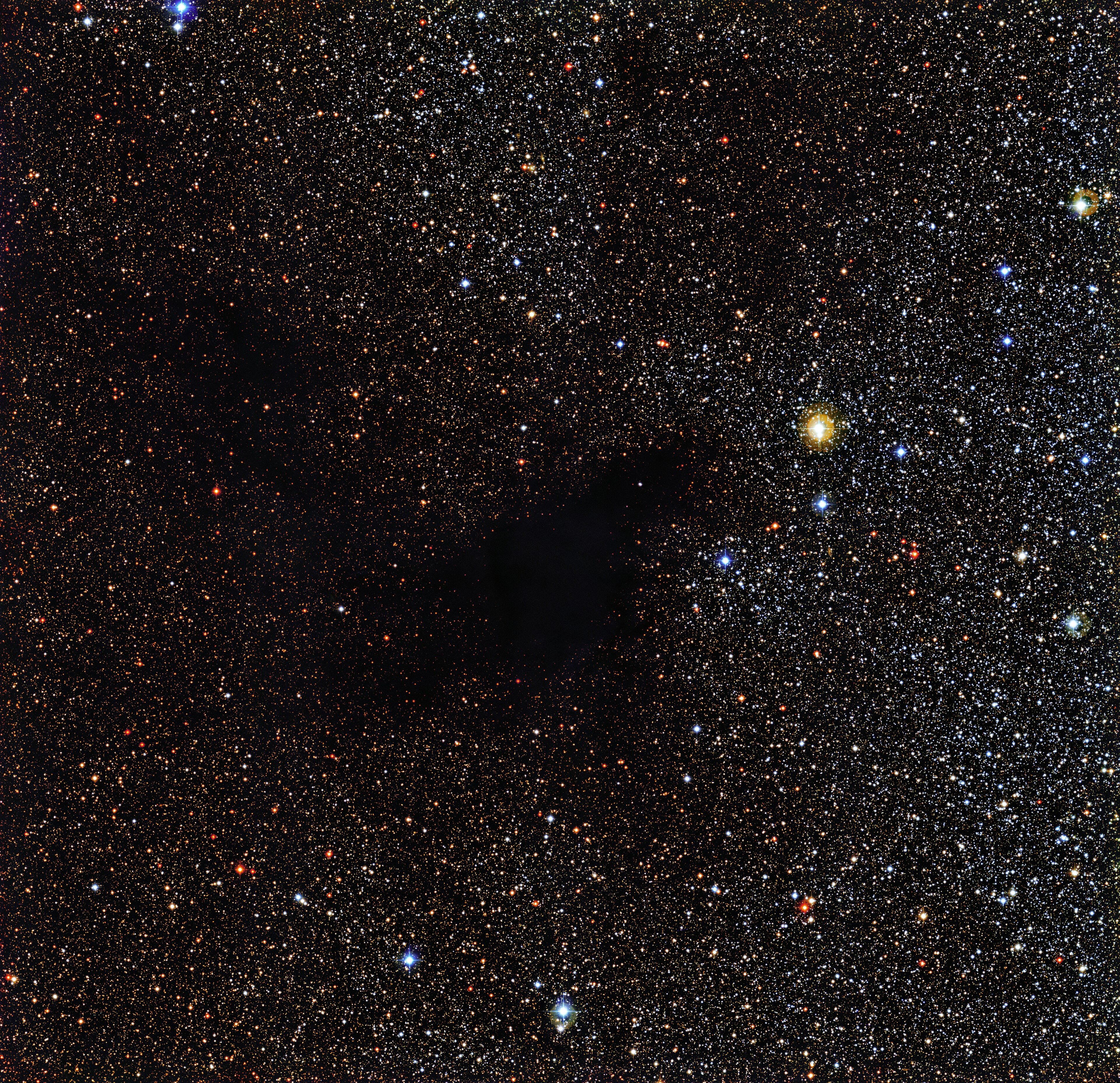
This page describes an image The LDN 483 Dark Nebula
Download File ( image 31.01 MB)
Image caption:
This image shows a dark molecular cloud known as LDN 483, captured by the Wide Field Imager on the MPG/ESO 2.2-metre telescope at the La Silla Observatory in Chile. At first glance, the patch of sky looks like a region where stars are missing, but the effect is due to interstellar extinction — dust and gas within LDN 483 absorb and scatter light from background stars, making them appear faint or invisible to telescopes that observe visible light. Interstellar extinction is the dimming of light from distant objects caused by dust and gas between the object and the observer, a common phenomenon in astronomy that must be accounted for when measuring stellar brightness and color.
Dark nebulae like LDN 483 are dense concentrations of interstellar matter located within our Milky Way Galaxy. This particular cloud lies about 700 light-years from Earth in the constellation Serpens and contains enough material to block most visible light from stars behind it. Because dust grains preferentially scatter shorter (bluer) wavelengths of light, extinction can also make objects appear redder than they truly are — a related effect known as interstellar reddening. Understanding and correcting for extinction is essential for astronomers to reveal the true brightness, distance, and physical properties of celestial objects seen through dusty regions of space.
Scroll to captions in other languages
Image credit: ESO Credit Link
Related glossary terms:
Dark Nebula
, Interstellar Extinction
, Interstellar Medium
Image license: Creative Commons Attribution 4.0 International (CC BY 4.0) Creative Commons Attribution 4.0 International (CC BY 4.0) icons
The media file captions presented on the OAE website were written, translated and reviewed by a collective effort from the OAE, the OAE Centers and Nodes, the OAE National Astronomy Education Coordinators (NAECs) and other volunteers. You can find a full list of credits for our translation project here. All media file captions are released under a Creative Commons CC BY-4.0 license and should be credited to "IAU OAE". The media files themselves may have different licenses (see above) and should be credited as listed above under "credit".
If you notice a factual error in this caption or an error in any of its translations then please get in touch.
Captions in Different Languages:
Image caption: Dieses Bild zeigt eine dunkle Molekülwolke namens LDN 483, aufgenommen mit dem Wide Field Imager am MPG/ESO-2,2-Meter-Teleskop am La-Silla-Observatorium in Chile. Auf den ersten Blick sieht dieser Ausschnitt des Himmels wie ein Bereich aus, in dem keine Sterne zu sehen sind, doch dieser Effekt ist auf interstellare Extinktion zurückzuführen: Staub und Gas innerhalb von LDN 483 absorbieren und streuen das Licht der Hintergrundsterne, sodass diese für Teleskope, die im sichtbaren Licht beobachten, nur schwach oder gar nicht sichtbar sind. Interstellare Extinktion ist die Abschwächung des Lichts von entfernten Objekten durch Staub und Gas zwischen dem Objekt und dem Beobachter – ein in der Astronomie weit verbreitetes Phänomen, das bei der Messung der Helligkeit und Farbe von Sternen berücksichtigt werden muss.
Dunkle Nebel wie LDN 483 sind dichte Ansammlungen interstellarer Materie innerhalb unserer Milchstraße. Diese spezielle Wolke befindet sich etwa 700 Lichtjahre von der Erde entfernt im Sternbild Serpens und enthält genug Material, um den größten Teil des sichtbaren Lichts der dahinter liegenden Sterne zu blockieren. Da Staubkörner vorrangig kürzere (bläulichere) Wellenlängen des Lichts streuen, kann die Extinktion Objekte zudem rötlicher erscheinen lassen, als sie tatsächlich sind. Dieser Effekt wird als interstellare Rötung bezeichnet. Das Verständnis und die Korrektur der Extinktion sind für Astronomen unerlässlich, um die wahre Helligkeit, Entfernung und die physikalischen Eigenschaften von Himmelsobjekten zu ermitteln, die durch staubige Regionen des Weltraums hindurch beobachtet werden.
Image credit: ESO
Related glossary terms: Dunkelnebel , Interstellare Extinktion , Interstellares Medium Caption translation status: Not yet approved by a reviewer
Caption translators: Simon Kraus
Image caption: Questa immagine mostra una nube molecolare scura nota come LDN 483, ripresa dalla Wide Field Imager installata sul telescopio MPG/ESO da 2,2 metri presso l’Osservatorio di La Silla in Cile. A prima vista, quella porzione di cielo sembra una regione priva di stelle, ma l’effetto è dovuto all’estinzione interstellare: la polvere e il gas all’interno di LDN 483 assorbono e diffondono la luce delle stelle sullo sfondo, rendendole deboli o invisibili ai telescopi che osservano la luce visibile. L'estinzione interstellare è l'attenuazione della luce proveniente da oggetti lontani causata dalla polvere e dal gas presenti tra l'oggetto e l'osservatore, un fenomeno comune in astronomia di cui si deve tenere conto quando si misurano la luminosità e il colore delle stelle.
Le nebulose scure come LDN 483 sono dense concentrazioni di materia interstellare situate all'interno della nostra galassia, la Via Lattea. Questa particolare nube si trova a circa 700 anni luce dalla Terra nella costellazione del Serpente e contiene materiale sufficiente a bloccare la maggior parte della luce visibile proveniente dalle stelle che si trovano dietro di essa. Poiché i granelli di polvere diffondono preferibilmente le lunghezze d'onda più corte (più blu) della luce, l'estinzione può anche far apparire gli oggetti più rossi di quanto non siano in realtà — un effetto correlato noto come arrossamento interstellare. Comprendere e correggere l'estinzione è essenziale per gli astronomi per rivelare la vera luminosità, la distanza e le proprietà fisiche degli oggetti celesti osservati attraverso regioni polverose dello spazio.
Image credit: ESO
Related glossary terms: Estinzione interstellare , Mezzo interstellare , Nebulosa Oscura Caption translation status: Not yet approved by a reviewer
Caption translators: Giuliana Giobbi