This page describes an image A Coronal Mass Ejection
下载文件 ( 图像 596.22 kB)
图片说明
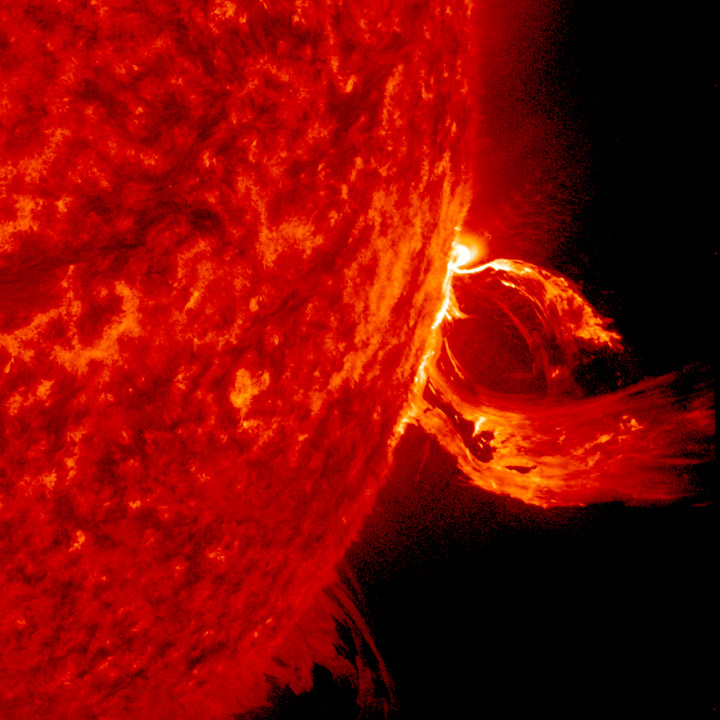
A burst of solar material can be seen erupting from the Sun in this view, illustrating a coronal mass ejection (CME)—a large eruption of plasma and magnetic field from the Sun’s outer atmosphere, or corona. These CMEs are caused by magnetic explosions in the Sun's corona. During a CME, huge amounts of electrically charged particles are launched into space at great speeds, carrying part of the Sun’s magnetic field with them. These events are driven by changes in the Sun’s magnetic structure and release vast clouds of hot gas that travel outward into the solar system. When a CME moves through space, it can interact with a planet’s magnetic field and atmosphere, sometimes creating spectacular auroras or, in strong cases, interfering with artificial satellites and power systems.
CMEs are often associated with a temporary brightening of the region of the Sun where the CME originated. This is known as a solar flare. Stars other than the Sun can also have CMEs and flares.
This image was taken by NASA's Solar Dynamics Observatory (SDO). This is a space mission to monitor the Sun. The image here is taken at a special wavelength which partially ionised helium emits strongly at.
滚动查看其他语言的字幕
图片来源 NASA/Goddard/SDO 来源链接
相关术语表词条:
太阳
, 日冕物质抛射(CME)
图片许可: 公共领域 公共领域 图标
OAE 网站上展示的媒体文件说明文字是由 OAE、OAE 各中心与节点、OAE 的 国家天文教育协调员(NAECs) 和其他志愿者共同撰写、翻译与审核的。您可以在 这里 查看我们翻译项目的完整致谢名单。所有媒体文件说明均遵循 Creative Commons CC BY-4.0 许可协议进行发布,应注明来源为“IAU OAE”。媒体文件本身可能有不同的许可协议(见上文),请根据“来源”部分注明相应来源。
如果您发现此词汇术语或定义中的事实或翻译错误, 请向 发邮件 联系.
其他语言版本的图注
图片说明 In dieser Ansicht ist ein Ausbruch von solarem Material zu sehen, der von der Sonne ausgestoßen wird. Er veranschaulicht einen koronalen Massenauswurf (CME) – eine gewaltige Eruption von Plasma und Magnetfeldern aus der äußeren Atmosphäre der Sonne, der Korona. Diese CMEs werden durch magnetische Explosionen in der Sonnenkorona ausgelöst. Bei einem CME werden gewaltige Mengen elektrisch geladener Teilchen mit enormer Geschwindigkeit ins All geschleudert, wobei sie einen Teil des solaren Magnetfelds mit sich führen. Diese Ereignisse werden durch Veränderungen in der magnetischen Struktur der Sonne ausgelöst und setzen riesige Wolken aus heißem Gas frei, die sich nach außen in das Sonnensystem ausbreiten. Wenn sich ein CME durch den Weltraum bewegt, kann er mit dem Magnetfeld und der Atmosphäre eines Planeten in Wechselwirkung treten und dabei manchmal spektakuläre Polarlichter erzeugen oder, in starken Fällen, künstliche Satelliten und die Stromversorgung stören.
CMEs gehen oft mit einer vorübergehenden Aufhellung des Sonnenbereichs einher, aus dem der CME stammt. Dies wird als Sonnenflare bezeichnet. Auch andere Sterne als die Sonne können CMEs und Flares aufweisen.
Dieses Bild wurde vom Solar Dynamics Observatory (SDO) der NASA aufgenommen. Dabei handelt es sich um eine Weltraummission zur Beobachtung der Sonne. Das vorliegende Bild wurde bei einer speziellen Wellenlänge aufgenommen, in der teilweise ionisiertes Helium stark strahlt.
图片来源 NASA/Goddard/SDO
相关术语表词条: Koronaler Massenauswurf (CME) , Sonne 注释翻译状态: 尚未由审核人员批准
注释翻译者: Simon Kraus
图片说明 A burst of solar material can be seen erupting from the Sun in this view, illustrating a coronal mass ejection (CME)—a large eruption of plasma and magnetic field from the Sun’s outer atmosphere, or corona. These CMEs are caused by magnetic explosions in the Sun's corona. During a CME, huge amounts of electrically charged particles are launched into space at great speeds, carrying part of the Sun’s magnetic field with them. These events are driven by changes in the Sun’s magnetic structure and release vast clouds of hot gas that travel outward into the solar system. When a CME moves through space, it can interact with a planet’s magnetic field and atmosphere, sometimes creating spectacular auroras or, in strong cases, interfering with artificial satellites and power systems.
CMEs are often associated with a temporary brightening of the region of the Sun where the CME originated. This is known as a solar flare. Stars other than the Sun can also have CMEs and flares.
This image was taken by NASA's Solar Dynamics Observatory (SDO). This is a space mission to monitor the Sun. The image here is taken at a special wavelength which partially ionised helium emits strongly at.
图片来源 NASA/Goddard/SDO
相关术语表词条: Coronal Mass Ejection (CME) , Sun
图片说明 In questa immagine si vede un getto di materiale solare che erompe dal Sole, a illustrazione di un’espulsione di massa coronale (CME), ovvero una grande eruzione di plasma e campo magnetico proveniente dall’atmosfera esterna del Sole, o corona. Queste CME sono causate da esplosioni magnetiche nella corona solare. Durante una CME, enormi quantità di particelle elettricamente cariche vengono lanciate nello spazio a velocità elevate, trasportando con sé parte del campo magnetico solare. Questi eventi sono determinati da cambiamenti nella struttura magnetica del Sole e rilasciano vaste nubi di gas caldo che si propagano verso l’esterno nel sistema solare. Quando un CME si muove nello spazio, può interagire con il campo magnetico e l’atmosfera di un pianeta, creando talvolta spettacolari aurore o, nei casi più intensi, interferendo con i satelliti artificiali e le reti elettriche.
I CME sono spesso associati a un temporaneo aumento di luminosità della regione del Sole da cui hanno avuto origine. Questo fenomeno è noto come brillamento solare. Anche altre stelle oltre al Sole possono essere soggette a CME e brillamenti.
Questa immagine è stata scattata dal Solar Dynamics Observatory (SDO) della NASA. Si tratta di una missione spaziale volta al monitoraggio del Sole. L’immagine qui riportata è stata acquisita a una lunghezza d’onda specifica, alla quale l’elio parzialmente ionizzato emette con particolare intensità.
图片来源 NASA/Goddard/SDO
相关术语表词条: Espulsione di massa coronale (CME) , Sole 注释翻译状态: 尚未由审核人员批准
注释翻译者: Giuliana Giobbi