Termo do glossário: Foguete
Descrição: Um foguete é um dispositivo comumente utilizado para lançar naves espaciais da superfície da Terra para o espaço sideral. Para esse fim, um foguete é composto por motores de foguete e tanques de combustível. Os motores de foguete também são utilizados para controlar o movimento das naves espaciais no espaço sideral, alterando a velocidade ou realizando correções de rota. O princípio básico de um motor de foguete é produzir um jato de partículas em alta velocidade, geralmente por meio da queima de combustível. Quando esse jato é direcionado para uma direção específica, o motor de foguete é acelerado na direção oposta — uma consequência de uma lei fundamental da física chamada conservação do momento. Observe que o jato de partículas não precisa empurrar nada para que esse efeito ocorra: os foguetes funcionam perfeitamente mesmo no quase vácuo do espaço sideral.
Termos relacionados:
Ver este termo em outros idiomas
Status do termo e da definição: A definição original deste termo em inglês foi aprovada por um astrônomo(a) pesquisador(a) e um(a) professor(a) A tradução deste termo e de sua definição ainda aguarda aprovação
O Glossário Multilíngue da OAE é um projeto do Escritório da IAU de Astronomia para a Educação (OAE) em colaboração com o Escritório da IAU para Divulgação da Astronomia (OAO). Os termos e definições foram selecionados, escritos e revisados por meio de um esforço coletivo da OAE, dos Centros e Nós da OAE, dos Coordenadores Nacionais de Educação em Astronomia (NAECs) da OAE e de outros voluntários. Você pode encontrar uma lista completa dos créditos aqui. Todos os termos do glossário e suas definições são disponibilizados sob uma licença Creative Commons CC BY-4.0 e devem ser creditados à "IAU OAE".
Se você notar algum erro factual ou de tradução neste termo do glossário ou em sua definição, por favor entre em contato.
Mídia relacionada
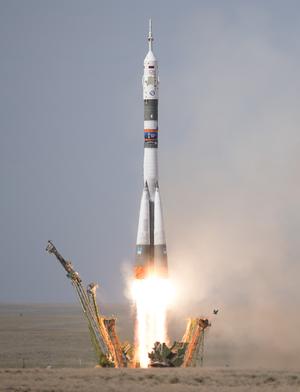
Lançamento do foguete Soyuz
Legenda: O foguete Soyuz MS-09 foi lançado do Cosmódromo de Baikonur, no Cazaquistão, em 6 de junho de 2018, levando a tripulação da Expedição 56 para a Estação Espacial Internacional (ISS). A tripulação era composta pelo comandante da Soyuz, Sergey Prokopyev, da Roscosmos, pela engenheira de voo Serena Auñón-Chancellor, da NASA, e pelo engenheiro de voo Alexander Gerst, da ESA (Agência Espacial Europeia).
Crédito: NASA/Joel Kowsky
link do crédito
License: CC-BY-NC-ND-2.0 Creative Commons Attribution-NonCommercial-NoDerivs 2.0 Generic ícones

The Speed of Spacecraft
Legenda: This infographic is part of the "Simplifying Astronomy for Arabic Speakers" project, aiming to present scientific concepts in a simple and accessible way. The design focuses on the speed of spacecraft during the various stages of their launch, illustrating how velocity changes as the spacecraft progresses to reach the desired orbit.
Details of the Stages:
Stage One (Launch):
The spacecraft begins its journey by launching from the launch pad with an increasing speed. The velocity in this stage is influenced by Earth's gravity and atmospheric resistance.
After One Minute:
The spacecraft reaches a speed of approximately 1,600 kilometers per hour (km/h), reflecting a rapid acceleration powered by its engines.
After Two and a Half Minutes:
The rocket boosters are jettisoned, allowing the spacecraft to reach a speed of about 4,800 km/h. At this point, the spacecraft becomes lighter, enabling it to accelerate more efficiently.
Final Stage:
By the end of the ascent phase, the spacecraft achieves its final speed of approximately 28,000 km/h, allowing it to enter the desired orbit around Earth.
Through educational designs like this, the project provides enthusiasts with an opportunity to understand the intricate details of space missions in an engaging and simplified manner.
Crédito: Ali Al-Edhari ; Background image credit - NASA
License: CC-BY-4.0 Creative Commons Attribution 4.0 International (CC BY 4.0) ícones