Término del glosario: Cola de un cometa
Descripción: Cuando un cometa se encuentra cerca del Sol, la radiación solar calienta su superficie y el hielo que contiene se convierte en gas (se «sublima»). En el proceso de sublimación del hielo, se arrastra también material rocoso y polvoriento que formará una nube alrededor del núcleo del cometa, denominada «coma».
En general, un cometa tiene dos colas: la de polvo y la iónica. Las partículas de polvo expulsadas forman la cola de polvo del cometa, que tiene una forma curvada característica. Esta cola está compuesta por partículas de polvo liberadas desde la superficie, que siguen al cometa a lo largo de su órbita alrededor del Sol. Las colas de polvo pueden alcanzar millones de kilómetros de longitud o más, reflejan la luz solar y, si las condiciones son adecuadas, su forma blanquecina y difusa constituye la mayor parte de lo que se puede observar cuando un cometa es visible a simple vista.
Una parte considerable del gas sublimado del cometa es arrastrada e ionizada por el viento solar —las partículas con carga eléctrica emitidas por el Sol—. Esos iones forman la cola iónica del cometa, que suele tener un color azulado. La cola iónica siempre apunta directamente en dirección opuesta al Sol. Si, por ejemplo, el cometa se aleja del Sol, la cola iónica va por delante del cometa; mientras que si se acerca, irá por detrás.
Términos relacionados:
Ver este término en otros idiomas
Estado del término y la definición: La definición original de este término en inglés ha sido aprobada por unastrónomo o astrónoma investigadora y un docente La traducción de este término y su definición aún están pendientes de aprobación
El Glosario multilingüe de la OAE es un proyecto de la Oficina de Astronomía para la Educación de la UAI (OAE) en colaboración con la Oficina de Divulgación de Astronomía de la UAI (OAO). Los términos y definiciones fueron seleccionados, redactados y revisados gracias al esfuerzo colectivo de la OAE, los Centros y Nodos de la OAE, los Coordinadores Nacionales de Educación Astronómica (NAECs) y otros voluntarios. Puedes encontrar una lista completa de créditos aquí. Todos los términos del glosario y sus definiciones se publican bajo la licencia Creative Commons CC BY-4.0 y deben atribuirse a la "IAU OAE".
Si detectas algún error de contenido o de traducción en este término del glosario o en ladefinición, ponte en contacto con nosotros.
En otros idiomas
- Árabe: ذيل المذنب
- Alemán: Kometenschweif
- Inglés: Cometary Tail
- Francés: Queue cométaire
- Italiano: Coda cometaria
- Japonés: 尾(彗星の) (enlace externo)
- Portugués de Brasil: Cauda de cometa
- Chino simplificado: 彗尾
- Chino tradicional: 彗尾
Contenidos relacionados
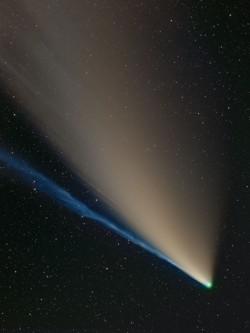
Comet C/2020F3 (Neowise) with separate dust and ion gas tails and a green glowing coma, by Dietmar Gutermuth, Germany
Pie de foto: Second place in the 2021 IAU OAE Astrophotography Contest, category Comets.
Comets have a very interesting structure comprising of four main parts: the nucleus, composed of rock, dust and frozen gases, typically spanning a few kilometres, although bigger ones have been observed; a small atmosphere of gas surrounding the nucleus (only present when the comet approaches its closest point to the Sun), called coma; and the two distinctive cometary tails (there is at times third tail). The green colour of the coma is due to carbon and nitrogen present in the coma reacting with the Sun’s ultraviolet radiation. The tail that we are mostly used to observing – dust tail and is composed of micron sized dust particles, the second tail composed of charged particles – ion or gas tail. The tails are released only when the comet approaches the Sun at a distance where the heat and radiation emanating from our star is intense enough to vaporize the frozen gases. The dust tail is curved, while the gas tail is straight and always points away from the Sun as this is carried by the solar wind - flow of charged particles emitted by the Sun. As comets are formed by leftover material, they carry with them important information about the early stages of the Solar System’s formation. This beautiful image shows the comet C/2020 F3 (Neowise), as seen from Germany in July 2020, with three of the four structures clearly visible – coma, gas, and dust tail.
Crédito: Dietmar Gutermuth/IAU OAE
License: CC-BY-4.0 Creative Commons Reconocimiento 4.0 Internacional (CC BY 4.0) íconos
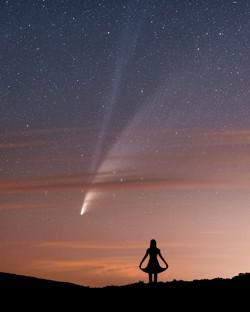
Hello Comet, shall we dance?, by Robert Barsa, Slovakia
Pie de foto: Third place in the 2021 IAU OAE Astrophotography Contest, category Comets.
This beautiful and poetic image taken from Slovakia in July 2020 captures the comet C/2020 F3 (Neowise). The direction of the tails of the comet provides a clue as to the position of the Sun. In the past, the appearance of a comet in the skies could be accompanied by apprehension and even fear from those who did not know what these objects really are. Through careful observations and the applications of knowledge from physics, chemistry and geology, we now understand that comets are objects left over from the earliest days when the Solar System formed. The most distinctive features of a comet are the bluish ion (gas) tail, and whitish dust tail, which can extend for tens of millions of kilometres. These distinctive features, easily observable with the unaided eye together with an understanding of the science, are no longer cause for fear, rather they help us understand the history of our Solar System, and bring awe, joy and contemplation, as portrayed in this image.
Crédito: Robert Barsa/IAU OAE
License: CC-BY-4.0 Creative Commons Reconocimiento 4.0 Internacional (CC BY 4.0) íconos
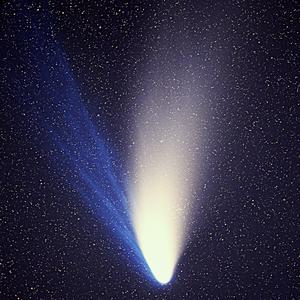
Comet Hale-Bopp
Pie de foto: Image of comet C/1995 O1 (Hale-Bopp), taken on 4 April 1997, with an exposure time of 10 minutes. The field shown is about 6.5°x6.5°. Two tails extend from the bright coma: one white-yellowish dust tail and a bluish gas tail, always pointing away from the Sun.
Crédito: E. Kolmhofer, H. Raab; Johannes-Kepler-Observatory, Linz, Austria
enlace de crédito
License: CC-BY-SA-3.0 Creative Commons Atribución-CompartirIgual 3.0 No portada íconos

El cometa Halley
Pie de foto: El cometa Halley es un cometa periódico conocido que recibe su nombre del astrónomo inglés Edmond Halley. Tiene un período orbital de aproximadamente 75 años y es visible a simple vista desde la Tierra cuando atraviesa el sistema solar interior.
La imagen muestra el cometa Halley, llamado oficialmente 1P/Halley, con una cola de gas y polvo que se aleja del Sol. Fue tomada desde el Observatorio de La Silla, en Chile, en 1986, durante su última visita al sistema solar interior. Las estrellas en esta imagen aparecen elongadas o como líneas formadas por tres puntos de diferentes colores, ya que la imagen se creó a partir de tres observaciones independientes a diferentes frecuencias mientras el telescopio seguía el movimiento del cometa, que se desplazaba muy ligeramente en comparación con las estrellas del fondo. Obsérvese que la cola del cometa no apunta exactamente en la misma dirección que el alargamiento de las estrellas. Esto nos muestra que la cola del cometa no siempre se encuentra detrás de él, sino que apunta en dirección opuesta al Sol.
El cometa pasa por su perihelio (la distancia más cercana al Sol) a una distancia de alrededor de 0,59 unidades astronómicas, justo entre las órbitas de Mercurio y Venus. Más allá de Neptuno, alcanza su afelio (la distancia máxima del Sol) a una distancia de aproximadamente 35 unidades astronómicas. El cometa Halley alcanzó su afelio en diciembre de 2023 y ahora se está acercando de nuevo. Se espera que vuelva a ser visible a simple vista desde la Tierra a mediados de 2061.
Crédito: ESO
enlace de crédito
License: CC-BY-4.0 Creative Commons Reconocimiento 4.0 Internacional (CC BY 4.0) íconos