This page describes an image The Callisto satellite
شرح الصورة:
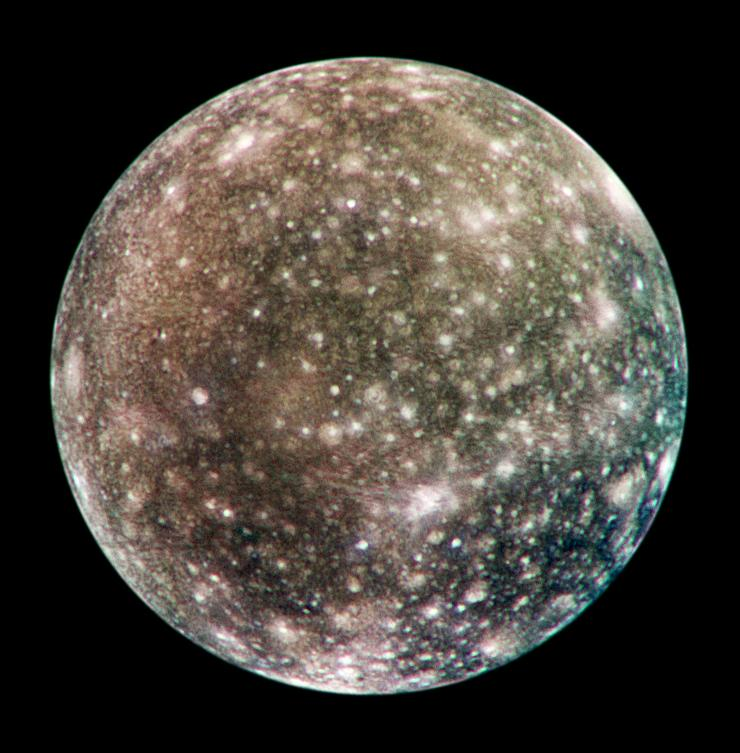
Callisto is the outermost of the four large Galilean moons of Jupiter and the third largest in the whole solar system, falling behind only Ganymede and Saturn's moon Titan. It orbits Jupiter at an average distance of around 1.9 million kilometers, roughly six times the distance between Earth and the Moon.
With a diameter of nearly 5,000 kilometers, it is almost as large as Mercury, the smallest planet in our solar system, but has only a third of its mass as it is composed of approximately equal amounts of rock and ice.
Callisto orbits Jupiter in a tidally locked rotation, always showing the same side to Jupiter. In contrast to the other three Galilean satellites – Io, Europa, and Ganymede – it is not in orbital resonance due to its farther outward location and is thus not appreciably tidally heated. It does not show any signs of plate tectonics or volcanic activity. Its lack of geological processes means that surface features like craters remain unchanged for billions of years. It is thought to have evolved predominantly under the influence of impacts, as its surface is the oldest and most heavily cratered object in the solar system. In fact, it is so covered in craters that any new impact will likely erase a former one.
Callisto's internal structure is still subject to discussion; it may consist of a deep salty ocean. It is thought to be composed mainly of a mix of ice and rock, which are present in various states throughout the inner layers of the moon. Callisto hosts a very thin atmosphere composed mainly of carbon dioxide and some traces of oxygen. The moon has been studied by numerous space probes, such as the Pioneer and Voyager missions and the Galileo orbiter, and will be subject to further explorations by NASA, ESA, and China’s National Space Administration (CNSA).
انتقل إلى الشروح بلغات أخرى
مصدر الصورة: NASA/JPL/DLR رابط المصدر
شروح بلغات مختلفة:
شرح الصورة: Callisto ist der äußerste der vier großen Galileischen Monde des Jupiter und der drittgrößte im gesamten Sonnensystem. Größer sind nur Ganymed und der Saturnmond Titan. Callisto umkreist den Jupiter in einer Entfernung von etwa 1,9 Millionen Kilometern, was in etwa dem Sechsfachen der Entfernung zwischen Erde und Mond entspricht.
Mit einem Durchmesser von fast 5.000 Kilometern ist er fast so groß wie Merkur, der kleinste Planet unseres Sonnensystems, hat aber nur ein Drittel seiner Masse, da er zu etwa gleichen Teilen aus Gestein und Eis besteht.
Callisto umkreist den Jupiter in einer gebundenen Rotation, so dass stets die gleiche Seite in Richtung Jupiter weist. Im Gegensatz zu den anderen drei Galileischen Monden – Io, Europa und Ganymed – befindet er sich aufgrund seiner weiter außen liegenden Position nicht in einer Umlaufresonanz und wird daher nicht nennenswert durch Gezeitenkräfte erwärmt. Er weist keine Anzeichen von Plattentektonik oder vulkanischer Aktivität auf. Das Fehlen geologischer Prozesse bedeutet, dass Oberflächenmerkmale wie Krater über Milliarden von Jahren unverändert bleiben. Man geht davon aus, dass er sich vorwiegend unter dem Einfluss von Einschlägen entwickelt hat, da seine Oberfläche die älteste und am stärksten mit Kratern übersäte des Sonnensystems ist. Tatsächlich ist er so stark mit Kratern übersät, dass jeder neue Einschlag wahrscheinlich einen früheren überdecken wird.
Die innere Struktur von Callisto ist noch Gegenstand von Diskussionen. Möglicherweise besteht er aus einem tiefen Salzwasser-Ozean. Man geht davon aus, dass er hauptsächlich aus einer Mischung aus Eis und Gestein besteht, die in den inneren Schichten des Mondes in verschiedenen Aggregatzuständen vorkommen. Callisto verfügt über eine sehr dünne Atmosphäre, die hauptsächlich aus Kohlendioxid und Spuren von Sauerstoff besteht. Der Mond wurde bereits von zahlreichen Raumsonden untersucht - darunter die „Pioneer“- und „Voyager“-Missionen sowie der „Galileo“-Orbiter - und wird auch in Zukunft durch die NASA, die ESA und die chinesische Raumfahrtbehörde (CNSA) weiter erkundet werden.
مصدر الصورة: NASA/JPL/DLR
مصطلحات معجم ذات صلة: Galileische Satelliten , Monde حالة ترجمة الشرح: لم تتم الموافقة من قبل مُراجع بعد
مترجمو الشروح: Simon Kraus
شرح الصورة: Callisto is the outermost of the four large Galilean moons of Jupiter and the third largest in the whole solar system, falling behind only Ganymede and Saturn's moon Titan. It orbits Jupiter at an average distance of around 1.9 million kilometers, roughly six times the distance between Earth and the Moon.
With a diameter of nearly 5,000 kilometers, it is almost as large as Mercury, the smallest planet in our solar system, but has only a third of its mass as it is composed of approximately equal amounts of rock and ice.
Callisto orbits Jupiter in a tidally locked rotation, always showing the same side to Jupiter. In contrast to the other three Galilean satellites – Io, Europa, and Ganymede – it is not in orbital resonance due to its farther outward location and is thus not appreciably tidally heated. It does not show any signs of plate tectonics or volcanic activity. Its lack of geological processes means that surface features like craters remain unchanged for billions of years. It is thought to have evolved predominantly under the influence of impacts, as its surface is the oldest and most heavily cratered object in the solar system. In fact, it is so covered in craters that any new impact will likely erase a former one.
Callisto's internal structure is still subject to discussion; it may consist of a deep salty ocean. It is thought to be composed mainly of a mix of ice and rock, which are present in various states throughout the inner layers of the moon. Callisto hosts a very thin atmosphere composed mainly of carbon dioxide and some traces of oxygen. The moon has been studied by numerous space probes, such as the Pioneer and Voyager missions and the Galileo orbiter, and will be subject to further explorations by NASA, ESA, and China’s National Space Administration (CNSA).
مصدر الصورة: NASA/JPL/DLR
مصطلحات معجم ذات صلة: Galilean Satellites , Moons
شرح الصورة: Callisto è la più esterna delle quattro grandi lune galileiane di Giove e la terza più grande dell’intero sistema solare, superata solo da Ganimede e da Titano, la luna di Saturno. Orbita attorno a Giove a una distanza media di circa 1,9 milioni di chilometri, all’incirca sei volte la distanza tra la Terra e la Luna.
Con un diametro di quasi 5.000 chilometri, è grande quasi quanto Mercurio, il pianeta più piccolo del nostro sistema solare, ma ha solo un terzo della sua massa poiché è composto in parti approssimativamente uguali da roccia e ghiaccio.
Callisto orbita attorno a Giove con una rotazione sincrona, mostrando sempre lo stesso lato al pianeta. A differenza degli altri tre satelliti galileiani – Io, Europa e Ganimede – non si trova in risonanza orbitale a causa della sua posizione più esterna e non subisce quindi un riscaldamento mareale apprezzabile. Non mostra alcun segno di tettonica a placche o di attività vulcanica. L’assenza di processi geologici fa sì che le caratteristiche superficiali, come i crateri, rimangano immutate per miliardi di anni. Si ritiene che si sia evoluto prevalentemente sotto l’influenza degli impatti, poiché la sua superficie è quella più antica e più craterizzata dell’intero sistema solare. Infatti, è talmente ricoperta di crateri che qualsiasi nuovo impatto probabilmente ne cancellerà uno precedente.
La struttura interna di Callisto è ancora oggetto di discussione; potrebbe consistere in un profondo oceano salato. Si ritiene che sia composta principalmente da una miscela di ghiaccio e roccia, presenti in vari stati negli strati interni della luna. Callisto ospita un’atmosfera molto rarefatta, composta principalmente da anidride carbonica e alcune tracce di ossigeno. La luna è stata studiata da numerose sonde spaziali, come le missioni Pioneer e Voyager e l’orbiter Galileo, e sarà oggetto di ulteriori esplorazioni da parte della NASA, dell’ESA e dell’Agenzia Spaziale Nazionale Cinese (CNSA).
مصدر الصورة: NASA/JPL/DLR
مصطلحات معجم ذات صلة: Lune , Satelliti galileiani حالة ترجمة الشرح: لم تتم الموافقة من قبل مُراجع بعد
مترجمو الشروح: Giuliana Giobbi