Glossar-Begriff: Waage
Beschreibung: Die Waage (lateinisch Libra) ist ein Sternbild im Tierkreis, d. h. die Sterne, aus denen dieses Sternbild besteht, befinden sich in dem Teil des Himmels, der sich mit der Ekliptik schneidet. Die Ekliptikebene ist durch die Umlaufbahn der Erde um die Sonne definiert. Daher können wir von der Erde aus gesehen die Sonne und auch die anderen Planeten des Sonnensystems regelmäßig in diesem Sternbild finden - im Falle der Sonne von Ende Oktober bis Ende November. Wenn sich die Sonne in der Waage befindet, können wir die Sterne des Sternbilds natürlich nicht sehen. Die Waage ist eines der 88 modernen Sternbilder, die von der Internationalen Astronomischen Union definiert wurden, und auch eines der 48 klassischen Sternbilder, die vom Astronomen Claudius Ptolemäus im 2. Jahrhundert beschrieben wurden.
Ähnliche Begriffe:
Dieser Begriff in anderen Sprachen
Begriffs- und Definitionsstatus Die Originaldefinition dieses Begriffes auf Englisch wurden von einem forschenden Astronom und einer Lehrkraft bestätigt Die Übersetzung dieses Begriffs und seiner Definition warten auf Prüfung und Bestätigung
The OAE Multilingual Glossary is a project of the IAU Office of Astronomy for Education (OAE) in collaboration with the IAU Office of Astronomy Outreach (OAO). The terms and definitions were chosen, written and reviewed by a collective effort from the OAE, the OAE Centers and Nodes, the OAE National Astronomy Education Coordinators (NAECs) and other volunteers. You can find a full list of credits here. All glossary terms and their definitions are released under a Creative Commons CC BY-4.0 license and should be credited to "IAU OAE".
Wenn dir ein inhaltlicher oder Übersetzungsfehler in diesem Glossarbegriff oder dieser Definition auffallen, bitte kontaktiere uns.
Ähnliche Diagramme
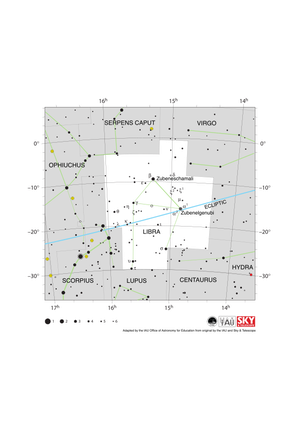
Libra Constellation Map
Unterschrift: The constellation Libra along with its bright stars and surrounding constellations. Libra is surrounded by (going clockwise from the top) Serpens Caput, Virgo, Hydra, Centaurus, Lupus, Scorpius and Ophiuchus. Libra lies on the ecliptic (shown here as a blue line), this is the path the Sun appears to take across the sky over the course of a year. The Sun is in Libra from late October to late November. The other planets of the Solar System can often be found in Libra.
Libra lies just south of the celestial equator and is thus visible at some time in all but the most arctic regions. Libra is most visible in the evenings in the northern hemisphere late spring/early summer and southern hemisphere late autumn/early winter.
The y-axis of this diagram is in degrees of declination with north as up and the x-axis is in hours of right ascension with east to the left. The sizes of the stars marked here relate to the star's apparent magnitude, a measure of its apparent brightness. The larger dots represent brighter stars. The Greek letters mark the brightest stars in the constellation. These are ranked by brightness with the brightest star being labeled alpha, the second brightest beta, etc., although this ordering is not always followed exactly. The dotted boundary lines mark the IAU's boundaries of the constellations and the solid green lines mark one of the common forms used to represent the figures of the constellations. Neither the constellation boundaries, nor the line marking the ecliptic, nor the lines joining the stars appear on the sky.
Bild: Adapted by the IAU Office of Astronomy for Education from the original by IAU/Sky & Telescope
License: CC-BY-4.0 Creative Commons Namensnennung 4.0 International (CC BY 4.0) Symbole
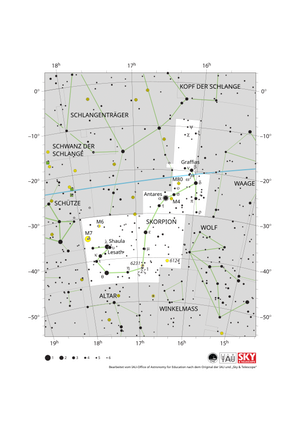
Karte des Sternbilds Skorpion
Unterschrift: Das Sternbild Skorpion (lateinisch Scorpio) mit seinen hellen Sternen und den umliegenden Sternbildern. Der Skorpion ist umgeben von (im Uhrzeigersinn von oben beginnend) dem Schlangenträger, dem Kopf der Schlange, der Waage, dem Wolf, dem Winkelmaß, dem Altar, der südlichen Krone und dem Schützen. Der hellste Stern des Skorpions, Antares, befindet sich im Herzen des Sternbilds, während sich der berühmte Schwanz des Skorpions nach Südosten (unten links) erstreckt. Der Skorpion liegt auf der Ekliptik (hier als blaue Linie dargestellt); dies ist die Bahn, die die Sonne im Laufe eines Jahres scheinbar am Himmel zurücklegt. Die Sonne verbringt nur eine kurze Zeit Ende November im Sternbild Skorpion. Die Planeten des Sonnensystems sind regelmäßig im Skorpion zu finden.
Der Skorpion liegt südlich des Himmelsäquators. Das gesamte Sternbild ist von den arktischen Regionen der Erde aus nicht sichtbar. Für Beobachter in den nördlichen Teilen Asiens, Europas und Nordamerikas sind Teile des Skorpions verdeckt. Der Skorpion ist am besten abends im Sommer der nördlichen Hemisphäre und im Winter der südlichen Hemisphäre zu sehen.
Die gelben Kreise markieren die Positionen der offenen Sternhaufen M6, M7 und NGC 6231, während die gelben Kreise mit darübergelegten Pluszeichen die Kugelsternhaufen M4 und M80 kennzeichnen.
Die y-Achse dieses Diagramms zeigt die Deklination in Grad, wobei Norden oben liegt, und die x-Achse zeigt die Rektaszension in Stunden mit Osten nach links. Die Größe der hier dargestellten Sterne bezieht sich auf deren scheinbare Helligkeit, ein Maß für die ankommende Strahlungsintensität. Die größeren Punkte repräsentieren hellere Sterne. Die griechischen Buchstaben kennzeichnen die hellsten Sterne des Sternbilds. Diese sind nach Helligkeit geordnet, wobei der hellste Stern mit Alpha bezeichnet wird, der zweithellste mit Beta usw. – wobei diese Reihenfolge nicht immer exakt eingehalten wird. Die gepunkteten Grenzlinien markieren die offiziellen Sternbildgrenzen der IAU, und die durchgezogenen grünen Linien zeigen eine der üblichen Formen, um die Figuren der Sternbilder darzustellen. Weder die Sternbildgrenzen noch die Verbindungslinien zwischen den Sternen sind am realen Himmel zu sehen.
Bild: Bearbeitet vom IAU-Office of Astronomy for Education nach dem Original der IAU und „Sky & Telescope“
License: CC-BY-4.0 Creative Commons Namensnennung 4.0 International (CC BY 4.0) Symbole

Jungfrau-Sternenkarte
Unterschrift: Das Tierkreissternbild Jungfrau und die umliegenden Sternbilder. Von oben nach unten im Uhrzeigersinn sind dies das Haar Der Berenike, Löwe, Becher, Rabe, Waage und Bärenhüter. Der hellste Stern in der Jungfrau, Spica, liegt knapp unterhalb der Ekliptik (hier als blaue Linie dargestellt) in der Mitte der Karte. Eine Möglichkeit, diesen Stern am Nachthimmel ausfindig zu machen, besteht darin, dem Henkel des Großen Wagens bis zum Stern Arkturus im Bärenhüter zu folgen und dann auf einer geraden Linie hinunter zu Spica zu gehen ("Bogen zu Arkturus und Spitze zu Spica"). Dieser Stern liegt knapp unterhalb der Ekliptik. Die Ekliptik ist der Weg, den die Sonne im Laufe eines Jahres über den Himmel zu nehmen scheint. Die Sonne befindet sich von Mitte September bis Ende Oktober in der Jungfrau. Die anderen Planeten des Sonnensystems sind oft in der Jungfrau zu finden.
Die Jungfrau erstreckt sich über den Himmelsäquator und ist daher im Laufe des Jahres irgendwann von der gesamten Erde aus sichtbar, wobei ein Teil des Sternbilds in den arktischen und antarktischen Regionen der Welt verdeckt ist. Die Jungfrau ist am besten abends im Frühling auf der Nordhalbkugel und im Herbst auf der Südhalbkugel sichtbar.
Das Sternbild Jungfrau erscheint als eine Person, die mit dem Rücken zur Ekliptik liegt, die Arme ausgestreckt hat und deren Füße nach Osten zeigen. In der Jungfrau sind mehrere Deep-Sky-Objekte zu sehen, darunter NGC4697, M49, M87, M86, M84 und M60, die alle auf der Karte als rote Ellipsen gekennzeichnet sind. Dies sind alles Spiral- und elliptische Galaxien, die mehrere Millionen Lichtjahre von der Erde entfernt sind. Vor allem M87 beherbergt das supermassereiche Schwarze Loch (Pōwehi), das 2019 mit dem Event Horizon Telescope aufgenommen wurde. Alle diese Galaxien gehören zum Virgo-Galaxienhaufen, dem der Milchstraße am nächsten gelegenen Galaxienhaufen.
Die y-Achse dieses Diagramms ist in Deklinationsgraden mit Norden nach oben und die x-Achse ist in Rektaszensionsstunden mit Osten nach links. Die Größe der hier markierten Sterne bezieht sich auf die scheinbare Helligkeit des Sterns. Je größer der Punkt, desto heller scheint der Stern den er darstellt. Die griechischen Buchstaben kennzeichnen die hellsten Sterne des Sternbildes. Diese sind nach ihrer Helligkeit geordnet, wobei der hellste Stern mit Alpha, der zweithellste mit Beta usw. bezeichnet wird, obwohl diese Reihenfolge nicht immer genau eingehalten wird. Die gepunkteten Begrenzungslinien markieren die von der IAU festgelegten Grenzen der Sternbilder, und die durchgezogenen grünen Linien markieren eine der üblichen Formen, die zur Darstellung der Sternbilder verwendet werden. Weder die Sternbildgrenzen, noch die Linie, die die Ekliptik markiert, noch die Linien, die die Sterne verbinden, sind am Himmel sichtbar.
Bild: Angepasst vom IAU Office of Astronomy for Education nach dem Original von IAU/Sky & Telescope
License: CC-BY-4.0 Creative Commons Namensnennung 4.0 International (CC BY 4.0) Symbole
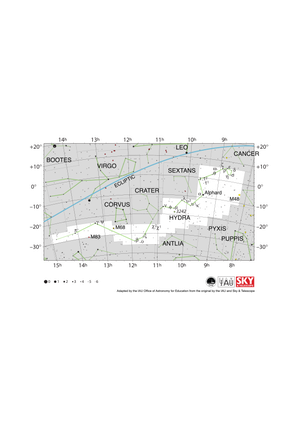
Hydra Constellation Map
Unterschrift: The constellation Hydra with its bright stars and surrounding constellations. Hydra is surrounded by (going clockwise from the top): Leo, Cancer, Canis Minor, Monoceros, Puppis, Pyxis, Antlia, Centaurus, Lupus, Libra, Virgo, Corvus, Crater and Sextans.
Hydra is a large constellation that covers over a quarter of the celestial sphere in right ascension. It also spans the celestial equator and thus part of the constellation is visible from everywhere on the Earth at some point in the year. All parts of the constellation are visible at some point for all but the most antarctic parts of the southern hemisphere and to equatorial and most temperate regions of the northern hemisphere. However the wide span of the constellation means that all of it may not be visible at the same time in many of these regions. Hydra is best viewed in the northern hemisphere spring and southern hemisphere autumn.
The famous spiral galaxy M83, also known as the Pinwheel Galaxy, lies in Hydra. It is marked here with a red ellipse. The planetary nebula NGC 3242 can also be found in Hydra. It is marked here with a green circle with a plus sign superimposed on it. The open cluster M48 is marked here with a yellow circle while the globular cluster M68 is marked with a yellow circle with a plus sign superimposed on it.
The y-axis of this diagram is in degrees of declination with north as up and the x-axis is in hours of right ascension with east to the left. The sizes of the stars marked here relate to the star's apparent magnitude, a measure of its apparent brightness. The larger dots represent brighter stars. The Greek letters mark the brightest stars in the constellation. These are ranked by brightness with the brightest star being labeled alpha, the second brightest beta, etc., although this ordering is not always followed exactly. The dotted boundary lines mark the IAU's boundaries of the constellations and the solid green lines mark one of the common forms used to represent the figures of the constellations. The blue line on the diagram marks the ecliptic. Neither the constellation boundaries, nor the line marking the ecliptic, nor the lines joining the stars appear on the sky.
Bild: Adapted by the IAU Office of Astronomy for Education from the original by the IAU and Sky & Telescope
License: CC-BY-4.0 Creative Commons Namensnennung 4.0 International (CC BY 4.0) Symbole
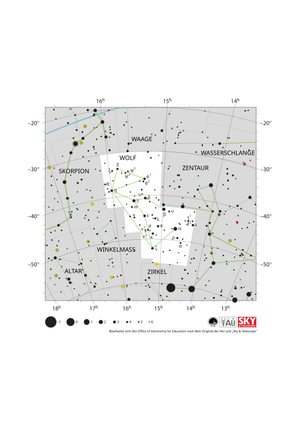
Karte des Sternbilds Wolf
Unterschrift: Das Sternbild Wolf (lateinisch Lupus) mit seinen hellen Sternen und den umliegenden Sternbildern. Der Wolf ist umgeben von (im Uhrzeigersinn von oben): Waage, Wasserschlange, Zentaur, Zirkel, Winkelmaß und Skorpion.
Der Wolf ist ein südliches Sternbild, daher ist das gesamte Sternbild zu einem Zeitpunkt im Jahr von der gesamten südlichen Hemisphäre sichtbar. In äquatorialen und einigen gemäßigten Regionen der nördlichen Hemisphäre ist das gesamte Sternbild sichtbar, während in den übrigen gemäßigten Regionen zumindest Teile des Sternbilds zu sehen sind. Der Wolf lässt sich am besten abends im Sommer der nördlichen Hemisphäre und im Winter der südlichen Hemisphäre beobachten.
Die y-Achse dieses Diagramms zeigt die Deklination in Grad, wobei Norden oben liegt, und die x-Achse zeigt die Rektaszension in Stunden mit Osten nach links. Die Größe der hier dargestellten Sterne bezieht sich auf deren scheinbare Helligkeit, ein Maß für die ankommende Strahlungsintensität. Die größeren Punkte repräsentieren hellere Sterne. Die griechischen Buchstaben kennzeichnen die hellsten Sterne des Sternbilds. Diese sind nach Helligkeit geordnet, wobei der hellste Stern mit Alpha bezeichnet wird, der zweithellste mit Beta usw. – wobei diese Reihenfolge nicht immer exakt eingehalten wird. Die gepunkteten Grenzlinien markieren die offiziellen Sternbildgrenzen der IAU, und die durchgezogenen grünen Linien zeigen eine der üblichen Formen, um die Figuren der Sternbilder darzustellen. Weder die Sternbildgrenzen noch die Verbindungslinien zwischen den Sternen sind am realen Himmel zu sehen.
Bild: Bearbeitet vom IAU-Office of Astronomy for Education nach dem Original der IAU und „Sky & Telescope“
License: CC-BY-4.0 Creative Commons Namensnennung 4.0 International (CC BY 4.0) Symbole