This page describes an image Europa
Datei runterladen ( Bild 622.91 kB)
Bildunterschrift:
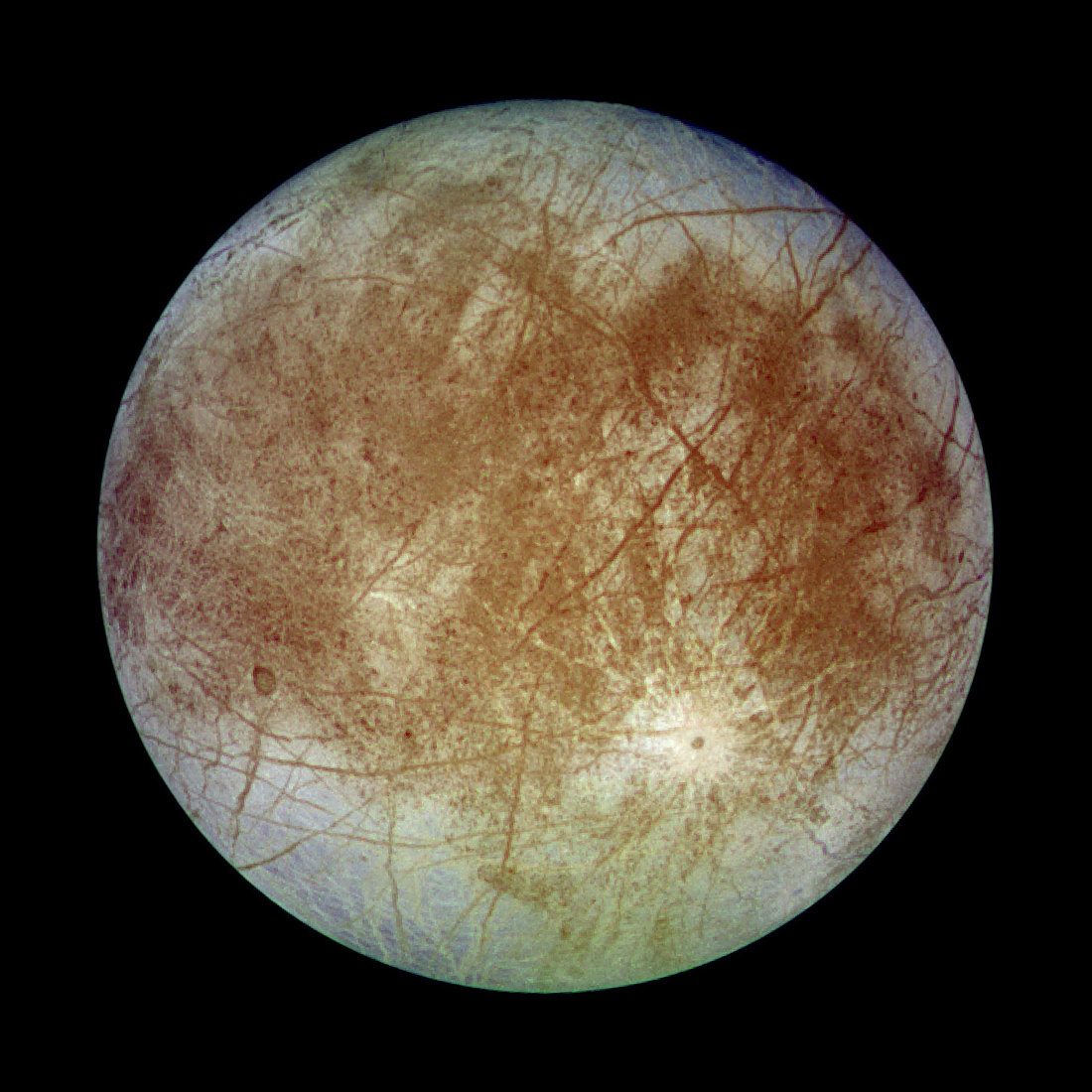
Dieses von der NASA-Raumsonde Galileo im September 1996 aufgenommene Bild zeigt den mit Eis bedeckten Jupitersatelliten Europa in annähernd natürlicher Farbe. Lange, dunkle Linien sind Brüche in der Kruste, von denen einige mehr als 3.000 Kilometer lang sind (1.850 Meilen). Das helle Merkmal mit dem dunklen Fleck in der Mitte im unteren Drittel des Bildes ist ein junger Einschlagskrater mit einem Durchmesser von etwa 50 Kilometern (31 Meilen). Europa hat einen Durchmesser von etwa 3.160 Kilometern (1.950 Meilen), was in etwa der Größe des Erdmondes entspricht.
Scroll zu Unterschriften auf anderen Sprachen
Bildquelle:
NASA/JPL/DLR
Unterschrift Übersetzungsstatus: Noch nicht bestätigt von einem Rezensenten
Unterschrift-Übersetzer: Emma Krojanski
Ähnliche Glossarbegriffe:
Galileische Satelliten
, Monde
Kategorien:
Sonnensystem
Bildlizenz: Gemeinfrei Gemeinfrei Symbole
The media file captions presented on the OAE website were written, translated and reviewed by a collective effort from the OAE, the OAE Centers and Nodes, the OAE National Astronomy Education Coordinators (NAECs) and other volunteers. You can find a full list of credits for our translation project here. All media file captions are released under a Creative Commons CC BY-4.0 license and should be credited to "IAU OAE". The media files themselves may have different licenses (see above) and should be credited as listed above under "credit".
Falls dir ein inhaltlicher Fehler in dieser Unterschrift oder ein Fehler in einer der Übersetzungen auffällt, bitte kontaktiere uns.
Unterschriften auf verschiedenen Sprachen:
Bildunterschrift: This image taken by NASA's Galileo space probe in September 1996 shows Jupiter's ice-covered satellite, Europa, in approximate natural color. Long, dark lines are fractures in the crust, some of which are more than 3,000 kilometers (1,850 miles) long. The bright feature containing a central dark spot in the lower third of the image is a young impact crater some 50 kilometers (31 miles) in diameter. Europa is about 3,160 kilometers (1,950 miles) in diameter, or about the size of Earth's moon.
Bildquelle: NASA/JPL/DLR
Ähnliche Glossarbegriffe: Galilean Satellites , Moons
Bildunterschrift: Cette image prise par la sonde spatiale Galileo de la NASA en septembre 1996 montre le satellite de Jupiter recouvert de glace, Europe, dans sa couleur naturelle approximative. Les longues lignes sombres représentent des fractures dans la croûte, dont certaines font plus de 3 000 kilomètres de long. L'élément brillant contenant une tache sombre centrale dans le tiers inférieur de l'image est un jeune cratère d'impact d'environ 50 kilomètres de diamètre. Europa a un diamètre d'environ 3 160 km, soit à peu près la taille de la Lune.
Bildquelle: NASA/JPL/DLR
Ähnliche Glossarbegriffe: Lunes , Satellites galiléens Unterschrift Übersetzungsstatus: Noch nicht bestätigt von einem Rezensenten
Unterschrift-Übersetzer: Gilles Remy
Bildunterschrift: Questa immagine, scattata dalla sonda spaziale Galileo della NASA nel settembre 1996, mostra il satellite di Giove ricoperto di ghiaccio, Europa, con un colore approssimativamente al naturale. Le lunghe linee scure sono fratture nella crosta, alcune delle quali sono lunghe più di 3.000 chilometri (1.850 miglia). L'elemento luminoso contenente una macchia scura centrale nel terzo inferiore dell'immagine è un giovane cratere da impatto di circa 50 chilometri (31 miglia) di diametro. Europa ha un diametro di circa 3.160 chilometri (1.950 miglia), all'incirca le dimensioni della Luna.
Bildquelle: NASA/JPL/DLR
Ähnliche Glossarbegriffe: Lune , Satelliti galileiani Unterschrift Übersetzungsstatus: Bestätigt von einem Rezensenten
Unterschrift-Übersetzer: Giuliana Giobbi
Unterschrift-Prüfende: Rosa Valiante, Rodolfo Canestrari
Bildunterschrift: Esta imagem, obtida pela sonda espacial Galileo da NASA em setembro de 1996, mostra Europa, o satélite coberto de gelo de Júpiter, em cores naturais aproximadas. As longas linhas escuras são fraturas na crosta, algumas com mais de 3.000 quilômetros (1.850 milhas) de comprimento. A característica brilhante que contém uma mancha escura central no terço inferior da imagem é uma cratera de impacto jovem com cerca de 50 quilômetros (31 milhas) de diâmetro. Europa tem cerca de 3.160 quilômetros (1.950 milhas) de diâmetro, aproximadamente o tamanho da Lua da Terra.
Bildquelle: NASA/JPL/DLR
Ähnliche Glossarbegriffe: Luas , Satélites Galileanos Unterschrift Übersetzungsstatus: Noch nicht bestätigt von einem Rezensenten
Unterschrift-Übersetzer: Eduardo Monfardini Penteado
Bildunterschrift: 这张照片由美国国家航空航天局的伽利略探测器于1996年9月拍摄,展示了木星的被冰覆盖的卫星——欧罗巴,以近似自然色呈现。画面中长长的暗线是冰壳上的裂缝,其中一些裂缝长度超过3000公里(1850英里)。图像下方三分之一处,包含中央暗点的明亮区域是一个直径约50公里(31英里)新形成的撞击坑。欧罗巴的直径约为3160公里(1950英里),与地球的卫星月球大小相当。
Bildquelle: 美国国家航空航天局/喷气推进实验室/德国航空航天中心
Ähnliche Glossarbegriffe: 伽利略卫星 , 卫星 Unterschrift Übersetzungsstatus: Noch nicht bestätigt von einem Rezensenten
Unterschrift-Übersetzer: Li Jiankang
Bildunterschrift: 這張照片由美國國家航空航天局的伽利略探測器於1996年9月拍攝,展示了木星的被冰覆蓋的衛星——歐羅巴,以近似自然色呈現。畫面中長長的暗線是冰殼上的裂縫,其中一些裂縫長度超過3000公里(1850英里)。圖像下方三分之一處,包含中央暗點的明亮區域是一個直徑約50公里(31英里)新形成的撞擊坑。歐羅巴的直徑約為3160公里(1950英里),與地球的衛星月球大小相當。
Bildquelle: 美國國家航空航天局/噴氣推進實驗室/德國航空航天中心
Ähnliche Glossarbegriffe: 伽利略衛星 , 衛星 Unterschrift Übersetzungsstatus: Noch nicht bestätigt von einem Rezensenten
Unterschrift-Übersetzer: Eine automatische Transliteration der vereinfachten chinesischen Übersetzung von - Li Jiankang