Término del glosario: Tormenta geomagnética
Descripción: Además de la radiación electromagnética que emite el Sol, existe un flujo constante de partículas cargadas que salen del Sol, conocido como viento solar. Ciertos tipos de actividad solar —las erupciones solares y las más espectaculares eyecciones de masa coronal— pueden aumentar de forma repentina y drástica la cantidad de partículas cargadas que salen del Sol, creando un frente de choque dentro del viento solar que se propaga hacia el exterior. Si partes de ese frente de choque llegan a nuestro planeta, interactúan con el campo magnético terrestre, provocando una tormenta geomagnética (a veces también denominada tormenta solar). Las consecuencias van desde las inofensivas —unas auroras polares más intensas y bellas— hasta interacciones perjudiciales que pueden dañar satélites, perturbar las emisiones y, en casos extremos, alterar las redes eléctricas.
Términos relacionados:
Ver este término en otros idiomas
Estado del término y la definición: La definición original de este término en inglés ha sido aprobada por unastrónomo o astrónoma investigadora y un docente La traducción de este término y su definición aún están pendientes de aprobación
El Glosario multilingüe de la OAE es un proyecto de la Oficina de Astronomía para la Educación de la UAI (OAE) en colaboración con la Oficina de Divulgación de Astronomía de la UAI (OAO). Los términos y definiciones fueron seleccionados, redactados y revisados gracias al esfuerzo colectivo de la OAE, los Centros y Nodos de la OAE, los Coordinadores Nacionales de Educación Astronómica (NAECs) y otros voluntarios. Puedes encontrar una lista completa de créditos aquí. Todos los términos del glosario y sus definiciones se publican bajo la licencia Creative Commons CC BY-4.0 y deben atribuirse a la "IAU OAE".
Si detectas algún error de contenido o de traducción en este término del glosario o en ladefinición, ponte en contacto con nosotros.
En otros idiomas
- Árabe: العاصفة الجيومغناطيسية
- Alemán: Geomagnetischer Sturm
- Inglés: Geomagnetic Storm
- Francés: Tempête géomagnétique
- Italiano: Tempesta Geomagnetica
- Japonés: 磁気嵐 (enlace externo)
- Portugués de Brasil: Tempestade geomagnética
- Chino simplificado: 地磁暴
- Chino tradicional: 地磁暴
Contenidos relacionados
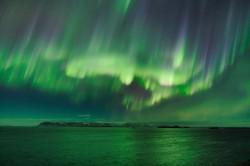
Iceland aurora, by Emanuele Balboni, Italy
Pie de foto: Third place in the 2021 IAU OAE Astrophotography Contest, category Aurorae (still images)
The blurred motions of the aurora caught during the exposure time of this photograph beautifully illustrate its dynamic nature. While certain forms of aurorae, like homogeneous arcs and bands or diffuse glows, can remain static for hours, others, like rayed arcs or bands (also called "curtains"), can change within seconds in shape and brightness.
Crédito: Emanuele Balboni/IAU OAE
License: CC-BY-4.0 Creative Commons Reconocimiento 4.0 Internacional (CC BY 4.0) íconos
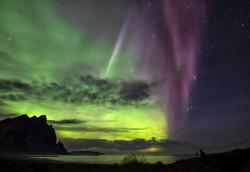
Multicolored aurora in Iceland, by Marco Migliardi on behalf of Associazione Astronomica Cortina, Italy
Pie de foto: First place in the 2021 IAU OAE Astrophotography Contest, category Aurorae (still images)
Aurorae are the result of ionisation and excitation processes in Earth's upper atmosphere, caused by charged particles from the solar wind or from coronal mass ejections. The different colours in an aurora display indicate the species of atmospheric atoms and molecules involved. The most common colour is a bright green, which, together with deep red, originates from atomic oxygen. Blue, purple and pink hues are much rarer and originate from molecular nitrogen. The reflection of the aurora in the water indicates the brightness of intense aurorae at higher latitudes.
Crédito: Marco Migliardi on behalf of Associazione Astronomica Cortina/IAU OAE.
License: CC-BY-4.0 Creative Commons Reconocimiento 4.0 Internacional (CC BY 4.0) íconos
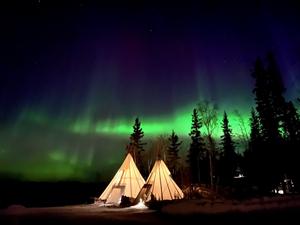
Northern Lights - Teepees
Pie de foto: Honorable mention in the 2023 IAU OAE Astrophotography Contest, category of Still images taken exclusively with smartphones/mobile devices.
Taken with a smartphone at Cassidy Point, Yellowknife, Canada, on 24 March 2023, this stunning display captured the ethereal Northern Lights painting the night sky. The biting cold of -20°F (-29°C) set the stage for the vibrant hues of the Aurora Borealis, a celestial ballet created by collisions between charged solar particles and the Earth's atmosphere. The Earth’s magnetic field directs the charged particles towards the polar regions, where they interact with the various atoms and molecules in the atmosphere. This natural phenomenon transforms the sky into a canvas of radiant greens, pinks, and purples, casting a mesmerising glow above. The different colours of an aurora are determined by the gases in Earth’s atmosphere, the altitude where the aurora occurs, the density of the atmosphere, and the energy of the charged particles. In general, green is attributed to atomic oxygen, red is associated with high-altitude atomic oxygen and molecular nitrogen, while purple and blue are associated with molecular nitrogen only. Pink auroras are typically associated with a mix of nitrogen blue and red. Against this cosmic backdrop, the teepees of Aurora Village below provide a tranquil contrast to the celestial spectacle unfolding overhead. Preserving the pristine darkness of this location ensures the continued splendour of such awe-inspiring natural light shows.
Crédito: Oanh Vuong/IAU OAE (CC BY 4.0)
License: CC-BY-4.0 Creative Commons Reconocimiento 4.0 Internacional (CC BY 4.0) íconos
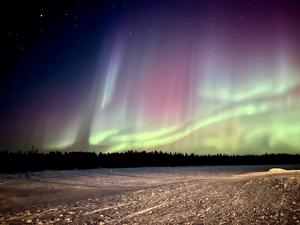
Colores de la aurora boreal
Pie de foto: Ganadora del Concurso de Astrofotografía de la IAU OAE 2023, en la categoría de imágenes fijas tomadas exclusivamente con smartphones o dispositivos móviles.
Esta fotografía, tomada con un smartphone, captura la belleza etérea de la aurora boreal en Cassidy Point, Yellowknife, Territorios del Noroeste (Canadá), el 24 de marzo de 2023, a temperaturas muy por debajo del punto de congelación (–29 °C). La fascinante danza de la aurora boreal (o austral), conocida comúnmente como aurora del norte (o del sur), pinta el cielo nocturno con tonos impresionantes. La aurora es un fenómeno natural causado por la interacción de partículas cargadas procedentes del Sol con la atmósfera terrestre, que son desviadas por el campo magnético terrestre hacia las regiones polares norte y sur. Las partículas cargadas excitan a los átomos y moléculas de la atmósfera, lo que da lugar a un espectáculo lumínico que varía en color y forma. Los diferentes colores de una aurora vienen determinados por los gases (átomos y moléculas) presentes en la atmósfera terrestre, la altitud de la aurora, la densidad de la atmósfera y la energía de las partículas cargadas. En general, el verde se atribuye al oxígeno atómico; el rojo se asocia al oxígeno atómico a gran altitud y al nitrógeno molecular, mientras que el púrpura y el azul se asocian únicamente al nitrógeno molecular. Las auroras rosas suelen estar asociadas a una mezcla de nitrógeno azul y rojo. Esa noche en concreto, el entorno sereno de Cassidy Point ofreció una vista sin obstáculos de las luces.
Crédito: Jason Johnson/IAU OAE (CC BY 4.0)
License: CC-BY-4.0 Creative Commons Reconocimiento 4.0 Internacional (CC BY 4.0) íconos
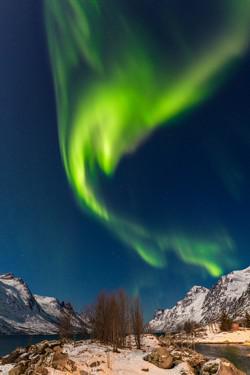
Aurora boreal con forma de dragón sobre Ersfjordbotn (Noruega)
Pie de foto: Segundo puesto en el Concurso de Astrofotografía de la IAU OAE 2021, categoría «Auroras» (imágenes fijas)
Las auroras suelen presentar patrones ondulantes similares a cortinas, en los que los arcos o bandas forman rizos, pliegues o incluso espirales en movimiento. Estas formas irregulares reflejan la estructura a pequeña escala del campo magnético terrestre al interactuar con los flujos de partículas cargadas. Aunque la luna llena ilumina tanto el paisaje como el cielo nocturno, la aurora es fácilmente visible, lo que demuestra que puede ser un fenómeno muy brillante y colorido.
Crédito: Rainer Sparenberg/IAU OAE
License: CC-BY-4.0 Creative Commons Reconocimiento 4.0 Internacional (CC BY 4.0) íconos