Término del glosario: Cometa
Descripción: Un cometa es un pequeño objeto del Sistema Solar formado por un núcleo compuesto por una mezcla de diferentes tipos de hielo y material rocoso y polvoriento: una bola de nieve sucia. Los núcleos de los cometas pueden tener un diámetro que oscila entre unos pocos cientos de metros y decenas de kilómetros. La mayoría de los cometas tienen órbitas muy elípticas. Cuando un cometa se acerca al Sol, parte del hielo de la superficie se evapora y es arrastrado por el viento solar, formando las características distintivas de la coma y la cola. Vemos los cometas gracias a la luz solar que se refleja en la coma o la cola o (en el caso de los cometas alejados del Sol) en el núcleo. Los cometas se clasifican como «periódicos» o de «período corto» si su paso se ha observado más de una vez, o si se sabe que su período es inferior a 200 años, y como «no periódicos» en los demás casos.
Términos relacionados:
Ver este término en otros idiomas
Estado del término y la definición: La definición original de este término en inglés ha sido aprobada por unastrónomo o astrónoma investigadora y un docente La traducción de este término y su definición aún están pendientes de aprobación
El Glosario multilingüe de la OAE es un proyecto de la Oficina de Astronomía para la Educación de la UAI (OAE) en colaboración con la Oficina de Divulgación de Astronomía de la UAI (OAO). Los términos y definiciones fueron seleccionados, redactados y revisados gracias al esfuerzo colectivo de la OAE, los Centros y Nodos de la OAE, los Coordinadores Nacionales de Educación Astronómica (NAECs) y otros voluntarios. Puedes encontrar una lista completa de créditos aquí. Todos los términos del glosario y sus definiciones se publican bajo la licencia Creative Commons CC BY-4.0 y deben atribuirse a la "IAU OAE".
Si detectas algún error de contenido o de traducción en este término del glosario o en ladefinición, ponte en contacto con nosotros.
Contenidos relacionados
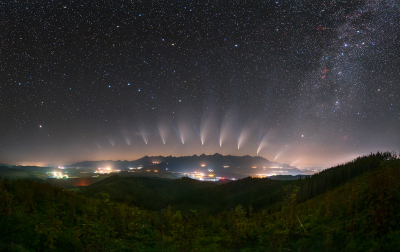
Neowise's metamorphosis, by Tomáš Slovinský and Petr Horálek, Slovakia
Pie de foto: First place in the 2021 IAU OAE Astrophotography Contest, category Comets.
This image uses the chronophotography technique to capture the evolution of the comet C/2020 F3 (Neowise) over time, as it became visible in the northern skies in July 2020. Orbits of comets are extremely elliptical, which means that during part of their orbit they get close to the Sun. As a comet approaches the Sun, it gets heated, releases gas and dust creating an envelope or coma around the nucleus. The solar wind and photons (particles of electromagnetic radiation) interact with the coma producing the cometary tail, which can be seen clearly in this image. The tail of a comet always points away from the Sun, and extends as much as tens of millions of kilometres. This tail has two parts: the relatively straight bluish gas (ion or plasma) tail, which is made up of charged particles interacting with the magnetic fields of the solar wind; and the whitish dust tail compose of very small dust particles that are pushed by the radiation pressure from the Sun into a curve due to their slower speeds. Two regions in the Solar System are often associated with being “storehouses” of comets: the Kuiper Belt and the Oort Cloud. Comets with periods up to about two hundred years come from the Kuiper belt, a reservoir of cometary nuclei material with a disk-like shape located beyond Neptune. Longer period comets come from the Oort cloud, another huge reservoir of icy objects, with a spherical shape surrounding the Solar System. The outer limit of the Oort Cloud is not known as yet, but it could be as much as 10 thousand times the Sun-Earth distance, or even more. Due to gravitational disturbances, some of these cometary nuclei might be ejected towards the inner regions of the Solar System, sometimes approaching the Earth, offering some of the most spectacular views of a celestial body. The image also shows some prominent constellations and asterisms like the Big and Little Dippers, and also the North (Pole) Star – Polaris.
Crédito: Tomáš Slovinský and Petr Horálek/IAU OAE
License: CC-BY-4.0 Creative Commons Reconocimiento 4.0 Internacional (CC BY 4.0) íconos
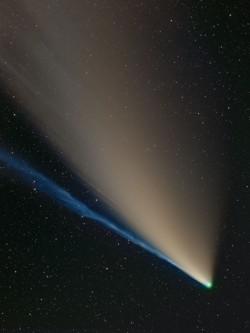
Comet C/2020F3 (Neowise) with separate dust and ion gas tails and a green glowing coma, by Dietmar Gutermuth, Germany
Pie de foto: Second place in the 2021 IAU OAE Astrophotography Contest, category Comets.
Comets have a very interesting structure comprising of four main parts: the nucleus, composed of rock, dust and frozen gases, typically spanning a few kilometres, although bigger ones have been observed; a small atmosphere of gas surrounding the nucleus (only present when the comet approaches its closest point to the Sun), called coma; and the two distinctive cometary tails (there is at times third tail). The green colour of the coma is due to carbon and nitrogen present in the coma reacting with the Sun’s ultraviolet radiation. The tail that we are mostly used to observing – dust tail and is composed of micron sized dust particles, the second tail composed of charged particles – ion or gas tail. The tails are released only when the comet approaches the Sun at a distance where the heat and radiation emanating from our star is intense enough to vaporize the frozen gases. The dust tail is curved, while the gas tail is straight and always points away from the Sun as this is carried by the solar wind - flow of charged particles emitted by the Sun. As comets are formed by leftover material, they carry with them important information about the early stages of the Solar System’s formation. This beautiful image shows the comet C/2020 F3 (Neowise), as seen from Germany in July 2020, with three of the four structures clearly visible – coma, gas, and dust tail.
Crédito: Dietmar Gutermuth/IAU OAE
License: CC-BY-4.0 Creative Commons Reconocimiento 4.0 Internacional (CC BY 4.0) íconos
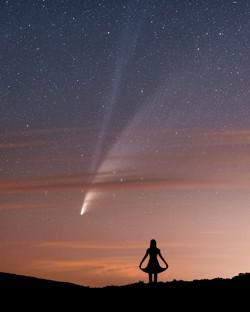
Hello Comet, shall we dance?, by Robert Barsa, Slovakia
Pie de foto: Third place in the 2021 IAU OAE Astrophotography Contest, category Comets.
This beautiful and poetic image taken from Slovakia in July 2020 captures the comet C/2020 F3 (Neowise). The direction of the tails of the comet provides a clue as to the position of the Sun. In the past, the appearance of a comet in the skies could be accompanied by apprehension and even fear from those who did not know what these objects really are. Through careful observations and the applications of knowledge from physics, chemistry and geology, we now understand that comets are objects left over from the earliest days when the Solar System formed. The most distinctive features of a comet are the bluish ion (gas) tail, and whitish dust tail, which can extend for tens of millions of kilometres. These distinctive features, easily observable with the unaided eye together with an understanding of the science, are no longer cause for fear, rather they help us understand the history of our Solar System, and bring awe, joy and contemplation, as portrayed in this image.
Crédito: Robert Barsa/IAU OAE
License: CC-BY-4.0 Creative Commons Reconocimiento 4.0 Internacional (CC BY 4.0) íconos
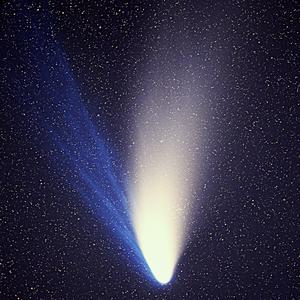
Comet Hale-Bopp
Pie de foto: Image of comet C/1995 O1 (Hale-Bopp), taken on 4 April 1997, with an exposure time of 10 minutes. The field shown is about 6.5°x6.5°. Two tails extend from the bright coma: one white-yellowish dust tail and a bluish gas tail, always pointing away from the Sun.
Crédito: E. Kolmhofer, H. Raab; Johannes-Kepler-Observatory, Linz, Austria
enlace de crédito
License: CC-BY-SA-3.0 Creative Commons Atribución-CompartirIgual 3.0 No portada íconos
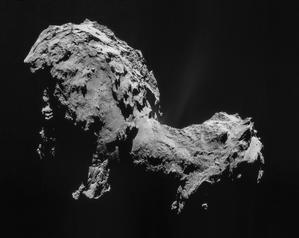
Comet 67P/Churyumov-Gerasimenko
Pie de foto: Comet 67P/Churyumov–Gerasimenko's nucleus is a "dirty snowball" made of a mixture of frozen materials and dust. It is shaped like two large lobes: one 4.1 km × 3.3 km × 1.8 km, the other 2.6 km × 2.3 km × 1.8 km. These lobes are connected by a small bridge. When a cometary nucleus such as this nears the Sun its frozen, icy material is heated, turning into gas. This, combined with the embedded dust, provide the material for the comet's characteristic coma and tail.
Crédito: ESA/Rosetta/NAVCAM
enlace de crédito
License: CC-BY-SA-3.0-IGO Creative Commons Attribution-ShareAlike 3.0 IGO íconos
Actividades relacionadas
Meteoroids, Meteors and Meteorites
astroEDU educational activity (links to astroEDU website) Description: Unveiling the mystery of "shooting stars": meteors, meteorites and meteroids
License: CC-BY-4.0 Creative Commons Reconocimiento 4.0 Internacional (CC BY 4.0) íconos
Etiquetas:
Geology
Rango de edades:
6-8
, 8-10
, 10-12
, 12-14
Nivel educativo:
Educación secundaria
, Primaria
Áreas de aprendizaje:
Clase interactiva
Costos:
Bajo coste
Duración:
1 hora y 30 minutos
Tamaño del grupo:
Grupo
Competencias:
Analizar e interpretar datos
, Plantear preguntas
, Comunicar información
, Participar en debates basados en pruebas
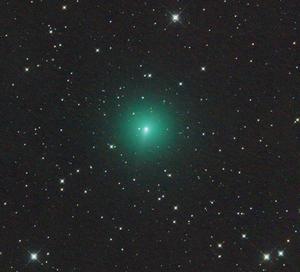
Measuring the average speed of a comet
astroEDU educational activity (links to astroEDU website) Description: Using telescope images of comet C/2019 Y4 we calculate its average speed and understand what a physical quantity is
License: CC-BY-4.0 Creative Commons Reconocimiento 4.0 Internacional (CC BY 4.0) íconos
Etiquetas:
Software
, average speed
Rango de edades:
12-14
, 14-16
, 16-19
, 19+
Nivel educativo:
Secondary
Costos:
Gratis
Duración:
1 hora y 30 minutos
Tamaño del grupo:
Grupo
Competencias:
Analizar e interpretar datos
, Desarrollar y utilizar modelos
, Participar en debates basados en pruebas