Término del glosario: Radiación electromagnética
Descripción: Cuando los físicos del siglo XIX describieron los fenómenos eléctricos y magnéticos, descubrieron que existe una forma en que los patrones de los campos eléctricos y magnéticos se propagan juntos por el espacio a la velocidad de la luz, incluso en situaciones en las que no hay cargas eléctricas cerca. Estas ondas se conocen como ondas electromagnéticas o radiación electromagnética. Las ondas electromagnéticas elementales pueden clasificarse según sus longitudes de onda, y el espectro electromagnético resultante incluye, de menor a mayor longitud de onda: rayos gamma, rayos X, ultravioleta, luz visible, infrarrojo, submilimétrico y ondas de radio (incluidas las milimétricas y las microondas). La radiación electromagnética procedente de objetos astronómicos distantes es la fuente de información más importante de que disponen los astrónomos sobre dichos objetos.
Términos relacionados:
- Fuerza electromagnética
- Rayos gamma
- Infrarrojo (IR)
- Luz
- Radiación de microondas
- Ultravioleta
- Espectro visible
- Astronomía submilimétrica
- Rayos X
Ver este término en otros idiomas
Estado del término y la definición: La definición original de este término en inglés ha sido aprobada por unastrónomo o astrónoma investigadora y un docente La traducción de este término y su definición aún están pendientes de aprobación
El Glosario multilingüe de la OAE es un proyecto de la Oficina de Astronomía para la Educación de la UAI (OAE) en colaboración con la Oficina de Divulgación de Astronomía de la UAI (OAO). Los términos y definiciones fueron seleccionados, redactados y revisados gracias al esfuerzo colectivo de la OAE, los Centros y Nodos de la OAE, los Coordinadores Nacionales de Educación Astronómica (NAECs) y otros voluntarios. Puedes encontrar una lista completa de créditos aquí. Todos los términos del glosario y sus definiciones se publican bajo la licencia Creative Commons CC BY-4.0 y deben atribuirse a la "IAU OAE".
Si detectas algún error de contenido o de traducción en este término del glosario o en ladefinición, ponte en contacto con nosotros.
En otros idiomas
- Árabe: الإشعاع الكهرومغناطيسي
- Alemán: Elektromagnetische Strahlung
- Inglés: Electromagnetic Radiation
- Francés: Rayonnement électromagnétique
- Hindi: इलेक्ट्रोमॅग्नेटिक रेडिएशन (विद्युतचुंबकीय विकिरण)
- Italiano: Radiazione elettromagnetica
- Japonés: 放射 (enlace externo)
- Coreano: 전자기복사
- Maratí: इलेक्ट्रोमॅग्नेटिक रेडिएशन (विद्युत चुंबकीय विकिरण)
- Portugués de Brasil: Radiação eletromagnética
- Chino simplificado: 电磁辐射
- Chino tradicional: 電磁輻射
Diagramas relacionados
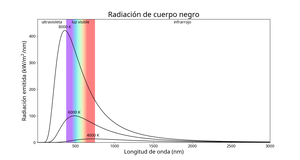
Radiación de cuerpo negro
Pie de foto: Las curvas de radiación emitida por cuerpos negros de diferentes temperaturas. El eje-x muestra la longitud de onda y el eje-y la cantidad de energía emitida cada segundo por un metro cuadrado de la superficie de ese cuerpo negro a cada longitud de onda.
Cuanto más caliente está el cuerpo, más corta es la longitud de onda y más azul es la luz con la que emite su máxima cantidad de energía. A pesar de que el cuerpo más frío de este gráfico tiene un pico de luz roja, los demás cuerpos más calientes emiten más luz roja que el cuerpo más frío.
Crédito: IAU OAE/Niall Deacon
License: CC-BY-4.0 Creative Commons Reconocimiento 4.0 Internacional (CC BY 4.0) íconos
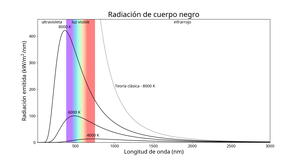
Radiación de cuerpo negro - Catástrofe UV
Pie de foto: Las curvas de radiación emitida por cuerpos negros de diferentes temperaturas. El eje-x muestra la longitud de onda y el eje-y la cantidad de energía emitida cada segundo por un metro cuadrado de la superficie de ese cuerpo negro a cada longitud de onda.
Cuanto más caliente está el cuerpo, más corta es la longitud de onda y más azul es la luz con la que emite su máxima cantidad de energía. A pesar de que el cuerpo más frío de este gráfico tiene un pico de luz roja, los demás cuerpos más calientes emiten más luz roja que el cuerpo más frío.
La línea punteada muestra la radiación emitida predicha por la teoría clásica anterior a la mecánica cuántica moderna. Esta predicción tiende a infinito en las longitudes de onda más cortas para cualquier temperatura del cuerpo negro superior a cero y se denominó "catástrofe ultravioleta".
Crédito: IAU OAE/Niall Deacon
License: CC-BY-4.0 Creative Commons Reconocimiento 4.0 Internacional (CC BY 4.0) íconos
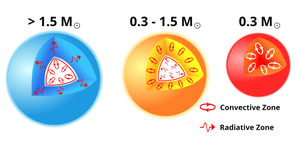
Stellar Structure
Pie de foto: Stars are balls of plasma. For most of a star’s life it burns hydrogen into helium in its core. This phase of a star’s life is known as the main sequence. Burning hydrogen into helium produces heat, that heat travels out of the star’s core eventually reaching the star’s photosphere (often referred to as the “surface” of the star). From here the heat can radiate into space as various forms of electromagnetic radiation. However, how heat travels from the core to the photosphere depends on the star’s mass.
Imagine a parcel of gas rising inside a star. As it rises, it moves into an area of lower pressure, so it cools down and expands. If the parcel is still hotter, and therefore less dense than its surroundings, it keeps moving upward due to buoyancy. Eventually, it will rise far enough to cool and sink back down. This rising and sinking cycle is called convection. Whether convection occurs depends on how quickly temperature changes as you move away from the star’s core. If the temperature in a star drops rapidly, rising parcels of gas are more likely to stay hotter than their surroundings, so convection dominates as the mode of energy transfer in this part of the star. Conversely if the temperature drops more slowly (i.e. if the temperature gradient is small) then heat will mostly be transferred by radiation (photons).
In the most massive main sequence stars (more massive than about 1.5 times the mass of the Sun, seen here on the left), hydrogen is burned into helium using the CNO cycle. This is highly temperature dependent and thus energy production is concentrated near the center of the star. This leads to a larger temperature gradient and thus a convective core. Further out the temperature gradient becomes smaller and heat transport is dominated by radiation. This is called the radiative zone.
For lower mass stars like the Sun (between 0.3 and 1.5 solar masses, seen here in the middle) hydrogen is burned to helium using a different process (the pp chain). This depends less on the internal temperature than the CNO cycle and so energy production is more distributed in the star’s core. This leads to a smaller temperature gradient and thus a radiative core where convection occurs surrounded by a radiative zone. Going further out the gas becomes cool enough for some elements to hang to on some of their electrons, i.e. not being completely ionised. This partially ionised gas is more opaque to photons, trapping heat. This leads to a large temperature gradient and thus convection.
The lowest mass stars (below 0.3 solar masses, seen here on the right) have no radiative zone and are fully convective.
The arrows in the radiative zone are shown as wavy lines heading out of the star. However, a photon’s journey out of a star is much more complex with each individual photon travelling only a short distance before being deflected by some of the charged particles that make up the plasma of the star’s interior. This leads to a long and winding road that takes millennia instead of the few seconds it would take if the photon did not interact with particles in the plasma.
Crédito: Based on a vector diagram by Wikimedia user Д.Ильин which itself is based on a diagram from sun.org
License: CC-BY-4.0 Creative Commons Reconocimiento 4.0 Internacional (CC BY 4.0) íconos