This page describes an image Cosmic Microwave Background Radiation
Descargar archivo ( imagen 14.05 MB)
Pie de foto:
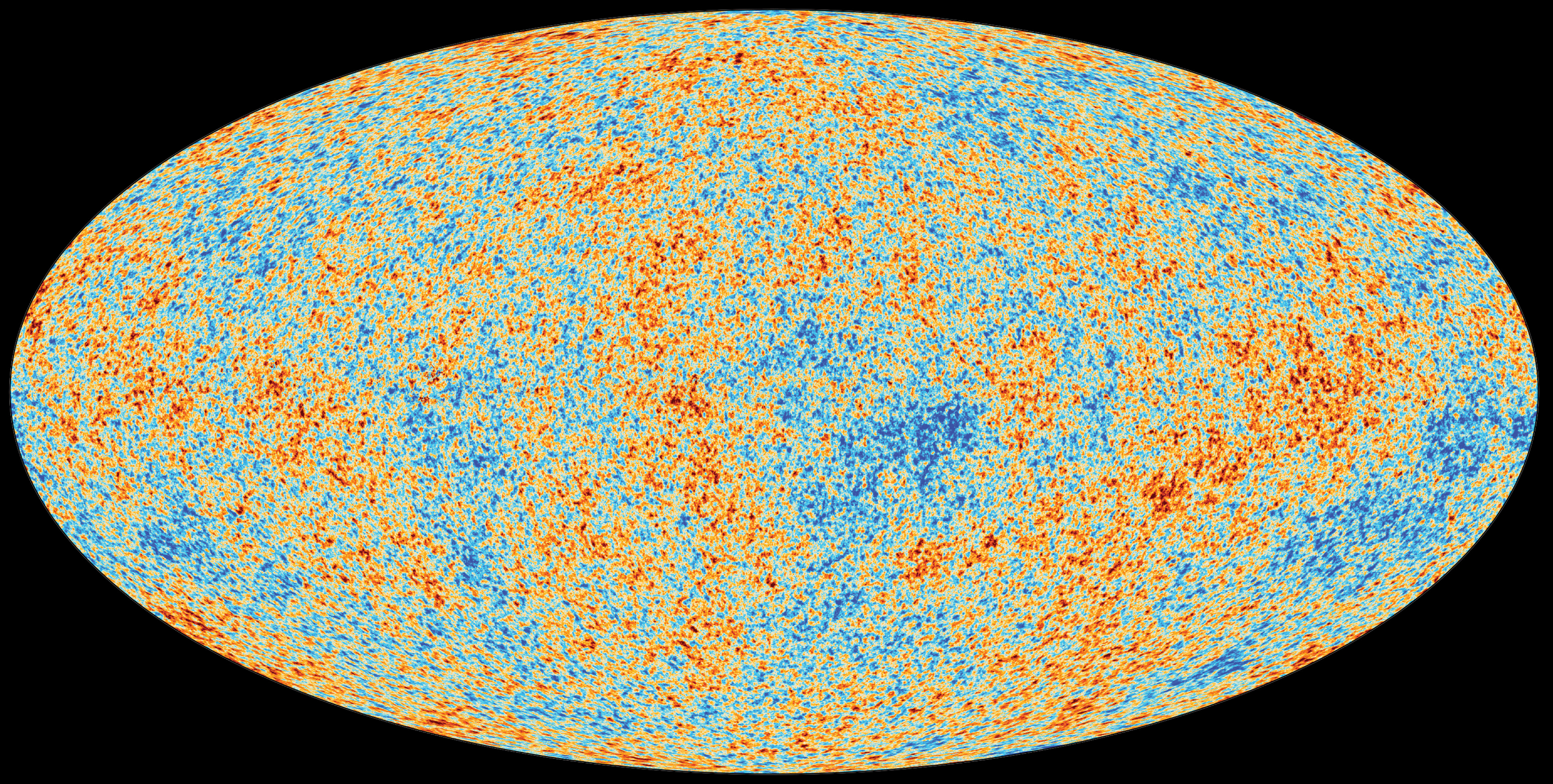
This image is a representation of the Cosmic Microwave Background (CMB) Radiation created using data from the Planck satellite. The CMB is the glow left over from when the Universe was approximately 380,000 years old. The early Universe was hot and dense, so the photons from that era were high energy. Due to the expansion of the Universe over 13.8 billion years photons of ""light"" from the early Universe have been stretched to longer wavelengths and are detectable in millimetre wavelengths (microwave region of the electromagnetic spectrum). The ""mottled"" pattern in the image is referred to as anisotropies, and it represents very small temperature fluctuations. These fluctuations correspond to regions of slightly different densities, and are essentially the seeds for larger structure in the Universe e.g.: galaxies, galaxy clusters, and the very first stars.
The data from the CMB allows various characteristics of the Universe to be derived, for example, composition, shape, age, and allows for certain predictions to be made about the future evolution of the Universe.
The shape of the image is the result of a mapping projection, where the entire sky is mapped onto a single flat oval shape called Molleweide projection. The center of the Milky Way galaxy is located at the centre of the image.
Desplázate hasta los subtítulos en otros idiomas
Crédito de la imagen: ESA/Planck Collaboration Enlace del crédito
Términos relacionados del glosario:
Cosmología
, Fondo cósmico de microondas (CMB)
Categorías:
Cosmología
Licencia de la imagen: Creative Commons Reconocimiento-CompartirIgual 4.0 Internacional (CC BY-SA 4.0) Creative Commons Reconocimiento-CompartirIgual 4.0 Internacional (CC BY-SA 4.0) íconos
Las descripciones de los archivos multimedia que aparecen en la página web de la OAE han sido redactadas, traducidas y revisadas gracias al esfuerzo conjunto de la OAE y los Centros y Nodos de la OAE, los Coordinadores Nacionales de Educación Astronómica (NAECs) y otros voluntarios. Puedes consultar la lista completa de los créditos de nuestro proyecto de traducción aquí. Todos los pies de foto de los archivos multimedia se publican bajo una Creative Commons CC BY-4.0 licencia y deben atribuirse a la "IAU OAE". Los propios archivos multimedia pueden tener diferentes licencias (véase más arriba) y deben citarse tal y como se indica en "credit".
Pies de foto en diferentes idiomas:
Pie de foto: এই ছবিটি প্ল্যাঙ্ক স্যাটেলাইট থেকে ডেটা ব্যবহার করে তৈরি কসমিক মাইক্রোওয়েভ ব্যাকগ্রাউন্ড (সিএমবি) রেডিয়েশনের একটি উপস্থাপনা। সিএমবি হল মহাবিশ্বের প্রায় ৩৮০,০০০ বছর বয়সের সময় থেকে অবশিষ্ট আভা। প্রথম দিকের মহাবিশ্ব গরম এবং ঘন ছিল, তাই সেই যুগের ফোটনগুলি উচ্চ শক্তির ছিল। মহাবিশ্বের সম্প্রসারণের ১৩.৮ বিলিয়ন বছরেরও বেশি সময় ধরে মহাবিশ্বের প্রথম দিকের ""আলো"" এর ফোটনগুলি দীর্ঘতর তরঙ্গদৈর্ঘ্যে প্রসারিত হয়েছে এবং মিলিমিটার তরঙ্গদৈর্ঘ্যে (ইলেক্ট্রোম্যাগনেটিক বর্ণালীর মাইক্রোওয়েভ অঞ্চল) সনাক্ত করা যায়। ছবিতে ""মোটলড"" প্যাটার্নটিকে অ্যানিসোট্রপিস হিসাবে উল্লেখ করা হয়েছে এবং এটি খুব ছোট তাপমাত্রার ওঠানামাকে প্রতিনিধিত্ব করে। এই ওঠানামাগুলি সামান্য ভিন্ন ঘনত্বের অঞ্চলগুলির সাথে সামঞ্জস্যপূর্ণ, এবং মূলত মহাবিশ্বের বৃহত্তর কাঠামোর বীজ যেমন: ছায়াপথ, গ্যালাক্সি ক্লাস্টার এবং একেবারে প্রথম নক্ষত্র।
সিএমবি থেকে পাওয়া ডেটা মহাবিশ্বের বিভিন্ন বৈশিষ্ট্যকে প্রাপ্ত করার অনুমতি দেয়, উদাহরণস্বরূপ, গঠন, আকৃতি, বয়স, এবং মহাবিশ্বের ভবিষ্যত বিবর্তন সম্পর্কে নির্দিষ্ট ভবিষ্যদ্বাণী করার অনুমতি দেয়।
চিত্রের আকৃতিটি একটি ম্যাপিং প্রজেকশনের ফলাফল, যেখানে সমগ্র আকাশকে একটি সমতল ডিম্বাকৃতির আকৃতিতে ম্যাপ করা হয় যাকে মোলেওয়েইড প্রজেকশন বলা হয়। মিল্কিওয়ে গ্যালাক্সির কেন্দ্রটি ছবিটির কেন্দ্রে অবস্থিত।
Crédito de la imagen: ইএসএ/প্ল্যাঙ্ক সহযোগিতা
Términos relacionados del glosario: Cosmology , মহাজাগতিক মাইক্রোওয়েভ ব্যাকগ্রাউন্ড (CMB) Estado de la traducción de los subtítulos: Aún no ha sido aprobado por un revisor o revisora
Traductores de las leyendas: Raktim Mukherjee
Pie de foto: Dieses Bild ist eine Darstellung der kosmischen Mikrowellenhintergrundstrahlung (CMB), die anhand von Daten des Planck-Satelliten erstellt wurde. Der kosmische Mikrowellenhintergrund ist ein Überbleibsel aus der Zeit, als das Universum etwa 380.000 Jahre alt war. Das frühe Universum war heiß und dicht, so dass die Photonen aus dieser Zeit eine sehr hohe Energie hatten. Durch die Ausdehnung des Universums im Laufe von 13,8 Milliarden Jahren wurden die Photonen des "Lichts" aus dem frühen Universum auf längere Wellenlängen gestreckt und sind nun im Millimeterwellenbereich (Mikrowellenbereich des elektromagnetischen Spektrums) nachweisbar. Das "gesprenkelte" Muster auf dem Bild wird als Anisotropie bezeichnet und stellt sehr kleine Temperaturschwankungen dar. Diese Schwankungen entsprechen Regionen mit leicht unterschiedlicher Dichte und sind im Wesentlichen die Keimzelle für größere Strukturen im Universum, z. B. Galaxien, Galaxienhaufen und die ersten Sterne.
Aus den Daten des CMB lassen sich verschiedene Merkmale des Universums ableiten, z. B. Zusammensetzung, Form und Alter, und es können bestimmte Vorhersagen über die künftige Entwicklung des Universums gemacht werden.
Die Form des Bildes ist das Ergebnis einer Abbildungsprojektion, bei der der gesamte Himmel auf eine einzige flache ovale Form, die Molleweide-Projektion, abgebildet wird. Das Zentrum der Milchstraßengalaxie befindet sich in der Mitte des Bildes.
Crédito de la imagen: ESA/Planck-Kollaboration
Términos relacionados del glosario: Kosmische Hintergrundstrahlung , Kosmologie Estado de la traducción de los subtítulos: Aún no ha sido aprobado por un revisor o revisora
Traductores de las leyendas: Emma Krojanski
Pie de foto: This image is a representation of the Cosmic Microwave Background (CMB) Radiation created using data from the Planck satellite. The CMB is the glow left over from when the Universe was approximately 380,000 years old. The early Universe was hot and dense, so the photons from that era were high energy. Due to the expansion of the Universe over 13.8 billion years photons of ""light"" from the early Universe have been stretched to longer wavelengths and are detectable in millimetre wavelengths (microwave region of the electromagnetic spectrum). The ""mottled"" pattern in the image is referred to as anisotropies, and it represents very small temperature fluctuations. These fluctuations correspond to regions of slightly different densities, and are essentially the seeds for larger structure in the Universe e.g.: galaxies, galaxy clusters, and the very first stars.
The data from the CMB allows various characteristics of the Universe to be derived, for example, composition, shape, age, and allows for certain predictions to be made about the future evolution of the Universe.
The shape of the image is the result of a mapping projection, where the entire sky is mapped onto a single flat oval shape called Molleweide projection. The center of the Milky Way galaxy is located at the centre of the image.
Crédito de la imagen: ESA/Planck Collaboration
Términos relacionados del glosario: Cosmic Microwave Background (CMB) , Cosmology
Pie de foto: Questa immagine è una rappresentazione della radiazione cosmica di fondo a microonde (CMB) creata utilizzando i dati del satellite Planck. La CMB è il bagliore residuo risalente a quando l'Universo aveva circa 380.000 anni. L'Universo primordiale era caldo e denso, quindi i fotoni di quell'epoca erano ad alta energia. A causa dell'espansione dell'Universo nel corso di 13,8 miliardi di anni, i fotoni di "luce" dell'Universo primordiale sono stati allungati a lunghezze d'onda maggiori e sono rilevabili a lunghezze d'onda millimetriche (regione delle microonde dello spettro elettromagnetico). Il motivo "screziato" nell'immagine è definito anisotropia e rappresenta piccole fluttuazioni di temperatura. Queste fluttuazioni corrispondono a regioni di densità leggermente diversa e sono essenzialmente i semi di strutture più grandi nell'Universo, come le galassie, gli ammassi di galassie e le prime stelle.
I dati della CMB consentono di ricavare varie caratteristiche dell'Universo, ad esempio la composizione, la forma, l'età, e permettono di fare alcune previsioni sull'evoluzione futura dell'Universo.
La forma dell'immagine è il risultato di una proiezione di mappatura, in cui l'intero cielo è mappato su un'unica forma ovale piatta, denominata proiezione di Molleweide. Il cuore della Via Lattea si trova al centro dell'immagine.
Crédito de la imagen: Collaborazione ESA/Planck
Términos relacionados del glosario: Cosmologia , Fondo cosmico a microonde (CMB) Estado de la traducción de los subtítulos: Aprobado por un revisor o revisora
Traductores de las leyendas: Giuliana Giobbi
Revisores de las leyendas: Rodolfo Canestrari
Pie de foto: Esta imagem é uma representação da Radiação Cósmica de Fundo (em Micro-ondas CMB), criada a partir de dados do satélite Planck. A CMB é o brilho remanescente da época em que o Universo tinha aproximadamente 380.000 anos. O Universo primitivo era quente e denso, de modo que os fótons daquela época possuíam alta energia. Devido à expansão do Universo ao longo de 13,8 bilhões de anos, os fótons de “luz” do Universo primitivo foram esticados para comprimentos de onda mais longos e hoje podem ser detectados em comprimentos de onda milimétricos (região de micro-ondas do espectro eletromagnético). O padrão “manchado” na imagem é conhecido como anisotropias e representa flutuações de temperatura muito pequenas. Essas flutuações correspondem a regiões com densidades ligeiramente diferentes e funcionam essencialmente as sementes das estruturas maiores no Universo, por exemplo: galáxias, aglomerados de galáxias e as primeiras estrelas.
Os dados da CMB permitem deduzir várias características do Universo, como composição, forma e idade, além de possibilitar certas previsões sobre a evolução futura do Universo. A forma da imagem é resultado de uma projeção cartográfica, na qual todo o céu é mapeado em uma única forma oval plana, chamada projeção de Molleweide. O centro da Via Láctea está localizado no centro da imagem.
Crédito de la imagen: ESA/Planck Collaboration
Términos relacionados del glosario: Cosmologia , Radiação Cósmica de Fundo em Micro-ondas (CMB) Estado de la traducción de los subtítulos: Aún no ha sido aprobado por un revisor o revisora
Traductores de las leyendas: Eduardo Monfardini Penteado
Pie de foto: 这张图片是利用普朗克卫星的数据绘制的宇宙微波背景(CMB)辐射图。CMB 是宇宙大约 38 万年前留下的光辉。早期的宇宙炽热又致密,因此那个时期的光子能量很高。由于 138 亿年来宇宙的膨胀,早期宇宙的光子的波长被拉长,可以在毫米波段(电磁波谱的微波区域)被探测到。图像中的 "斑驳 "图案被称为各向异性,它代表了非常小的温度波动。这些波动与密度略有不同的区域相对应,本质上是宇宙中更大结构的种子,例如:星系、星系团和最初的恒星。
通过 CMB 的数据可以得出宇宙的各种特征,如组成、形状、年龄等,并对宇宙未来的演化做出一定的预测。
图像的形状是投影的结果,整个天空被映射到一个扁平的椭圆形上,这个椭圆形被称为摩尔威德(Mollweide)投影。银河系的中心位于图像的中心。
Crédito de la imagen: 欧空局/普朗克合作组织
Términos relacionados del glosario: 宇宙学 , 宇宙微波背景辐射(CMB) Estado de la traducción de los subtítulos: Aún no ha sido aprobado por un revisor o revisora
Traductores de las leyendas: Hu Xueying
Pie de foto: 這張圖片是利用普朗克衛星的數據繪製的宇宙微波背景(CMB)輻射圖。CMB 是宇宙大約 38 萬年前留下的光輝。早期的宇宙熾熱又緻密,因此那個時期的光子能量很高。由於 138 億年來宇宙的膨脹,早期宇宙的光子的波長被拉長,可以在毫米波段(電磁波譜的微波區域)被探測到。圖像中的 "斑駁 "圖案被稱為各向異性,它代表了非常小的溫度波動。這些波動與密度略有不同的區域相對應,本質上是宇宙中更大結構的種子,例如:星系、星系團和最初的恆星。
通過 CMB 的數據可以得出宇宙的各種特徵,如組成、形狀、年齡等,並對宇宙未來的演化做出一定的預測。
圖像的形狀是投影的結果,整個天空被映射到一個扁平的橢圓形上,這個橢圓形被稱為摩爾威德(Mollweide)投影。銀河系的中心位於圖像的中心。
Crédito de la imagen: 歐空局/普朗克合作組織
Términos relacionados del glosario: 宇宙學 , 宇宙微波背景輻射(CMB) Estado de la traducción de los subtítulos: Aún no ha sido aprobado por un revisor o revisora
Traductores de las leyendas: Una transcripción automática a partir de la traducción al chino simplificado realizada por -Hu Xueying