This page describes an image Ganymede seen by Juno spacecraft
Télécharger le fichier ( image 1.85 MB)
Légende d'image :
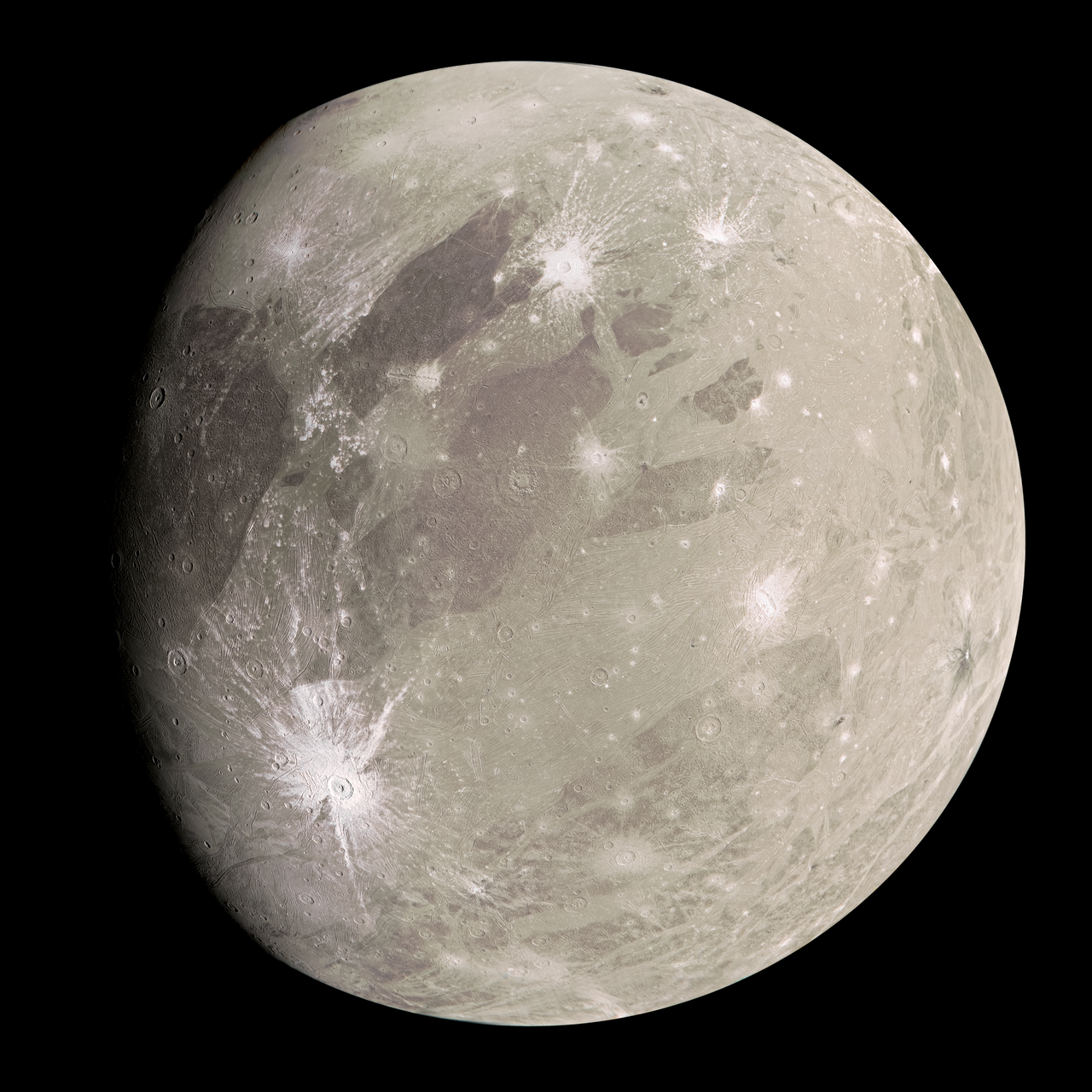
Ganymede is the largest and most massive natural moon of Jupiter, and at the same time, the largest moon in the solar system. It also stands out as it is the only moon in the solar system which has an internally generated magnetic field. This is likely created by a liquid iron or iron sulfide core.
With a diameter of over 5,000 kilometers, it exceeds Mercury in size. Although it has more than twice the mass of Earth's Moon, it hosts weaker surface gravity than Mercury, Io, and the Moon due to its lower mean density.
Ganymede's appearance is primarily composed of darker, heavily cratered regions, and brighter, less bombarded ones with deep grooves and ridges indicating geological activity. Whether this might be caused by tidal heating is still subject to further analysis. The brighter regions make up around two-thirds of Ganymede's surface.
The remaining area consists of dark regions, saturated with impact craters, which have been dated back to four billion years. It is assumed that the moon hosts a large saltwater ocean under its icy surface with extreme depths of up to 800 kilometers.
Ganymede likely has a very tenuous oxygen atmosphere, comparable to that found on the Jupiter moon Europa. It cannot be interpreted as a sign of life. Instead, it is thought that hydrogen and oxygen are split up by radiation on the moon's surface.
The first space probe to visit Ganymede was Pioneer 10, performing a high-speed flyby manoeuvre through the Jupiter system. Since then, it has been investigated by several other probes such as Galileo, New Horizons, and Juno. The Jupiter Icy Moons Explorer (JUICE) will be the first to actually enter orbit around Ganymede itself (in around 2034) to further study the moon's magnetic and icy surface. JUICE will impact Ganymede as the last act of its mission.
Faire défiler pour afficher les légendes dans d'autres langues
Crédits pour l'image : NASA/JPL-Caltech/SwRI/MSSS/Kevin M. Gill Lien du crédit
Termes du glossaire en rapport :
Lunes
, Satellites galiléens
Licence de l'image : Creative Commons (CC) Attribution 2.0 Générique Creative Commons (CC) Attribution 2.0 Générique Icônes
Les légendes des fichiers média présents sur le site de l'OAE ont été écrites, traduites et relues grâce à un effort collectif de l'OAE, les Centres et les Noeuds de l'OAE, les Coordinateurs Nationaux de l'Astronomie pour l'Education de l'OAE(NAECs) et d'autres volontaires. La liste complète des crédits pour ce projet est disponible ici . Toutes les légendes des fichiers média sont déposés sous licence Creative Commons CC BY-4.0 et doivent être créditées au nom de "IAU OAE". Les fichiers média eux-mêmes peuvent avoir des licences différentes (voir plus haut) et et doivent être crédités comme indiqué ci-dessus sous le terme "credit".
Si vous constatez une erreur dans cette légende ou dans un de ses traductions, veuillez nous contacter veuillez nous contacter.
Légendes proposées dans différentes langues :
Légende d'image : Ganymed ist der größte und massereichste natürliche Mond des Jupiter und zugleich der größte Mond im Sonnensystem. Er ist dazu der einzige Mond im Sonnensystem, der über ein intrinsisch erzeugtes Magnetfeld verfügt. Dieses entsteht vermutlich durch einen Kern aus flüssigem Eisen oder Eisensulfid.
Mit einem Durchmesser von über 5.000 Kilometern übertrifft er den Merkur an Größe. Obwohl er mehr als doppelt so massereich ist wie der Erdmond, weist er jedoch aufgrund seiner geringeren mittleren Dichte eine schwächere Oberflächengravitation auf als Merkur, Io und der Erdmond.
Das Erscheinungsbild von Ganymed wird hauptsächlich geprägt durch dunkle, stark verkraterte Regionen und hellere, weniger stark durch Einschläge gezeichnete Bereiche mit tiefen Rillen und Graten, die auf geologische Aktivität hindeuten. Ob dies möglicherweise durch Gezeitenerwärmung verursacht wird, muss noch weiter untersucht werden. Die helleren Regionen machen etwa zwei Drittel der Oberfläche von Ganymed aus.
Der verbleibende Bereich besteht aus dunklen, mit Einschlagskratern übersäten Regionen, deren Alter auf vier Milliarden Jahre datiert wurde. Es wird angenommen, dass der Mond unter seiner eisigen Oberfläche einen großen Salzwasser-Ozean mit extremen Tiefen von bis zu 800 Kilometern beherbergt.
Ganymed verfügt wahrscheinlich über eine sehr dünne Sauerstoffatmosphäre, vergleichbar mit der des Jupitermonds Europa. Diese Atmosphäre kann jedoch nicht als Hinweis auf Leben interpretiert werden. Stattdessen wird angenommen, dass Wasserstoff und Sauerstoff auf der Mondoberfläche durch Strahlung aufgespalten werden.
Die erste Raumsonde, die Ganymed besuchte, war Pioneer 10, die ein Hochgeschwindigkeits-Vorbeiflugmanöver durch das Jupitersystem vollführte. Seitdem wurde er von mehreren anderen Sonden wie Galileo, New Horizons und Juno untersucht. Der Jupiter Icy Moons Explorer (JUICE) wird als erste Sonde tatsächlich in die Umlaufbahn um Ganymed selbst eintreten (etwa im Jahr 2034) und in späteren Phasen auf dem Mond einschlagen, um die Zusammensetzung seiner Oberfläche genauer zu untersuchen.
Crédits pour l'image : NASA/JPL-Caltech/SwRI/MSSS/Kevin M. Gill
Termes du glossaire en rapport : Galileische Satelliten , Monde Statuts de la traduction de la légende: Pas encore approuvé par un·e relecteur(rice)
Traducteurs de la légende: Simon Kraus
Légende d'image : Ganymede is the largest and most massive natural moon of Jupiter, and at the same time, the largest moon in the solar system. It also stands out as it is the only moon in the solar system which has an internally generated magnetic field. This is likely created by a liquid iron or iron sulfide core.
With a diameter of over 5,000 kilometers, it exceeds Mercury in size. Although it has more than twice the mass of Earth's Moon, it hosts weaker surface gravity than Mercury, Io, and the Moon due to its lower mean density.
Ganymede's appearance is primarily composed of darker, heavily cratered regions, and brighter, less bombarded ones with deep grooves and ridges indicating geological activity. Whether this might be caused by tidal heating is still subject to further analysis. The brighter regions make up around two-thirds of Ganymede's surface.
The remaining area consists of dark regions, saturated with impact craters, which have been dated back to four billion years. It is assumed that the moon hosts a large saltwater ocean under its icy surface with extreme depths of up to 800 kilometers.
Ganymede likely has a very tenuous oxygen atmosphere, comparable to that found on the Jupiter moon Europa. It cannot be interpreted as a sign of life. Instead, it is thought that hydrogen and oxygen are split up by radiation on the moon's surface.
The first space probe to visit Ganymede was Pioneer 10, performing a high-speed flyby manoeuvre through the Jupiter system. Since then, it has been investigated by several other probes such as Galileo, New Horizons, and Juno. The Jupiter Icy Moons Explorer (JUICE) will be the first to actually enter orbit around Ganymede itself (in around 2034) to further study the moon's magnetic and icy surface. JUICE will impact Ganymede as the last act of its mission.
Crédits pour l'image : NASA/JPL-Caltech/SwRI/MSSS/Kevin M. Gill
Termes du glossaire en rapport : Galilean Satellites , Moons
Légende d'image : Ganimede è il satellite naturale più grande e più massiccio di Giove e, al contempo, il satellite più grande del sistema solare. Si distingue inoltre per essere l’unico satellite del sistema solare dotato di un campo magnetico generato internamente, probabilmente dovuto alla presenza di un nucleo di ferro liquido o di solfuro di ferro.
Con un diametro di oltre 5.000 chilometri, supera Mercurio in termini di dimensioni. Sebbene abbia una massa più che doppia rispetto a quella della Luna terrestre, presenta una gravità superficiale inferiore a quella di Mercurio, Io e della Luna a causa della sua minore densità media.
L’aspetto di Ganimede è caratterizzato principalmente da regioni più scure e ricche di crateri, e da aree più luminose e meno bombardate, con profondi solchi e creste che indicano un’attività geologica. Se ciò sia causato dal riscaldamento mareale è ancora oggetto di ulteriori analisi. Le regioni più luminose costituiscono circa i due terzi della superficie di Ganimede.
L’area restante è costituita da regioni scure, ricche di crateri da impatto, la cui datazione risale a quattro miliardi di anni fa. Si ipotizza che il satellite ospiti un vasto oceano di acqua salata sotto la sua superficie ghiacciata, con profondità estreme che raggiungono gli 800 chilometri.
Ganimede possiede probabilmente un’atmosfera di ossigeno molto rarefatta, paragonabile a quella riscontrata su Europa, una luna di Giove. Ciò non può essere interpretato come un segno di vita. Si ritiene invece che l’idrogeno e l’ossigeno vengano scissi dalle radiazioni sulla superficie della luna.
La prima sonda spaziale a visitare Ganimede fu la Pioneer 10, che effettuò una manovra di sorvolo ad alta velocità attraverso il sistema di Giove. Da allora, è stato studiato da diverse altre sonde, quali Galileo, New Horizons e Juno. La sonda Jupiter Icy Moons Explorer (JUICE) sarà la prima ad entrare effettivamente in orbita attorno a Ganimede (intorno al 2034) e a impattare con esso nelle fasi successive per studiare in modo più approfondito la composizione della superficie del satellite. JUICE impatterà su Ganimede come ultimo atto della sua missione.
Crédits pour l'image : NASA/JPL-Caltech/SwRI/MSSS/Kevin M. Gill
Termes du glossaire en rapport : Lune , Satelliti galileiani Statuts de la traduction de la légende: Pas encore approuvé par un·e relecteur(rice)
Traducteurs de la légende: Giuliana Giobbi
Légende d'image : Ganimedes é a maior e mais massiva lua natural de Júpiter e, ao mesmo tempo, a maior lua do sistema solar. Ela também se destaca por ser a única lua do sistema solar que possui um campo magnético gerado internamente. Esse campo é provavelmente produzido por um núcleo líquido de ferro ou de sulfeto de ferro.
Com um diâmetro de mais de 5.000 quilômetros, ela supera Mercúrio em tamanho. Embora tenha mais do que o dobro da massa da Lua da Terra, sua gravidade superficial é mais fraca do que a de Mercúrio, Io e da Lua, devido à sua menor densidade média.
A aparência de Ganimedes é composta principalmente por regiões mais escuras e densamente craterizadas, e por regiões mais claras e menos impactadas, com sulcos profundos e cristas que indicam atividade geológica. Se isso pode ter sido causado pelo aquecimento de maré ainda está sujeito a análises mais aprofundadas. As regiões mais claras compõem cerca de dois terços da superfície de Ganimedes.
A área restante consiste em regiões escuras, repletas de crateras de impacto, cuja idade foi estimada em quatro bilhões de anos. Presume-se que a lua abrigue um grande oceano de água salgada sob sua superfície gelada, com profundidades extremas de até 800 quilômetros.
Ganimedes provavelmente possui uma atmosfera de oxigênio muito tênue, comparável à encontrada na lua de Júpiter, Europa. Isso não pode ser interpretado como um sinal de vida. Em vez disso, acredita-se que o hidrogênio e o oxigênio sejam dissociados pela radiação na superfície da lua.
A primeira sonda espacial a visitar Ganimedes foi a Pioneer 10, que realizou uma manobra de sobrevoo em alta velocidade pelo sistema de Júpiter. Desde então, ela foi estudada por várias outras sondas, como a Galileo, a New Horizons e a Juno. A Jupiter Icy Moons Explorer (JUICE) será a primeira a entrar efetivamente em órbita ao redor de Ganimedes (por volta de 2034) para estudar mais a fundo o campo magnético e a superfície gelada da lua. A JUICE colidirá com Ganimedes como ato final de sua missão.
Crédits pour l'image : NASA/JPL-Caltech/SwRI/MSSS/Kevin M. Gill
Termes du glossaire en rapport : Luas , Satélites Galileanos Statuts de la traduction de la légende: Pas encore approuvé par un·e relecteur(rice)
Traducteurs de la légende: Eduardo Monfardini Penteado









- Ressources
- Moteur de recherche des ressources pédagogiques
- Parcourir les ressources pédagogiques par Sujet
- Parcourir les images
- AstroEdu - Activités en classe
- Grandes Idées - Littéracie en astronomie
- Glossaire
- Rapports de l'OAE
- L'astronomie pour l'Education à travers le monde
- Sélection de ressources externes