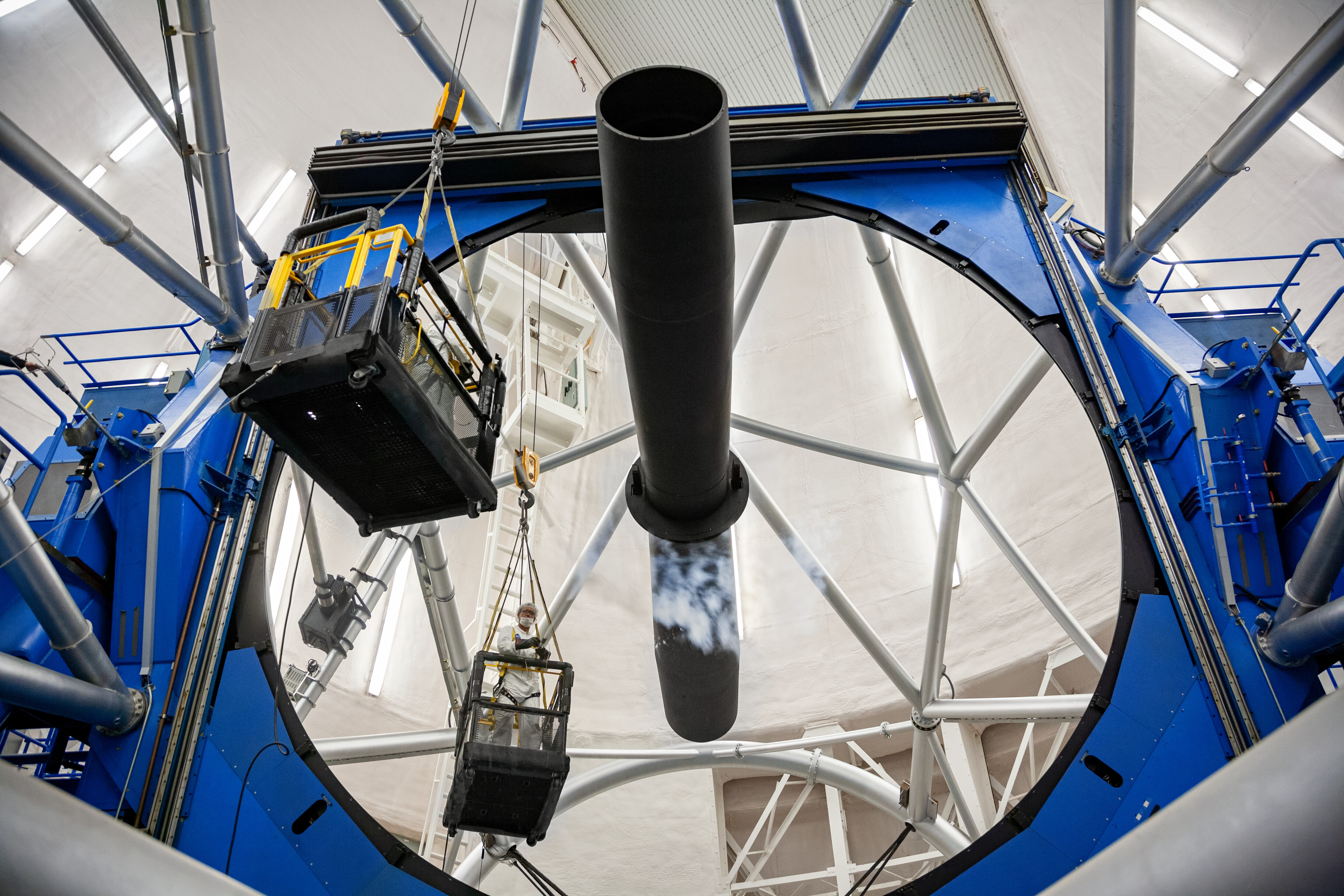
This page describes an image Gemini South's primary mirror and telescope structure
Télécharger le fichier ( image 23.24 MB)
Légende d'image :
This is the primary mirror and supporting structure of a large optical telescope at the Gemini South Observatory in Chile. The primary mirror is the largest and most important mirror in a reflecting telescope: its gently curved surface gathers light from faint stars, galaxies, and nebulae and reflects that light to a focal point. At this focal point light is either fed directly in to an instrument to record spectra and images or redirected to such an instrument by a series of further mirrors. The sturdy metal framework around the primary mirros keeps the mirror precisely aligned and protected while the telescope moves to track objects across the sky.
In telescopes that use mirrors instead of lenses, such as this one, the mirror is what collects and focuses the light from distant celestial objects. Larger mirrors can capture more light, allowing astronomers to see fainter and more distant objects. A larger primary mirror can also take sharper images of the sky, but this is often negated by the blurring effect of the Earth's atmopshere. A primary mirror must be perfectly smooth to tolerances of fractions of a wavelength of light so that it produces sharp, clear images. We can think of the primary mirror as the “eye” of the telescope that looks out into space, with its shape and support enabling powerful astronomical observations.
Faire défiler pour afficher les légendes dans d'autres langues
Crédits pour l'image : International Gemini Observatory/NOIRLab/NSF/AURA/M. Paredes Lien du crédit
Termes du glossaire en rapport :
Miroir
, Télescope à réflexion
Catégories :
Astronomie observationnelle
, Télescopes, instruments et observatoires
Licence de l'image : Creative Commons (CC) Attribution 4.0 International (CC BY 4.0) Creative Commons (CC) Attribution 4.0 International (CC BY 4.0) Icônes
Les légendes des fichiers média présents sur le site de l'OAE ont été écrites, traduites et relues grâce à un effort collectif de l'OAE, les Centres et les Noeuds de l'OAE, les Coordinateurs Nationaux de l'Astronomie pour l'Education de l'OAE(NAECs) et d'autres volontaires. La liste complète des crédits pour ce projet est disponible ici . Toutes les légendes des fichiers média sont déposés sous licence Creative Commons CC BY-4.0 et doivent être créditées au nom de "IAU OAE". Les fichiers média eux-mêmes peuvent avoir des licences différentes (voir plus haut) et et doivent être crédités comme indiqué ci-dessus sous le terme "credit".
Si vous constatez une erreur dans cette légende ou dans un de ses traductions, veuillez nous contacter veuillez nous contacter.
Légendes proposées dans différentes langues :
Légende d'image : Dies ist der Hauptspiegel und die Tragkonstruktion eines großen optischen Teleskops am Gemini-South-Observatorium in Chile. Der Hauptspiegel ist der größte und wichtigste Spiegel in einem Spiegelteleskop: Seine sanft gewölbte Oberfläche sammelt das Licht von schwachen Sternen, Galaxien und Nebeln und reflektiert es zu einem Brennpunkt. An diesem Brennpunkt wird das Licht entweder direkt in ein Instrument geleitet, um Spektren und Bilder aufzuzeichnen, oder über eine Reihe weiterer Spiegel zu einem solchen Instrument umgelenkt. Das stabile Metallgerüst um den Hauptspiegel sorgt dafür, dass der Spiegel präzise ausgerichtet und geschützt bleibt, während sich das Teleskop bewegt, um Objekte am Himmel zu verfolgen.
In Teleskopen, die Spiegel anstelle von Linsen verwenden, wie dieses hier, ist es der Spiegel, der das Licht von entfernten Himmelsobjekten sammelt und bündelt. Größere Spiegel können mehr Licht einfangen, wodurch Astronomen schwächere und weiter entfernte Objekte beobachten können. Ein größerer Hauptspiegel kann zudem schärfere Bilder des Himmels liefern, was jedoch oft durch die Unschärfe zunichte gemacht wird, die durch die Erdatmosphäre verursacht wird. Ein Hauptspiegel muss bis auf Bruchteile einer Lichtwellenlänge perfekt glatt sein, damit er scharfe, klare Bilder erzeugt. Man kann sich den Hauptspiegel als das „Auge“ des Teleskops vorstellen, das in den Weltraum blickt, wobei seine Form und seine Halterung leistungsstarke astronomische Beobachtungen ermöglichen.
Crédits pour l'image : Internationales Gemini-Observatorium/NOIRLab/NSF/AURA/M. Paredes
Termes du glossaire en rapport : Spiegel , Spiegelteleskop Statuts de la traduction de la légende: Pas encore approuvé par un·e relecteur(rice)
Traducteurs de la légende: Simon Kraus
Légende d'image : This is the primary mirror and supporting structure of a large optical telescope at the Gemini South Observatory in Chile. The primary mirror is the largest and most important mirror in a reflecting telescope: its gently curved surface gathers light from faint stars, galaxies, and nebulae and reflects that light to a focal point. At this focal point light is either fed directly in to an instrument to record spectra and images or redirected to such an instrument by a series of further mirrors. The sturdy metal framework around the primary mirros keeps the mirror precisely aligned and protected while the telescope moves to track objects across the sky.
In telescopes that use mirrors instead of lenses, such as this one, the mirror is what collects and focuses the light from distant celestial objects. Larger mirrors can capture more light, allowing astronomers to see fainter and more distant objects. A larger primary mirror can also take sharper images of the sky, but this is often negated by the blurring effect of the Earth's atmopshere. A primary mirror must be perfectly smooth to tolerances of fractions of a wavelength of light so that it produces sharp, clear images. We can think of the primary mirror as the “eye” of the telescope that looks out into space, with its shape and support enabling powerful astronomical observations.
Crédits pour l'image : International Gemini Observatory/NOIRLab/NSF/AURA/M. Paredes
Termes du glossaire en rapport : Mirror , Reflecting Telescope
Légende d'image : Si tratta dello specchio primario e della struttura portante di un grande telescopio ottico presso l’Osservatorio Gemini Sud in Cile. Lo specchio primario è lo specchio più grande e importante di un telescopio riflettente: la sua superficie leggermente curva raccoglie la luce proveniente da stelle, galassie e nebulose poco luminose e la riflette verso un punto focale. In questo punto focale la luce viene convogliata direttamente verso uno strumento per registrare spettri e immagini ,oppure reindirizzata verso tale strumento tramite una serie di ulteriori specchi. La robusta struttura metallica che circonda lo specchio primario mantiene lo specchio perfettamente allineato e protetto mentre il telescopio si muove per seguire gli oggetti nel cielo.
Nei telescopi che utilizzano specchi anziché lenti, come questo, è lo specchio a raccogliere e mettere a fuoco la luce proveniente da oggetti celesti lontani. Gli specchi più grandi possono catturare più luce, consentendo agli astronomi di osservare oggetti più deboli e più distanti. Uno specchio primario più grande può anche fornire immagini più nitide del cielo, ma questo vantaggio è spesso vanificato dall’effetto di sfocatura causato dall’atmosfera terrestre. Uno specchio primario deve essere perfettamente liscio, con tolleranze dell’ordine di frazioni di una lunghezza d’onda della luce, in modo da produrre immagini nitide e chiare. Possiamo pensare allo specchio primario come all’«occhio» del telescopio che guarda verso lo spazio, la cui forma e il cui supporto consentono potenti osservazioni astronomiche.
Crédits pour l'image : Osservatorio Internazionale Gemini/NOIRLab/NSF/AURA/M. Paredes
Termes du glossaire en rapport : Specchio , Telescopio a riflessione Statuts de la traduction de la légende: Pas encore approuvé par un·e relecteur(rice)
Traducteurs de la légende: Giuliana Giobbi
Ceci pourrait vous intéresser également






.jpg)

- Ressources
- Moteur de recherche des ressources pédagogiques
- Parcourir les ressources pédagogiques par Sujet
- Parcourir les images
- AstroEdu - Activités en classe
- Grandes Idées - Littéracie en astronomie
- Glossaire
- Rapports de l'OAE
- L'astronomie pour l'Education à travers le monde
- Sélection de ressources externes