Termo do glossário: Observatório
Descrição: Um observatório é um local ou edifício dedicado a observações astronômicas. As observações ópticas e infravermelhas são geralmente realizadas com telescópios colocados em cúpulas para protegê-los durante condições climáticas adversas. Os radiotelescópios e alguns telescópios submilimétricos são frequentemente instalados ao ar livre. Observatórios astronômicos modernos em solo, voltados para observações ópticas, no infravermelho ou submilimétricos, são instalados no topo de montanhas, acima da maior parte possível da atmosfera terrestre. Estes observatórios dispõem de instrumentos especializados, tais como telescópios, câmaras e espectrógrafos. Uma localização elevada é menos necessária para os observatórios astronômicos de rádio e de raios cósmicos. Outras partes do espectro eletromagnético (radiação gama, raios X, radiação ultravioleta e radiação infravermelha de comprimento de onda mais longo) podem ser estudadas com telescópios espaciais específicos, que às vezes também são chamados de observatórios. Observações feitas por radiotelescópios em diferentes locais podem ser combinadas entre si. Esses vários locais são frequentemente referidos coletivamente como um único observatório.
Termos relacionados:
- Raio Cósmico
- Radiação eletromagnética
- Raio gama
- Infravermelho (IV)
- Radiação de micro-ondas
- Ondas de rádio
- Telescópio
- Ultravioleta
- Espectro visível
- Astronomia de Raios Cósmicos
- Astronomia submilimétrica
Ver este termo em outros idiomas
Status do termo e da definição: A definição original deste termo em inglês foi aprovada por um astrônomo(a) pesquisador(a) e um(a) professor(a) A tradução deste termo e de sua definição ainda aguarda aprovação
O Glossário Multilíngue da OAE é um projeto do Escritório da IAU de Astronomia para a Educação (OAE) em colaboração com o Escritório da IAU para Divulgação da Astronomia (OAO). Os termos e definições foram selecionados, escritos e revisados por meio de um esforço coletivo da OAE, dos Centros e Nós da OAE, dos Coordenadores Nacionais de Educação em Astronomia (NAECs) da OAE e de outros voluntários. Você pode encontrar uma lista completa dos créditos aqui. Todos os termos do glossário e suas definições são disponibilizados sob uma licença Creative Commons CC BY-4.0 e devem ser creditados à "IAU OAE".
Se você notar algum erro factual ou de tradução neste termo do glossário ou em sua definição, por favor entre em contato.
Em outros idiomas
- Árabe: المرصد
- Alemão: Observatorium
- Inglês: Observatory
- Espanhol: Observatorio
- Francês: Observatoire
- Italiano: Osservatorio
- Chinês Simplificado: 天文台
- Chinês Tradicional: 天文臺
Mídia relacionada
Chilean observatories at home office, by Robert Barsa, Slovakia
Legenda: Third place in the 2021 IAU OAE Astrophotography Contest, category Wide star fields.
This rich panoramic image shows a range of constellations, deep sky objects and planets. The brightest point of light with a pale reddish hue (left of center) is the planet Mars. In the bottom far left of the image, located just above the sloped roof of the building are two points of light appearing very close to each other, these are the planets Jupiter (brighter) and Saturn. To the far right of the image the two fuzzy cloud-like objects are the Large and Small Magellanic Clouds. These are satellite dwarf galaxies of the Milky Way located at a distance of approximately 160,000 and 200,000 light years, respectively. The Andromeda Galaxy, which is located at an approximate distance of 2.5 million light years, appears in this image as a small, angled smudge between Mars and the brightest glow on the horizon (closer to the horizon). The bright glow is not from the Sun or the Moon, but the city lights of San Pedro de Atacama.
Prominent constellations include: Orion – identified by the three stars forming Orion’s Belt; Taurus – a small triangle shaped collection of stars to the left of Orion and identified by the pale orange star (Aldebaran) at the vertex of the triangle; Canis Major – to the bottom right of Orion, identified by the bright star Sirius (the brightest star in the night sky) and three stars in the shape of a triangle just above the observatory dome in the foreground; Pegasus – identified by the trapezium shape diagonally below Mars. Other constellations include Andromeda, Perseus and Aries. Diverse cultures around the world have their own names and rich stories associated with these constellations and many others.
To the top right of Orion’s Belt is an angled line of stars (Orion’s Sword) within which is a pinkish smudge (looks like a fuzzy star when observed with the unaided eye) that is the Orion Nebula – a stellar nursery located 1500 light years from Earth – where stars are formed. To the left of Taurus is a compact fuzzy smudge, and that is the Pleiades star cluster. The variation in the colour of stars is the result of temperature of the stars, for example, the red orange star to the bottom left of Orion’s Belt is the red giant star Betelgeuse. Cooler stars appear redder, compared to the higher temperature white and bluish stars. The colours in the image are enhanced because of the higher sensitivity of the digital camera compared to the human eye.
Crédito: Robert Barsa/IAU OAE
License: CC-BY-4.0 Creative Commons Attribution 4.0 International (CC BY 4.0) ícones
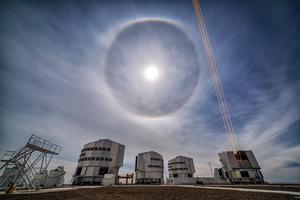
O Very Large Telescope (VLT) da ESO no Observatório Paranal com um halo lunar
Legenda: O Very Large Telescope, localizado no Cerro Paranal, no Chile, possui quatro telescópios refletores, cada um com um espelho primário de 8,2 m de diâmetro. Nesta imagem, uma das cúpulas está aberta e disparando feixes de laser para o céu. Esses lasers criam estrelas artificiais no céu que podem ser usadas para ajustar a óptica do telescópio e remover o efeito de borramento causado pela atmosfera terrestre. Esse processo é conhecido como óptica adaptativa.
No céu, a Lua está rodeada por um halo brilhante. Isso é causado pela luz da Lua refletindo dentro de cristais de gelo na atmosfera terrestre.
Crédito: Juan Carlos Muñoz-Mateos/ESO
link do crédito
License: CC-BY-4.0 Creative Commons Attribution 4.0 International (CC BY 4.0) ícones
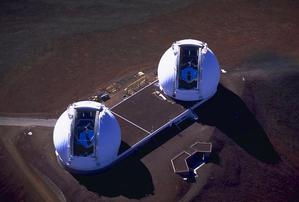
Telescópios Keck
Legenda: Os dois telescópios Keck em Mauna Kea, na ilha do Havaí. Esses dois telescópios são refletores com espelhos primários de 10 m de diâmetro.
Crédito: NASA/JPL
link do crédito
License: PD Domínio Público ícones

Telescópio Espacial Hubble sobre a Terra
Legenda: O Telescópio Espacial Hubble, da NASA/ESA, em órbita da Terra. Essa foto foi tirada pelos astronautas a bordo do ônibus espacial Columbia, logo após a Missão de Manutenção 3B do próprio telescópio espacial. O telescópio tem uma abertura que permite a entrada de luz (vista aqui à esquerda). A luz percorre a óptica do telescópio até chegar às câmeras e espectrógrafos localizados na outra extremidade do telescópio (visto aqui à direita). Os dados desses instrumentos são então enviados de volta à Terra por meio de uma antena. Os retângulos pretos em cada lado do observatório são os painéis solares que fornecem energia ao telescópio
Crédito: NASA/ESA
link do crédito
License: CC-BY-4.0 Creative Commons Attribution 4.0 International (CC BY 4.0) ícones
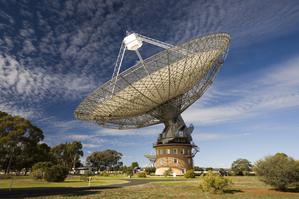
Radiotelescópio Parkes
Legenda: O radiotelescópio de 64 metros do Observatório Parkes (Nova Gales do Sul, Austrália) está em pleno funcionamento desde 1963 e vem sendo continuamente atualizado desde então. Também chamado de “The Dish” (A Antena), é operado pela Commonwealth Scientific and Industrial Research Organisation (CSIRO). O telescópio pode ser apontado para uma parte do céu. As ondas de rádio dessa parte do céu são então refletidas e focadas pela antena gigante em um receptor no ponto focal. Os dados desse receptor podem então ser analisados pelos astrônomos.
Crédito: David McClenaghan/CSIRO
link do crédito
License: CC-BY-3.0 Creative Commons Attribution 3.0 Unported ícones