Termo do glossário: Halo
Descrição: Um halo é um fenômeno óptico causado por cristais de gelo na atmosfera terrestre. Assim como a refração e a reflexão da luz em gotas de água causam arco-íris, a luz solar que atravessa cristais de gelo é refletida e refratada dentro deles, formando halos. Os halos podem assumir muitas formas diferentes e podem ser produzidos tanto pela luz do Sol como pela da Lua. O halo de 22 graus é um halo circular que se forma como um fino anel de luz ao redor do Sol ou da Lua. A geometria desse halo é o resultado das propriedades dos cristais de gelo pelos quais a luz solar ou lunar passa na atmosfera. A palavra halo também é usada em outros contextos astronômicos, incluindo: halo galáctico, halo de matéria escura e halo estelar, todos componentes importantes da estrutura das galáxias.
Termos relacionados:
Ver este termo em outros idiomas
Status do termo e da definição: A definição original deste termo em inglês foi aprovada por um astrônomo(a) pesquisador(a) e um(a) professor(a) A tradução deste termo e de sua definição ainda aguarda aprovação
O Glossário Multilíngue da OAE é um projeto do Escritório da IAU de Astronomia para a Educação (OAE) em colaboração com o Escritório da IAU para Divulgação da Astronomia (OAO). Os termos e definições foram selecionados, escritos e revisados por meio de um esforço coletivo da OAE, dos Centros e Nós da OAE, dos Coordenadores Nacionais de Educação em Astronomia (NAECs) da OAE e de outros voluntários. Você pode encontrar uma lista completa dos créditos aqui. Todos os termos do glossário e suas definições são disponibilizados sob uma licença Creative Commons CC BY-4.0 e devem ser creditados à "IAU OAE".
Se você notar algum erro factual ou de tradução neste termo do glossário ou em sua definição, por favor entre em contato.
Mídia relacionada
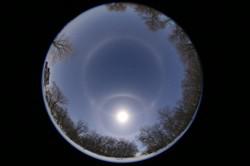
Selene meets the Moon, by Sheila Wiwchar, Canada
Legenda: First place in the 2021 IAU OAE Astrophotography Contest, category Sun/Moon haloes.
Photographed at Kaleida, Manitoba in Canada, this fisheye image beautifully captures the rare optical phenomena encircling the moon known as the “22° halo” and the horizontal white circle passing through the moon called the “paraselenic circle”. The white band circling the whole sky at the same altitude as the moon is named after Selene, the ancient Greek Titan, famously called the goddess of the moon. The more commonly observed counterpart produced by the sun is known as the parhelic circle, named after the Greek god of the sun, Helios. Both the 22° halo and the paraselenic circle are produced due to reflection of the moonlight from near vertical surfaces of ice crystals. Parts closer to the moon are caused due to external reflections, whereas those further away are created due to internal reflections. The constellation of the big dipper at the center makes this image even more spectacular. Can you spot it?
Crédito: Sheila Wiwchar/IAU OAE
License: CC-BY-4.0 Creative Commons Attribution 4.0 International (CC BY 4.0) ícones
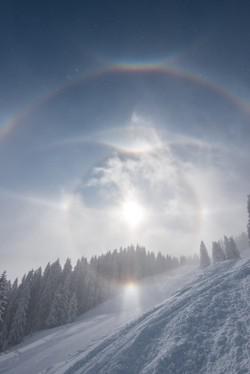
Winter Haloes, by Thomas Gigl, Germany
Legenda: Second place in the 2021 IAU OAE Astrophotography Contest, category Sun/Moon haloes.
Captured in Jochberg located in the famous Austrian ski-region of Tirol, this image shows multiple features related to ice halos, which are a more common appearance around the sun, due to its brightness, than the moon. External and internal reflection of sun rays from ice crystal faces and within different types of ice crystals lead to these halo related phenomena. The 22° halo encircles the sun, with two bright spots at the edge called Sundogs, Parhelia or Mock Suns observed to the left and right at the same height as the sun. The horizontal white band called the parhelic circle, named after the sun god Helios, passes through the sun and the Sundogs at the same angular elevation. An Upper tangent arc, a suncave parry arc and a lower tangent arc are also seen touching the top and bottom of the 22° halo. An upside down rainbow like arc or the circumzenithal arc is seen touching the bright supralateral arc, both of which are less frequently observed.
Crédito: Thomas Gigl/IAU OAE
License: CC-BY-4.0 Creative Commons Attribution 4.0 International (CC BY 4.0) ícones
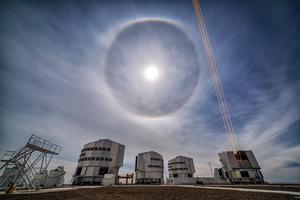
O Very Large Telescope (VLT) da ESO no Observatório Paranal com um halo lunar
Legenda: O Very Large Telescope, localizado no Cerro Paranal, no Chile, possui quatro telescópios refletores, cada um com um espelho primário de 8,2 m de diâmetro. Nesta imagem, uma das cúpulas está aberta e disparando feixes de laser para o céu. Esses lasers criam estrelas artificiais no céu que podem ser usadas para ajustar a óptica do telescópio e remover o efeito de borramento causado pela atmosfera terrestre. Esse processo é conhecido como óptica adaptativa.
No céu, a Lua está rodeada por um halo brilhante. Isso é causado pela luz da Lua refletindo dentro de cristais de gelo na atmosfera terrestre.
Crédito: Juan Carlos Muñoz-Mateos/ESO
link do crédito
License: CC-BY-4.0 Creative Commons Attribution 4.0 International (CC BY 4.0) ícones
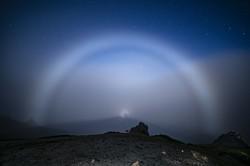
Lunar rainbow and lunar Brocken spectre, by Kouji Ohnishi, Japan
Legenda: Third place in the 2021 IAU OAE Astrophotography Contest, category Sun/Moon haloes.
This stunning photograph of the lunar rainbow and the lunar Brocken Spectre amidst the night sky was captured from Mount Tsubakuro located in Japan’s Hida Mountains in Nagano. Both these atmospheric occurrences are due to the moon’s light being reflected and refracted from water droplets. A lunar rainbow or a moonbow is a rare phenomenon that occurs with the right settings of a bright full moon which is less than 42° high, rain on the opposite side of the moon and a dark night sky. The Brocken Spectre is named after the highest peak of the Harz mountain range in Germany, where it was first recorded. Here it is seen from the summit as a magnified shadow of the observer cast onto the cloud surrounded by a glory consisting of concentric circles centered at the point directly opposite the bright moon in the background.
Crédito: Kouji Ohnishi/IAU OAE
License: CC-BY-4.0 Creative Commons Attribution 4.0 International (CC BY 4.0) ícones