词条 反射式望远镜
描述: 在反射式望远镜(或称镜面望远镜)中,主要的光学元件是一面反射镜,即“主镜”,它的作用是收集入射光。反射式望远镜通常以主镜直径为特征参数,从较小的业余望远镜的10厘米到专业望远镜中使用的最大实体镜的 8 米不等。将多个反射镜组合在一起,可以获得更大的集光面积,其作用相当于较大的实体镜。反射式望远镜有多种类型。例如,在牛顿式望远镜中,来自主镜的光线被一个较小的平面镜侧向反射到目镜或照相机中。在卡塞格林式望远镜中,较小的凸面副镜通过主镜上的开口将光线反射回去。
相关词条
用其他语言查看该词条
词条和定义状态: 该术语的英文原始定义已通过天文研究人员和教师的审核 该术语及其定义的译文仍待审核
OAE多语言词汇表是由国际天文学联合会(IAU) 天文教育办公室(OAE) 和 国际天文学联合会(IAU) 天文推广办公室(OAO)合作的项目。. 术语和定义由 OAE中心, OAE 国家天文教育协调员(NAECs) 以及其他志愿者共同选择、撰写和审阅。您可以在 找到完整的致谢列表。所有词汇表术语及其定义均根据 Creative Commons CC BY-4.0许可证发布 且版权归属于 “IAU OAE”。
如果您发现此词汇术语或定义中的事实或翻译错误, 请向 发邮件 联系.
其他语言版本
- 阿拉伯语: تلسكوب عاكس
- 德语: Spiegelteleskop
- 英语: Reflecting Telescope
- 西班牙语: Telescopio reflector
- 法语: Télescope à réflexion
- 意大利语: Telescopio a riflessione
- 日语: 反射望遠鏡 (外部链接)
- 马拉地语: परावर्ती दूरदर्शी
- 巴西葡萄牙语: Telescópio Refletor
- 繁体中文: 反射式望遠鏡
相关媒体
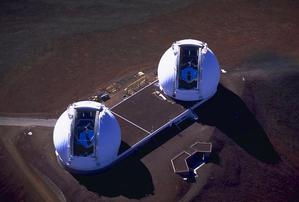
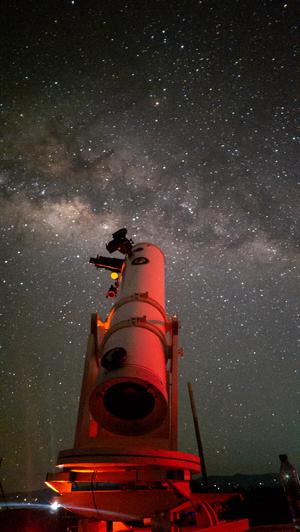
了解夜空
图注: 在哥伦比亚塔塔科阿沙漠广袤无垠的夜空下,一架天文望远镜对准了宏伟的银河核心,同时一部智能手机记录下了这次宇宙邂逅。这张照片拍摄于2023年6月9日的一次天文夏令营,象征着天体奇观的美丽与平易近人,它展示了夜空令人着迷的壮丽景色,吸引了普通的观星者和热情的天文学家。银河的壮丽通过移动设备优雅地捕捉下来,在精密设备与纯粹、深邃的观星乐趣之间架起了一座无缝的桥梁。
来源: Juan Pablo Botero Londoño/IAU OAE (CC BY 4.0)
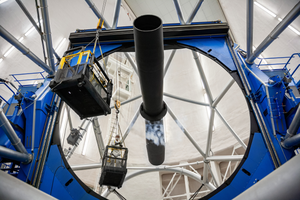
Gemini South's primary mirror and telescope structure
图注: This is the primary mirror and supporting structure of a large optical telescope at the Gemini South Observatory in Chile. The primary mirror is the largest and most important mirror in a reflecting telescope: its gently curved surface gathers light from faint stars, galaxies, and nebulae and reflects that light to a focal point. At this focal point light is either fed directly in to an instrument to record spectra and images or redirected to such an instrument by a series of further mirrors. The sturdy metal framework around the primary mirros keeps the mirror precisely aligned and protected while the telescope moves to track objects across the sky.
In telescopes that use mirrors instead of lenses, such as this one, the mirror is what collects and focuses the light from distant celestial objects. Larger mirrors can capture more light, allowing astronomers to see fainter and more distant objects. A larger primary mirror can also take sharper images of the sky, but this is often negated by the blurring effect of the Earth's atmopshere. A primary mirror must be perfectly smooth to tolerances of fractions of a wavelength of light so that it produces sharp, clear images. We can think of the primary mirror as the “eye” of the telescope that looks out into space, with its shape and support enabling powerful astronomical observations.
来源: International Gemini Observatory/NOIRLab/NSF/AURA/M. Paredes
来源链接
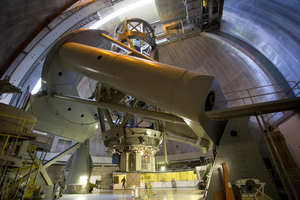
The Hale Telescope
图注: This image shows the Hale Telescope at the Palomar Observatory in northern San Diego County, California, USA and operated by the California Institute of Technology (Caltech). With its 5.1 m primary mirror, the Hale Telescope was the largest effective optical telescope in the world from its first light in 1949 until 1993.
Here we see the Hale Telescope when not in operation. The telescope itself is the large, vertical, approximately cylindrical object in the centre of the image. Telescopes like this use mirrors to gather faint light and form clear images of distant targets, enabling scientists to study everything from nearby stars and planets to remote galaxies. The primary mirror, seen here at the bottom of the telescope, focusses light from the sky to the prime focus at the top of the telescope. Instruments such as cameras and spectrographs can be placed at this prime focus or alternatively a secondary mirror can reflect light back down the telescope and through a hole in the primary mirror to instruments.
The telescope is supported by a large mount, seen here at an angle to the telescope. This particular mount is a type of equatorial mount. This means that one of the rotation axes of the mount points to the celestial poles. When a star or galaxy moves across the sky due to the Earth's rotation, the telescope only has rotate on this axis to keep pointing at that star or galaxy. Most modern large telescopes use a different kind of mount and rely on computer calculations to accurately track an object across the sky.
The Hale Telescope is housed under a large rotating dome that opens at night so the telescope can track objects across the sky.
来源: JPL/Caltech/Palomar Observatory
来源链接
License: PD 公共领域 图标








.jpg)