词条 反射镜
描述: 反射镜是一种从其表面反射光线的光学设备。凸面镜能使光束发散,而凹面镜则能使光束会聚。凹面镜可以经过塑形,从而使平行光束聚焦到一点。大多数现代望远镜都使用大型凹面镜作为主要集光区。
天文望远镜中使用的大多数反射镜的主体都是由玻璃制成的。镜体有时使用的其他材料包括陶瓷和金属。镜体需要经过研磨(或塑形)并抛光,如果材料本身不具有反射性,则会在表面涂上一层薄薄的金属涂层。铝是最常见的涂层材料,而金或银也是可选择的涂层材料。
对于直径超过6米的望远镜来说,铸造并支撑如此巨大的玻璃反射镜非常困难。因此,如今世界上最大的一些望远镜使用了许多较小的反射镜,这些反射镜排列在一起,就像一面巨大的反射镜一样聚焦光线。
相关词条
用其他语言查看该词条
词条和定义状态: 该术语的英文原始定义已通过天文研究人员和教师的审核 该术语及其定义的译文仍待审核
OAE多语言词汇表是由国际天文学联合会(IAU) 天文教育办公室(OAE) 和 国际天文学联合会(IAU) 天文推广办公室(OAO)合作的项目。. 术语和定义由 OAE中心, OAE 国家天文教育协调员(NAECs) 以及其他志愿者共同选择、撰写和审阅。您可以在 找到完整的致谢列表。所有词汇表术语及其定义均根据 Creative Commons CC BY-4.0许可证发布 且版权归属于 “IAU OAE”。
如果您发现此词汇术语或定义中的事实或翻译错误, 请向 发邮件 联系.
相关媒体
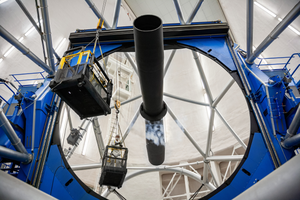
Gemini South's primary mirror and telescope structure
图注: This is the primary mirror and supporting structure of a large optical telescope at the Gemini South Observatory in Chile. The primary mirror is the largest and most important mirror in a reflecting telescope: its gently curved surface gathers light from faint stars, galaxies, and nebulae and reflects that light to a focal point. At this focal point light is either fed directly in to an instrument to record spectra and images or redirected to such an instrument by a series of further mirrors. The sturdy metal framework around the primary mirros keeps the mirror precisely aligned and protected while the telescope moves to track objects across the sky.
In telescopes that use mirrors instead of lenses, such as this one, the mirror is what collects and focuses the light from distant celestial objects. Larger mirrors can capture more light, allowing astronomers to see fainter and more distant objects. A larger primary mirror can also take sharper images of the sky, but this is often negated by the blurring effect of the Earth's atmopshere. A primary mirror must be perfectly smooth to tolerances of fractions of a wavelength of light so that it produces sharp, clear images. We can think of the primary mirror as the “eye” of the telescope that looks out into space, with its shape and support enabling powerful astronomical observations.
来源: International Gemini Observatory/NOIRLab/NSF/AURA/M. Paredes
来源链接







.jpg)