词条 恒星形成
描述: 恒星的诞生源于巨型分子云中被称为核心的低温致密区域的引力坍缩,这些区域大多位于星系的旋臂中。恒星的形成涉及复杂的物理过程,发生在不同的尺度上,由引力、压力、辐射、磁场、湍流、化学等作用造成,其中有些作用至今仍不甚明了。根据母云的质量和形成阶段的吸积过程,恒星的质量从 0.08 到几百个太阳质量不等。大多数恒星都不是孤立形成的,而是恒星群的一部分。在形成阶段,中心恒星周围会形成一个原恒星盘,最终为行星的形成提供原材料。
相关词条
用其他语言查看该词条
词条和定义状态: 该术语的英文原始定义已通过天文研究人员和教师的审核 该术语及其定义的译文仍待审核
OAE 多语言词汇表是由国际天文学联合会(IAU) 天文教育办公室(OAE) 和 国际天文学联合会(IAU) 天文推广办公室(OAO)合作的项目。. 术语和定义由 OAE中心, OAE 国家天文教育协调员(NAECs) 以及其他志愿者共同选择、撰写和审阅。您可以在 找到完整的致谢列表。所有词汇表术语及其定义均根据 Creative Commons CC BY-4.0许可证发布 且版权归属于 "IAU OAE"。
如果您发现此词汇术语或定义中的事实或翻译错误, 请向 发邮件 联系.
其他语言版本
- 阿拉伯语: تشكّل النجوم
- 德语: Sternentstehung
- 英语: Star Formation
- 西班牙语: Formación estelar
- 法语: Formation des étoiles
- 意大利语: Formazione delle stelle
- 日语: 星形成 (外部链接)
- 巴西葡萄牙语: Formação estelar
- 繁体中文: 恆星形成
相关媒体
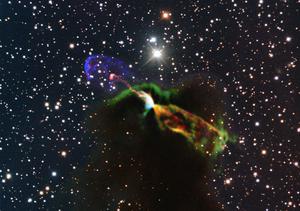
见证一颗恒星的诞生
图注: 阿塔卡马大毫米波/亚毫米波阵列(ALMA)和欧洲南方天文台新技术望远镜(NTT)拍摄的射电和可见光组合图像,揭示了赫比格-哈罗天体 HH 46/47 中一颗恒星的诞生过程。橙色和绿色的 ALMA 数据揭示了来自中央原恒星的高能喷流,由于尘埃遮挡和高密度气体的存在,该喷流在可见光波段被掩盖。粉色和紫色的 NTT 数据突出显示了喷流向观测者发射的可见光。
来源: ESO/ALMA (ESO/NAOJ/NRAO)/H.Arce. 致谢:Bo Reipurth
来源链接
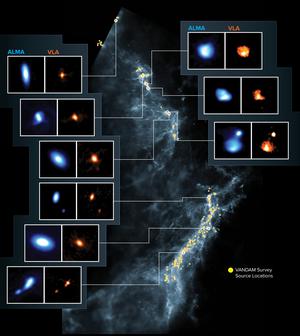
恒星诞生环境
图注: 使用阿塔卡马大型毫米/亚毫米波阵(ALMA)和甚大阵(VLA),拍摄了猎户座分子云中多颗原恒星形成的快照,更仔细地观察了每颗原恒星。对于恒星形成的过程和早期阶段,以及恒星从中形成的母云所产生的影响,这样的图像提供了独特的见解。
来源: ALMA (ESO/NAOJ/NRAO), J. Tobin; NRAO/AUI/NSF, S. Dagnello; Herschel/ESA
来源链接

The Pillars of Creation in comparison
图注: The 'Pillars of Creation' are a renowned astronomical feature situated within the Eagle Nebula in the Serpens constellation. The illustration provides a direct comparison between images captured by the Hubble Space Telescope (HST) and the James Webb Space Telescope (JWST), showcasing the pillars, which span several light years in diameter, in both visible light (also known as optical light) and infrared light. On the left are the pillars as seen by Hubble in visual light, taken in 2014. It displays dark pillars against an opaque background, with only a handful of visible stars. Conversely, the counterpart on the right is Webb’s near-infrared view published in 2022, penetrating the dust and revealing numerous stars of varying sizes.
Their distance from Earth is approximately 6,500 to 7,000 light years. Within these pillars, new stars are constantly forming, making them a subject of extensive study by astronomers. Composed mostly of cool molecular hydrogen and small amounts of interstellar dust, they are subject to erosion by the intense ultraviolet radiation emitted by nearby massive and newborn stars, a process known as photoevaporation.
来源: NASA, ESA, CSA, STScI
来源链接

Herschel’s view of new stars and molecular clouds
图注: This image shows the Westerhout 3, 4 and 5 star formation regions. This area has huge amounts of gas and dust. This gas and dust hides the physical processes going on in this region from studies using visible light. This image was taken in infrared light by the Herschel Space Observatory. This infrared light allowed Herschel to see deep into these star forming regions.
In Westerhout 3, 4 and 5, huge, cold clouds of molecular hydrogen have collapsed into dense knots and filaments. Within these new structures the gas is dense and cold enough for it to collapse and form stars. These new stars give off powerful winds of charged particles, like stronger versions of the solar wind our sun gives off. These winds have combined to blow massive bubbles in the surrounding gas and dust. These are visible as the large darker voids in the image.
来源: ESA/Herschel/NASA/JPL-Caltech; acknowledgement: R. Hurt (JPL-Caltech)
来源链接
相关图表
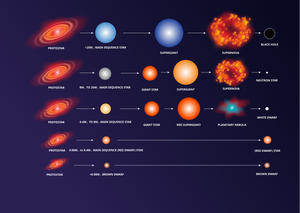
Stellar Evolution
图注: This diagram shows the life cycle of stars of different masses. The mass of the different types of star increases from bottom to top with time going from left to right.
The life cycle of a star depends on its mass, with lower mass stars have longer lifetimes. All stars form from clouds of gas that collapse under their own gravity. As the star collapses, its core becomes hotter and denser. If the star has a mass greater than 0.08 solar masses (0.08 times the mass of the Sun), the pressure of the star’s mass pushing down on its core creates a high enough core temperature for hydrogen fusion to ignite. This burns hydrogen into helium in the star’s core, providing a heat source to power the star and to stop its core from collapsing further. If the collapsing object has a mass below 0.08 solar masses then it does not ignite hydrogen fusion in its core. It continues to cool and slowly contract. Such substellar objects are known as brown dwarfs, shown here in the lowest row.
After stars have formed, they burn hydrogen in their cores and begin their so-called main sequence phase. The most massive stars (>25 solar masses, shown here at the top) have very high core temperatures and thus burn through their hydrogen fuel more quickly. This means they may only spend a few million years on the main sequence burning hydrogen in their cores. Once the hydrogen in the core is exhausted the star’s core contracts, becomes hotter and helium burning starts in the core. While the core contracts, the outer layers of the star expand and it becomes a supergiant. For the most massive stars strong stellar winds strip off the cooler outer layers, leading to the star being very large and very hot, a blue supergiant. Once helium is exhausted in the core, carbon is burned, and then heavier elements. Eventually the star ends with an iron core. Fusing iron into heavier elements does not generate energy so at this point fusion stops in the core. Once this core of iron is massive enough, it and the surrounding matter suddenly collapses to form a black hole and the outer layers are flung off in a supernova explosion.
Slightly lower mass stars (between 8 and 25 solar masses, seen here second top) evolve in a similar way although they do not have strong enough winds to push their outer layers away and become blue supergiants, instead it evolves into a red supergiant. While such stars also collapse and create supernova explosions. The remnant of the star’s core is not massive enough to collapse into a black hole. Instead, its electrons and protons combine to form neutrons and it is supported by a quantum mechanical effect called neutron degeneracy pressure. This results in the remnant of the star being a tiny neutron star, several solar masses in mass but only a few kilometres across.
For stars similar in mass to the Sun (between 0.4 and 8 solar masses, seen here in the middle row), the star burns hydrogen in its core until the hydrogen in its core is exhausted. At this point a hydrogen burning shell forms around the core. Eventually the core will become hot enough to burn helium into carbon and oxygen. After this the star is left with a carbon and oxygen core surrounded by shells burning helium and hydrogen. These shells are unstable producing thermal pulsations that convulse the star. Eventually these pulsations become so extreme that the star’s outer layers are thrown off. This leaves the carbon and oxygen core as a white dwarf supported by electron degeneracy pressure. The outer layers of the star form what is known as a planetary nebula (which doesn’t actually have anything to do with planets despite the name).
The lowest mass stars (seen here in the second bottom row) are so low in mass that their evolutionary timescales are much longer than the age of the universe. This means that none have evolved beyond the main-sequence. Low mass stars are fully convective meaning material in the core is constantly being mixed with material above. This means that all the hydrogen in the star would eventually be burned in the core, but this will take trillions of years.
来源: Danielle Futselaar/IAU OAE








.png)