Termo do glossário: Formação estelar
Descrição: O nascimento de uma estrela resulta do colapso gravitacional de regiões frias e densas chamadas núcleos dentro de nuvens moleculares gigantes, que são encontradas principalmente nos braços espirais das galáxias. A formação estelar envolve processos físicos complexos, ocorrendo em diferentes escalas, resultantes dos efeitos da gravidade, pressão, radiação, campos magnéticos, turbulência, química, etc., alguns dos quais ainda não são bem compreendidos. Dependendo da massa da nuvem parental e dos processos de acreção durante as fases de formação, a massa da estrela pode variar de 0,08 a algumas centenas de massas solares. A maioria das estrelas não se forma isoladamente, mas como parte de um aglomerado estelar. Durante as etapas de formação, um disco proto-estelar se forma ao redor da estrela central, fornecendo eventualmente o material de formação dos planetas.
Termos relacionados:
- Poeira
- Gás
- Protoestrela
- Massa Solar
- Galáxia espiral
- Estrela
- Aglomerado de estrelas
- Evolução estelar
- Campo magnético
Ver este termo em outros idiomas
Status do termo e da definição: A definição original deste termo em inglês foi aprovada por um astrônomo(a) pesquisador(a) e um(a) professor(a) A tradução deste termo e de sua definição ainda aguarda aprovação
O Glossário Multilíngue da OAE é um projeto do Escritório da IAU de Astronomia para a Educação(OAE) em colaboração com o Escritório da IAU para Divulgação da Astronomia (OAO). Os termos e definições foram selecionados, escritos e revisados por meio de um esforço coletivo da OAE, dos Centros e Nós da OAE, dos Coordenadores Nacionais de Educação em Astronomia (NAECs) da OAE e de outros voluntários. Você pode encontrar uma lista completa dos créditos aqui. Todos os termos do glossário e suas definições são disponibilizados sob uma licença Creative Commons CC BY-4.0 e devem ser creditados à "IAU OAE".
Se você notar algum erro factual ou de tradução neste termo do glossário ou em sua definição, por favor entre em contato.
Em outros idiomas
- Árabe: تشكّل النجوم
- Alemão: Sternentstehung
- Inglês: Star Formation
- Espanhol: Formación estelar
- Francês: Formation des étoiles
- Italiano: Formazione delle stelle
- Japonês: 星形成 (link externo)
- Chinês Simplificado: 恒星形成
- Chinês Tradicional: 恆星形成
Mídia relacionada
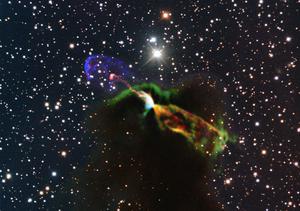
Testemunhando o nascimento de uma estrela
Legenda: Uma combinação de imagens em ondas de rádio e luz visível obtidas pelo Atacama Large Millimeter/submillimeter Array (ALMA) e pelo New Technology Telescope (NTT) do Observatório Europeu do Sul revelam o nascimento de uma estrela que forma o objeto Herbig-Haro HH 46/47. As observações do ALMA, mostradas em laranja e verde, revelam o jato energético da protoestrela central, que de outra forma estaria oculto no comprimento de onda visível devido à obscuridade da poeira e ao gás denso. As observações do NTT, em rosa e roxo, destacam a luz visível do jato emitida em direção ao observador.
Crédito: ESO/ALMA (ESO/NAOJ/NRAO)/H. Arce. Agradecimentos: Bo Reipurth
link do crédito
License: CC-BY-3.0 Creative Commons Attribution 3.0 Unported ícones
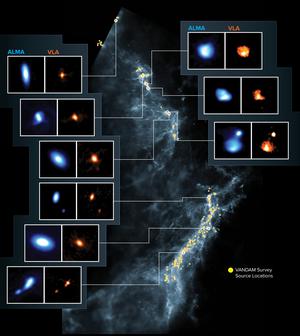
Ambiente de nascimento estelar
Legenda: Imagem da formação de múltiplas protoestrelas nas Nuvens Moleculares de Órion, com uma visão mais detalhada de cada uma delas através do Atacama Large Millimeter/submillimeter Array e do Very Large Array. Essa imagem fornece informações importantes sobre o processo e os estágios iniciais da formação estelar, bem como sobre a influência da nuvem-mãe na qual elas se formam.
Crédito: ALMA (ESO/NAOJ/NRAO), J. Tobin; NRAO/AUI/NSF, S. Dagnello; Herschel/ESA
link do crédito
License: CC-BY-3.0 Creative Commons Attribution 3.0 Unported ícones

The Pillars of Creation in comparison
Legenda: The 'Pillars of Creation' are a renowned astronomical feature situated within the Eagle Nebula in the Serpens constellation. The illustration provides a direct comparison between images captured by the Hubble Space Telescope (HST) and the James Webb Space Telescope (JWST), showcasing the pillars, which span several light years in diameter, in both visible light (also known as optical light) and infrared light. On the left are the pillars as seen by Hubble in visual light, taken in 2014. It displays dark pillars against an opaque background, with only a handful of visible stars. Conversely, the counterpart on the right is Webb’s near-infrared view published in 2022, penetrating the dust and revealing numerous stars of varying sizes.
Their distance from Earth is approximately 6,500 to 7,000 light years. Within these pillars, new stars are constantly forming, making them a subject of extensive study by astronomers. Composed mostly of cool molecular hydrogen and small amounts of interstellar dust, they are subject to erosion by the intense ultraviolet radiation emitted by nearby massive and newborn stars, a process known as photoevaporation.
Crédito: NASA, ESA, CSA, STScI
link do crédito
License: CC-BY-2.0 Creative Commons Attribution 2.0 Generic ícones

A visão de Herschel de novas estrelas e nuvens moleculares
Legenda: Esta imagem mostra as regiões de formação estelar Westerhout 3, 4 e 5. Essa área contém enormes quantidades de gás e poeira. Esse gás e poeira ocultam os processos físicos que ocorrem nesta região de estudos que utilizam luz visível. Esta imagem foi captada em luz infravermelha pelo Observatório Espacial Herschel. Essa radiação infravermelha permitiu que o Herschel observasse profundamente o interior dessas regiões de formação estelar.
Em Westerhout 3, 4 e 5, enormes nuvens frias de hidrogênio molecular colapsaram em nós e filamentos densos. Dentro dessas novas estruturas, o gás é denso e frio o suficiente para colapsar e formar estrelas. Essas novas estrelas emitem poderosos ventos de partículas carregadas, como versões mais fortes do vento solar que nosso Sol emite. Esses ventos se combinaram para soprar bolhas enormes no gás e poeira ao redor. Elas são visíveis como grandes vazios mais escuros na imagem.
Crédito: ESA/Herschel/NASA/JPL-Caltech; agradecimento: R. Hurt (JPL-Caltech)
link do crédito
License: CC-BY-3.0-IGO Creative Commons Attribution 3.0 IGO ícones
Diagramas relacionados
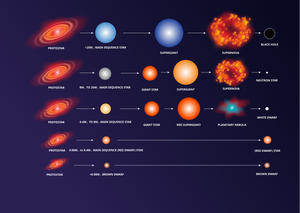
Stellar Evolution
Legenda: This diagram shows the life cycle of stars of different masses. The mass of the different types of star increases from bottom to top with time going from left to right.
The life cycle of a star depends on its mass, with lower mass stars have longer lifetimes. All stars form from clouds of gas that collapse under their own gravity. As the star collapses, its core becomes hotter and denser. If the star has a mass greater than 0.08 solar masses (0.08 times the mass of the Sun), the pressure of the star’s mass pushing down on its core creates a high enough core temperature for hydrogen fusion to ignite. This burns hydrogen into helium in the star’s core, providing a heat source to power the star and to stop its core from collapsing further. If the collapsing object has a mass below 0.08 solar masses then it does not ignite hydrogen fusion in its core. It continues to cool and slowly contract. Such substellar objects are known as brown dwarfs, shown here in the lowest row.
After stars have formed, they burn hydrogen in their cores and begin their so-called main sequence phase. The most massive stars (>25 solar masses, shown here at the top) have very high core temperatures and thus burn through their hydrogen fuel more quickly. This means they may only spend a few million years on the main sequence burning hydrogen in their cores. Once the hydrogen in the core is exhausted the star’s core contracts, becomes hotter and helium burning starts in the core. While the core contracts, the outer layers of the star expand and it becomes a supergiant. For the most massive stars strong stellar winds strip off the cooler outer layers, leading to the star being very large and very hot, a blue supergiant. Once helium is exhausted in the core, carbon is burned, and then heavier elements. Eventually the star ends with an iron core. Fusing iron into heavier elements does not generate energy so at this point fusion stops in the core. Once this core of iron is massive enough, it and the surrounding matter suddenly collapses to form a black hole and the outer layers are flung off in a supernova explosion.
Slightly lower mass stars (between 8 and 25 solar masses, seen here second top) evolve in a similar way although they do not have strong enough winds to push their outer layers away and become blue supergiants, instead it evolves into a red supergiant. While such stars also collapse and create supernova explosions. The remnant of the star’s core is not massive enough to collapse into a black hole. Instead, its electrons and protons combine to form neutrons and it is supported by a quantum mechanical effect called neutron degeneracy pressure. This results in the remnant of the star being a tiny neutron star, several solar masses in mass but only a few kilometres across.
For stars similar in mass to the Sun (between 0.4 and 8 solar masses, seen here in the middle row), the star burns hydrogen in its core until the hydrogen in its core is exhausted. At this point a hydrogen burning shell forms around the core. Eventually the core will become hot enough to burn helium into carbon and oxygen. After this the star is left with a carbon and oxygen core surrounded by shells burning helium and hydrogen. These shells are unstable producing thermal pulsations that convulse the star. Eventually these pulsations become so extreme that the star’s outer layers are thrown off. This leaves the carbon and oxygen core as a white dwarf supported by electron degeneracy pressure. The outer layers of the star form what is known as a planetary nebula (which doesn’t actually have anything to do with planets despite the name).
The lowest mass stars (seen here in the second bottom row) are so low in mass that their evolutionary timescales are much longer than the age of the universe. This means that none have evolved beyond the main-sequence. Low mass stars are fully convective meaning material in the core is constantly being mixed with material above. This means that all the hydrogen in the star would eventually be burned in the core, but this will take trillions of years.
Crédito: Danielle Futselaar/IAU OAE
License: CC-BY-4.0 Creative Commons Attribution 4.0 International (CC BY 4.0) ícones







.png)
