Terme du glossaire : Formation des étoiles
Description : La naissance d'une étoile résulte de l'effondrement gravitationnel de régions froides et denses, appelées noyaux, au sein de nuages moléculaires géants, que l'on trouve principalement dans les bras spiraux des galaxies. La formation des étoiles implique des processus physiques complexes, se produisant à différentes échelles et résultant des effets de la gravité, de la pression, du rayonnement, des champs magnétiques, de la turbulence, de la chimie, etc. En fonction de la masse du nuage parent et des processus d'accrétion au cours des phases de formation, la masse de l'étoile peut varier de 0,08 à quelques centaines de masses solaires. La plupart des étoiles ne se forment pas de manière isolée, mais au sein d'un amas d'étoiles. Au cours des phases de formation, un disque protostellaire se forme autour de l'étoile centrale, qui fournit à terme le matériau de construction nécessaire à la formation des planètes.
Termes associés :
- Poussière
- Gaz
- Protoétoile
- Masse solaire
- Galaxie spirale
- Étoile
- Amas d'étoiles
- Evolution stellaire
- Champ magnétique
Voir ce terme dans d'autres langues
Statut du terme et de sa définition : La définition initiale de ce terme en anglais a été aprouvée par un·e spécialiste de la recherche en astronomie et un·e spécialiste de l’éducation La traduction de ce terme et de sa définition n'ont pas encore été aprouvées
Le glossaire multilangue de l'OAE est un projet du Bureau de l'IAU de l'Astronomie pour l'Education (OAE) en collaboration avec le Bureau de l'IAU de diffusion de l'Astronomie (OAO). Les termes et définitions ont été choisis, écrits et relues grâce à un effort collectif de l'OAE, les Centres et les Noeuds de l'OAE, les Coordinateurs Nationaux de l'Astronomie pour l'Education de l'OAE(NAECs) et d'autres volontaires. La liste complète des crédits pour ce projet est disponible ici . Tous les termes du glossaire et leur définition sont déposés sous licence Creative Commons CC BY-4.0 et doivent être créditées au nom de "IAU OAE".
Si vous constatez une erreur dans ce terme ou sa définition, veuillez nous contacter .
Dans d'autres langues
- Arabe: تشكّل النجوم
- Allemand: Sternentstehung
- Anglais: Star Formation
- Espagnol: Formación estelar
- Italien: Formazione delle stelle
- Japonais: 星形成 (Liens externes)
- Portugais brésilien: Formação estelar
- Chinois simplifié: 恒星形成
- Chinois traditionnel: 恆星形成
Media associé
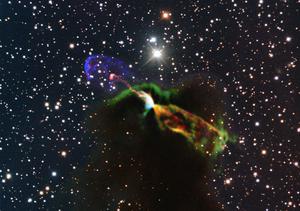
Witnessing the birth of a star
Légende : A combination of radio and visible light imaged with the Atacama Large Millimeter/submillimeter Array (ALMA) and European Southern Observatory's New Technology Telescope (NTT) revealing birth of a star forming the Herbig-Haro object HH 46/47. ALMA observations shown in orange and green unveil the energetic jet from the central protostar otherwise hidden at visible wavelength due to dust obscuration and dense gas. NTT observations in pink and purple highlight the visible light from the jet emitted towards the observer.
Crédit : ESO/ALMA (ESO/NAOJ/NRAO)/H. Arce. Acknowledgements: Bo Reipurth
Lien vers les crédits
License: CC-BY-3.0 Creative Commons (CC) Attribution 3.0 non transposé Icônes
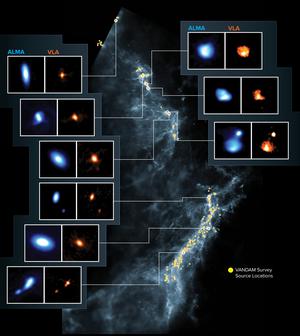
Stellar birth environment
Légende : Snapshot of the formation of multiple protostars in the Orion Molecular Clouds with a closer look at each of them with the Atacama Large Millimeter/submillimeter Array and Very Large Array. Such an image provides unique insights of the process and early stages of star formation as well as the influence of the parent cloud in which they form.
Crédit : ALMA (ESO/NAOJ/NRAO), J. Tobin; NRAO/AUI/NSF, S. Dagnello; Herschel/ESA
Lien vers les crédits
License: CC-BY-3.0 Creative Commons (CC) Attribution 3.0 non transposé Icônes

The Pillars of Creation in comparison
Légende : The 'Pillars of Creation' are a renowned astronomical feature situated within the Eagle Nebula in the Serpens constellation. The illustration provides a direct comparison between images captured by the Hubble Space Telescope (HST) and the James Webb Space Telescope (JWST), showcasing the pillars, which span several light years in diameter, in both visible light (also known as optical light) and infrared light. On the left are the pillars as seen by Hubble in visual light, taken in 2014. It displays dark pillars against an opaque background, with only a handful of visible stars. Conversely, the counterpart on the right is Webb’s near-infrared view published in 2022, penetrating the dust and revealing numerous stars of varying sizes.
Their distance from Earth is approximately 6,500 to 7,000 light years. Within these pillars, new stars are constantly forming, making them a subject of extensive study by astronomers. Composed mostly of cool molecular hydrogen and small amounts of interstellar dust, they are subject to erosion by the intense ultraviolet radiation emitted by nearby massive and newborn stars, a process known as photoevaporation.
Crédit : NASA, ESA, CSA, STScI
Lien vers les crédits
License: CC-BY-2.0 Creative Commons (CC) Attribution 2.0 Générique Icônes

Herschel’s view of new stars and molecular clouds
Légende : This image shows the Westerhout 3, 4 and 5 star formation regions. This area has huge amounts of gas and dust. This gas and dust hides the physical processes going on in this region from studies using visible light. This image was taken in infrared light by the Herschel Space Observatory. This infrared light allowed Herschel to see deep into these star forming regions.
In Westerhout 3, 4 and 5, huge, cold clouds of molecular hydrogen have collapsed into dense knots and filaments. Within these new structures the gas is dense and cold enough for it to collapse and form stars. These new stars give off powerful winds of charged particles, like stronger versions of the solar wind our sun gives off. These winds have combined to blow massive bubbles in the surrounding gas and dust. These are visible as the large darker voids in the image.
Crédit : ESA/Herschel/NASA/JPL-Caltech; acknowledgement: R. Hurt (JPL-Caltech)
Lien vers les crédits
License: CC-BY-3.0-IGO Creative Commons (CC) Attribution 3.0 Organisations Internationales Icônes
Diagrammes associés
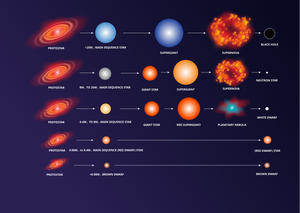
Stellar Evolution
Légende : This diagram shows the life cycle of stars of different masses. The mass of the different types of star increases from bottom to top with time going from left to right.
The life cycle of a star depends on its mass, with lower mass stars have longer lifetimes. All stars form from clouds of gas that collapse under their own gravity. As the star collapses, its core becomes hotter and denser. If the star has a mass greater than 0.08 solar masses (0.08 times the mass of the Sun), the pressure of the star’s mass pushing down on its core creates a high enough core temperature for hydrogen fusion to ignite. This burns hydrogen into helium in the star’s core, providing a heat source to power the star and to stop its core from collapsing further. If the collapsing object has a mass below 0.08 solar masses then it does not ignite hydrogen fusion in its core. It continues to cool and slowly contract. Such substellar objects are known as brown dwarfs, shown here in the lowest row.
After stars have formed, they burn hydrogen in their cores and begin their so-called main sequence phase. The most massive stars (>25 solar masses, shown here at the top) have very high core temperatures and thus burn through their hydrogen fuel more quickly. This means they may only spend a few million years on the main sequence burning hydrogen in their cores. Once the hydrogen in the core is exhausted the star’s core contracts, becomes hotter and helium burning starts in the core. While the core contracts, the outer layers of the star expand and it becomes a supergiant. For the most massive stars strong stellar winds strip off the cooler outer layers, leading to the star being very large and very hot, a blue supergiant. Once helium is exhausted in the core, carbon is burned, and then heavier elements. Eventually the star ends with an iron core. Fusing iron into heavier elements does not generate energy so at this point fusion stops in the core. Once this core of iron is massive enough, it and the surrounding matter suddenly collapses to form a black hole and the outer layers are flung off in a supernova explosion.
Slightly lower mass stars (between 8 and 25 solar masses, seen here second top) evolve in a similar way although they do not have strong enough winds to push their outer layers away and become blue supergiants, instead it evolves into a red supergiant. While such stars also collapse and create supernova explosions. The remnant of the star’s core is not massive enough to collapse into a black hole. Instead, its electrons and protons combine to form neutrons and it is supported by a quantum mechanical effect called neutron degeneracy pressure. This results in the remnant of the star being a tiny neutron star, several solar masses in mass but only a few kilometres across.
For stars similar in mass to the Sun (between 0.4 and 8 solar masses, seen here in the middle row), the star burns hydrogen in its core until the hydrogen in its core is exhausted. At this point a hydrogen burning shell forms around the core. Eventually the core will become hot enough to burn helium into carbon and oxygen. After this the star is left with a carbon and oxygen core surrounded by shells burning helium and hydrogen. These shells are unstable producing thermal pulsations that convulse the star. Eventually these pulsations become so extreme that the star’s outer layers are thrown off. This leaves the carbon and oxygen core as a white dwarf supported by electron degeneracy pressure. The outer layers of the star form what is known as a planetary nebula (which doesn’t actually have anything to do with planets despite the name).
The lowest mass stars (seen here in the second bottom row) are so low in mass that their evolutionary timescales are much longer than the age of the universe. This means that none have evolved beyond the main-sequence. Low mass stars are fully convective meaning material in the core is constantly being mixed with material above. This means that all the hydrogen in the star would eventually be burned in the core, but this will take trillions of years.
Crédit : Danielle Futselaar/IAU OAE
License: CC-BY-4.0 Creative Commons (CC) Attribution 4.0 International (CC BY 4.0) Icônes
Ceci pourrait vous intéresser également





.png)

- Ressources
- Moteur de recherche des ressources pédagogiques
- Parcourir les ressources pédagogiques par Sujet
- Parcourir les images
- AstroEdu - Activités en classe
- Grandes Idées - Littéracie en astronomie
- Glossaire
- Rapports de l'OAE
- L'astronomie pour l'Education à travers le monde
- Sélection de ressources externes