بلغات أخرى
- الألمانيّة: Kompakte Objekte
- الإنجليزيّة: Stellar Remnants
- الإسبانيّة: Remanentes estelares
- الفرنسيّة: Vestiges stellaires
- الإيطاليّة: Residui stellari
- البرتغاليّة البرازيليّة: Remanescentes estelares
- الصينيّة المبسطة: 恒星残骸
- الصينيّة التقليدية: 恆星殘骸
وسائط ذات صلة
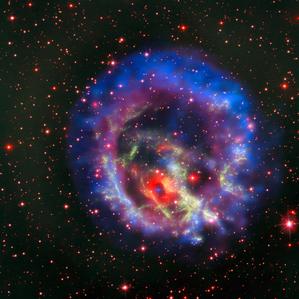
موت نجم ضخم

Remnant of SN 1006
الشرح: This image shows the remnant of the supernova SN 1006. This was probably the result of a white dwarf that accreted so much material from a binary companion star that the white dwarf exploded (this is called a Type 1a supernova by astronomers). This explosion happened several thousand years ago, however it took time for the light from this event to reach Earth, only arriving in the year 1006. This bright explosion was noticed by observers across the Earth and its appearance was noted in the records of many different societies.
Here we see the effect that supernova has had on its surroundings in the galaxy. The force of the explosion has blown a huge bubble in the surrounding interstellar gas with a hot shockwave at its edge. The image appears to be a simple color picture but it actually represents light far beyond what our eye can see. The blue is X-ray data from NASA's Chandra X-ray Observatory, the yellow and orange are data from optical telescopes and the red is detections in radio waves from the Very Large Array and the Green Bank Telescope. The bright blue of the outer shell shows the gas there is very hot and that the explosion produced energetic shock waves.
المصدر: X-ray: NASA/CXC/Rutgers/G.Cassam-Chenai, Hughes et al.; Radio: NRAO/AUI/NSF/GBT/VLA/Dyer, Maddalena & Cornwell; Optical: Middlebury College/F.Winkler, NOAO/AURA/NSF/CTIO Schmidt & DSS
رابط المصدر
License: PD الملكية العامة أيقونات

The Crab Pulsar
الشرح: At the heart of the Crab Nebula, situated approximately 6,500 light-years away in the constellation of Taurus, lies the Crab Nebula Pulsar. This is remnant of a massive star that exploded at the end of its life. This happened several thousand years ago but the light from this explosion only reached the Earth in the year 1054. This celestial event was viewed by people across the world with many different societies noting it in their records.
The Crab Nebula Pulsar rotates about 30 times per second and emits light in many different wavelengths, including the visible spectrum. It is roughly one and a half times the mass of the sun but the force of the explosion that formed it crammed this mass into a tiny space, roughly ten kilometres in radius.
This image is a composite of several observations conducted by the Gemini North observatory in Hawaii, USA. The pulsar can be seen at the center. The observations that this image was created from were taken over a period of five years. Data from 2009 is shown in blue and data from 2014 is shown in red. Over this time material has flowed away from the pulsar resulting in this colored ripple effect. Again the colors do not show real colors in the image, the ripples show the positions of the shockwaves as they moved away from the pulsar and hit into the surrounding gas.
المصدر: International Gemini Observatory/NOIRLab/NSF/AUR, Jen Miller, Travis Rector, Mahdi Zamani & Davide de Martin
رابط المصدر
License: CC-BY-4.0 المشاع الإبداعي نَسب المُصنَّف 4.0 دولي (CC BY 4.0) أيقونات
الرسوم التوضيحية المرتبطة
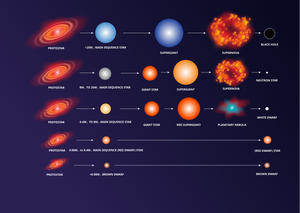
Stellar Evolution
الشرح: This diagram shows the life cycle of stars of different masses. The mass of the different types of star increases from bottom to top with time going from left to right.
The life cycle of a star depends on its mass, with lower mass stars have longer lifetimes. All stars form from clouds of gas that collapse under their own gravity. As the star collapses, its core becomes hotter and denser. If the star has a mass greater than 0.08 solar masses (0.08 times the mass of the Sun), the pressure of the star’s mass pushing down on its core creates a high enough core temperature for hydrogen fusion to ignite. This burns hydrogen into helium in the star’s core, providing a heat source to power the star and to stop its core from collapsing further. If the collapsing object has a mass below 0.08 solar masses then it does not ignite hydrogen fusion in its core. It continues to cool and slowly contract. Such substellar objects are known as brown dwarfs, shown here in the lowest row.
After stars have formed, they burn hydrogen in their cores and begin their so-called main sequence phase. The most massive stars (>25 solar masses, shown here at the top) have very high core temperatures and thus burn through their hydrogen fuel more quickly. This means they may only spend a few million years on the main sequence burning hydrogen in their cores. Once the hydrogen in the core is exhausted the star’s core contracts, becomes hotter and helium burning starts in the core. While the core contracts, the outer layers of the star expand and it becomes a supergiant. For the most massive stars strong stellar winds strip off the cooler outer layers, leading to the star being very large and very hot, a blue supergiant. Once helium is exhausted in the core, carbon is burned, and then heavier elements. Eventually the star ends with an iron core. Fusing iron into heavier elements does not generate energy so at this point fusion stops in the core. Once this core of iron is massive enough, it and the surrounding matter suddenly collapses to form a black hole and the outer layers are flung off in a supernova explosion.
Slightly lower mass stars (between 8 and 25 solar masses, seen here second top) evolve in a similar way although they do not have strong enough winds to push their outer layers away and become blue supergiants, instead it evolves into a red supergiant. While such stars also collapse and create supernova explosions. The remnant of the star’s core is not massive enough to collapse into a black hole. Instead, its electrons and protons combine to form neutrons and it is supported by a quantum mechanical effect called neutron degeneracy pressure. This results in the remnant of the star being a tiny neutron star, several solar masses in mass but only a few kilometres across.
For stars similar in mass to the Sun (between 0.4 and 8 solar masses, seen here in the middle row), the star burns hydrogen in its core until the hydrogen in its core is exhausted. At this point a hydrogen burning shell forms around the core. Eventually the core will become hot enough to burn helium into carbon and oxygen. After this the star is left with a carbon and oxygen core surrounded by shells burning helium and hydrogen. These shells are unstable producing thermal pulsations that convulse the star. Eventually these pulsations become so extreme that the star’s outer layers are thrown off. This leaves the carbon and oxygen core as a white dwarf supported by electron degeneracy pressure. The outer layers of the star form what is known as a planetary nebula (which doesn’t actually have anything to do with planets despite the name).
The lowest mass stars (seen here in the second bottom row) are so low in mass that their evolutionary timescales are much longer than the age of the universe. This means that none have evolved beyond the main-sequence. Low mass stars are fully convective meaning material in the core is constantly being mixed with material above. This means that all the hydrogen in the star would eventually be burned in the core, but this will take trillions of years.
المصدر: Danielle Futselaar/IAU OAE
License: CC-BY-4.0 المشاع الإبداعي نَسب المُصنَّف 4.0 دولي (CC BY 4.0) أيقونات