词条 月球
描述: 月球是自身并不发光的天体,但它会反射落在其上的太阳光。这就产生了月球特有的月相。月球是地球唯一的主要天然卫星,其大小和质量在太阳系内的所有天然卫星中排名第五。在英文中,首字母大写的“Moon”表示月球,而首字母小写的“moon”则表示太阳系内外的其他天然卫星。与太阳系内的其他卫星相比,月球的体积相对于它所环绕行星的体积的占比是最大的。月球沿围绕地球的椭圆轨道运行,与地球的平均距离为38.4万千米。月球没有大气层,物质组分与地球类似,内核富含铁,外层为岩石。这种相似并非偶然:据我们所知,大约45亿年前,地球和一颗火星大小的行星碰撞,产生的碎片最终形成了月球,它的大部分物质来自最初的地球地幔。月球表面既有被称为“月海”的深色区域,也有浅色高地,并布满了陨击坑。月球表面积为3.79×10⁷平方千米,体积为2.20×10¹⁰立方千米,质量为7.35×10²²千克。月球围绕地球运行的轨道周期的确切数值取决于参考系:相对于遥远的恒星,月球每27.3天运行一圈(“恒星月”)。对于地球上的观测者来说,两个新月之间的间隔时间为29.5天(“朔望月”)。
相关词条
用其他语言查看该词条
词条和定义状态: 该术语的英文原始定义已通过天文研究人员和教师的审核 该术语及其定义的译文仍待审核
OAE多语言词汇表是由国际天文学联合会(IAU) 天文教育办公室(OAE) 和 国际天文学联合会(IAU) 天文推广办公室(OAO)合作的项目。. 术语和定义由 OAE中心, OAE 国家天文教育协调员(NAECs) 以及其他志愿者共同选择、撰写和审阅。您可以在 找到完整的致谢列表。所有词汇表术语及其定义均根据 Creative Commons CC BY-4.0许可证发布 且版权归属于 “IAU OAE”。
如果您发现此词汇术语或定义中的事实或翻译错误, 请向 发邮件 联系.
相关媒体
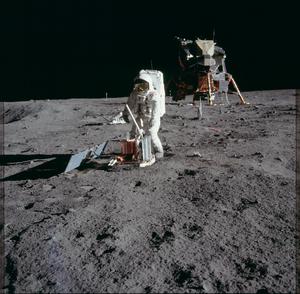
阿波罗 11 号任务的月面活动
图注: 美国国家航空航天局宇航员埃德温·巴兹·奥尔德林在月球上进行舱外活动(EVA)时,在阿波罗11号 "鹰 "月球着陆器前安装地震仪。尼尔·阿姆斯特朗在1969年人类首次登月任务中拍摄了这张照片。
来源: 美国国家航空航天局/阿波罗项目档案
来源链接
License: PD 公共领域 图标
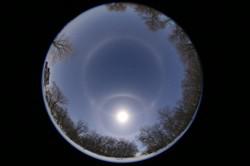
塞勒涅与月亮相遇,作者Sheila Wiwchar,加拿大
图注: 2021 年国际天文学联合会 OAE 天体摄影比赛日/月晕类第一名。
这幅精美的鱼眼照片拍摄于加拿大曼尼托巴省的卡莱伊达(Kaleida),捕捉到了环绕月亮的罕见光学现象,即 "22°晕 ",和穿过月亮的水平白圈,即 "幻月环"。与月亮在同一高度环绕整个天空的白色光带是以古希腊提坦女神塞勒涅的名字命名的,她被称为月亮女神。由太阳产生的对应现象更常被观测到,称为 "幻日环"(parhelic circle),以希腊太阳神赫利俄斯的名字命名。22° 晕和幻月环都是由于月光从近乎垂直的冰晶表面反射而产生的。离月球较近的部分是由于外部反射造成的,而离月球较远的部分则是内部反射造成的。位于中心的北斗七星让这幅图像更加壮观。你能发现它吗?
来源: Sheila Wiwchar/IAU OAE
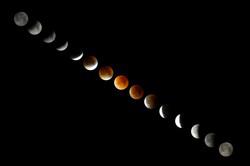
红月,法国丹尼尔·亨利昂作品
图注: 2021年国际天文学联合会教育办公室举办的天体摄影比赛月全食类季军作品。
这是 2015 年 9 月 28 日发生的超级月亮月全食的延时摄影照片。照片记录了月球穿过地球本影的过程:地球本影于协调世界时凌晨 1 时 07 分接触月球外缘(左上角),于协调世界时凌晨 4 时 27 分离开月球表面(右下角)。
来源: 丹尼尔·亨利/国际天文学联合会教育办公室
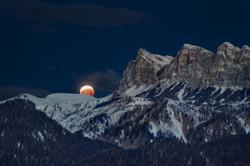
正发生月食的月亮从多洛米蒂山脉(联合国教科文组织世界遗产区)普伦德拉岩峰(Rochetta di Prendera )附近落下,作者 Alessandra Masi,意大利
图注: 2021 年国际天文学联合会 OAE 天体摄影比赛月全食类第一名。
月食发生于满月进入地球阴影时。这种现象发生在太阳、地球和月球的排布完全或非常接近一条直线时。月球表面反射的红光是太阳光照射月球途中,穿过地球大气层时发生折射造成的。较蓝的光由于瑞利散射作用消失,因此月球表面呈现红色。地球阴影在月球表面显示出的圆形形状,曾被亚里士多德用作地球是球体的证据之一。这张照片拍摄于2019 年 1 月 21 日,展示了被地球阴影笼罩的月球(月食)在意大利多洛米蒂山脉(联合国教科文组织世界遗产区)普伦德拉岩峰(Rochetta di Prendera ) 附近落下的景象。
来源: Alessandra Masi/IAU OAE
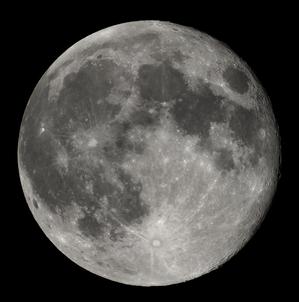
满月
图注: 这张图像展示了用小型望远镜和单反相机观察到的接近满月的月亮。
来源: 卢克 维亚图尔
来源链接
License: CC-BY-SA-3.0 知识共享许可协议 Attribution-ShareAlike 3.0 Unported 图标
相关图表
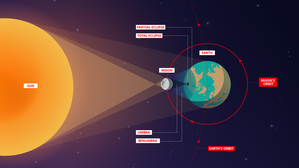
Total Solar Eclipse
图注: This not to scale diagram shows what happens during a total solar eclipse. The Moon orbits the Earth, but its orbit is slightly tilted with respect to the Earth’s orbit around the Sun. During the new moon lunar phase, the Moon lies between the Earth and the Sun, but due to the Moon’s tilted orbit around the Earth, the Moon normally lies above or below the Sun at this point. However twice a year the Moon’s orbit lines up in such a way that the Moon can lie in a direct line between the Earth and Sun. During each of these periods (each of which last roughly a month) solar (and lunar) eclipses can occur. The Moon is about 400 times smaller than the Sun, but is 400 times closer to the Earth than the Sun. Hence the Sun and Moon have approximately the same angular size when viewed from the Earth. This means that it is possible for the Moon to completely cover the Sun when viewed from Earth. This is known as a total solar eclipse.
Here we see a schematic of such and eclipse. The Moon casts a shadow on the Earth known as the umbra. This is a roughly circular shadow a few hundred kilometres across although its shape can be severely distorted when the eclipse is at the edge of the illuminated part of the Earth. Any region within the umbra will see the Moon completely cover the Sun and thus will experience a total solar eclipse. Outside of the umbra there are regions where the Moon will cover part of the Sun. This partial shadow is known as the penumbra. Regions in the penumbra will experience a partial solar eclipse.
An eclipse is a dynamic event with the Moon moving in its orbit and the Earth rotating. Hence the umbra and penumbra move across the Earth’s surface together. The path the umbra takes across the Earth is known as the path of totality. Let’s consider one particular region that lies in the path of totality: except in rare cases where an eclipse begins at sunrise, a region that experiences totality will first see the Moon cover part of the Sun and gradually move across Sun until it is totally covered. From outside the Earth this would appear as the penumbra moving over this particular region followed by the umbra moving over this region. Once the Moon moves so that it no longer completely covers the Sun, totality ends and the umbra moves away from this particular region. The Moon will continue to uncover the Sun until (unless the Sun sets before the end of the eclipse) the Sun is completely uncovered. From outside the Earth this would appear as the umbra moving away from our particular region and the edge of the penumbra approaching and eventually passing over the region.
Outside of the path or totality there is a much broader region that will lie in the penumbra but will be missed by the umbra. Such regions will not experience a total solar eclipse during this event, only a partial solar eclipse.
来源: Aneta Margraf/IAU OAE
相关活动
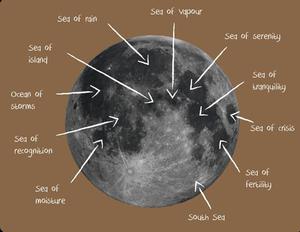
Lunar Landscape
astroEDU educational activity (links to astroEDU website) Description: Create craters and explore the lunar landscape with this hands-on activity.
License: CC-BY-4.0 知识共享许可协议 署名 4.0 国际 (CC BY 4.0) 图标
标签:
Hands-on
, Model
, Lunar landscape
, Craters
年龄段:
4-6
, 6-8
, 8-10
受教育等级:
Primary
学习领域:
建模
费用:
中等成本
组别大小:
小组
技能:
提出问题
, 传达信息
, 开发和使用模型
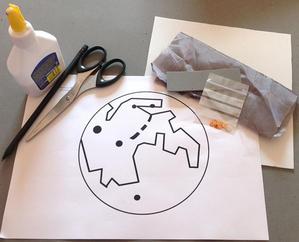
Meet Our Neighbours: Moon
astroEDU educational activity (links to astroEDU website) Description: Explore the tactile version of our moon with household materials.
License: CC-BY-4.0 知识共享许可协议 署名 4.0 国际 (CC BY 4.0) 图标
标签:
Hands-on
, Model
, Visually Impaired
, Tactile
年龄段:
6-8
, 8-10
, 10-12
受教育等级:
初中
, Primary
, 中学
学习领域:
互动讲座
, 建模
费用:
低成本
组别大小:
小组
技能:
分析和解读数据
, 提出问题
, 传达信息
, 开发和使用模型
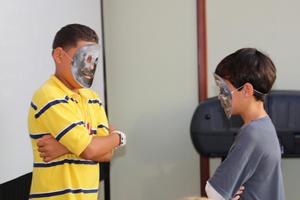
Lunar Day
astroEDU educational activity (links to astroEDU website) Description: Through a fun-learning activity, understand why moon always keeps the same face towards Earth.
License: CC-BY-4.0 知识共享许可协议 署名 4.0 国际 (CC BY 4.0) 图标
标签:
Lunar day
年龄段:
4-6
, 6-8
受教育等级:
Primary
, 中学
学习领域:
建模
, 以模拟为主
费用:
零成本
时间跨度:
30 分钟
组别大小:
小组
技能:
分析和解读数据
, 提出问题
, 传达信息
, 构建解释
, 开发和使用模型
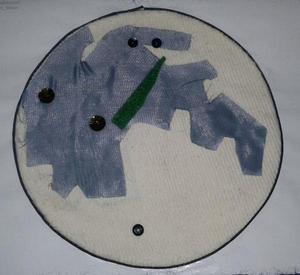
Sun, Earth and Moon Model
astroEDU educational activity (links to astroEDU website) Description: Build an Earth-Moon-Sun mobile to learn about how they orbit.
License: CC-BY-4.0 知识共享许可协议 署名 4.0 国际 (CC BY 4.0) 图标
标签:
Hands-on
, Model
年龄段:
8-10
受教育等级:
Primary
学习领域:
游戏化学习
, 建模
, 结构化探究式学习
费用:
中等成本
时间跨度:
1 小时 30 分钟
组别大小:
小组
技能:
提出问题
, 传达信息
, 开发和使用模型
Children's Planetary Maps: The Moon
astroEDU educational activity (links to astroEDU website) Description: An up close look at our own satellite
License: CC-BY-4.0 知识共享许可协议 署名 4.0 国际 (CC BY 4.0) 图标
标签:
Maps
, Planetary cartography
, Spatial thinking
年龄段:
6-8
, 8-10
, 10-12
, 12-14
受教育等级:
初中
, Primary
, 中学
学习领域:
结构化探究式学习
费用:
低成本
时间跨度:
2 小时
组别大小:
小组
技能:
分析和解读数据
, 提出问题
, 传达信息
, 构建解释
, 开发和使用模型
, 从证据中进行论证
, 规划并开展调查