Término del glosario: Actividad estelar
Descripción: La actividad estelar es un término genérico que engloba los distintos efectos que los campos magnéticos ejercen sobre las estrellas. Las estrellas con campos magnéticos intensos presentan más manchas estelares en su superficie. Además, es probable que los campos magnéticos estelares sean la fuente de calor de la corona de una estrella, por lo que las estrellas con campos magnéticos más intensos emitirán más rayos X y radiación ultravioleta desde su corona. La actividad también puede observarse en el espectro de la estrella, en particular en la emisión de la línea de hidrógeno alfa. En conjunto, estos efectos cuantifican de forma aproximada la «actividad» de una estrella. Las estrellas masivas (de tipo espectral O, B y A temprana) suelen tener una actividad baja. La actividad aumenta entonces en las estrellas de menor masa, alcanzando su máximo en las enanas rojas (enanas M). Las estrellas jóvenes son más activas que las viejas. El Sol sigue un ciclo de actividad de 11 años que da lugar a una variación en el número de manchas solares.
Términos relacionados:
- Estrella de tipo B
- Corona
- Hidrógeno
- Enana Roja
- Ciclo solar
- Tipo espectral
- Mancha solar
- Ciclo de manchas solares
- Ultravioleta
- Estrella tipo M
- Campo magnético
- Estrella de tipo O
- Rayos X
Ver este término en otros idiomas
Estado del término y la definición: La definición original de este término en inglés ha sido aprobada por unastrónomo o astrónoma investigadora y un docente La traducción de este término y su definición aún están pendientes de aprobación
El Glosario multilingüe de la OAE es un proyecto de la Oficina de Astronomía para la Educación de la UAI (OAE) en colaboración con la Oficina de Divulgación de Astronomía de la UAI (OAO). Los términos y definiciones fueron seleccionados, redactados y revisados gracias al esfuerzo colectivo de la OAE, los Centros y Nodos de la OAE, los Coordinadores Nacionales de Educación Astronómica (NAECs) y otros voluntarios. Puedes encontrar una lista completa de créditos aquí. Todos los términos del glosario y sus definiciones se publican bajo la licencia Creative Commons CC BY-4.0 y deben atribuirse a la "IAU OAE".
Si detectas algún error de contenido o de traducción en este término del glosario o en ladefinición, ponte en contacto con nosotros.
En otros idiomas
- Árabe: النشاط النجمي
- Alemán: Stellare Aktivität
- Inglés: Stellar Activity
- Francés: activité stellaire
- Italiano: attività stellare
- Portugués de Brasil: Atividade estelar
- Chino simplificado: 恒星活动
- Chino tradicional: 恆星活動
Contenidos relacionados
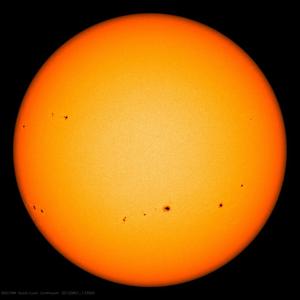
Sunspots
Pie de foto: In this image the sun peppered with groups of sunspots over almost nine days between July and August 2012. The sunspots seen in this image have been sources of the solar flares and coronal mass ejections (CME). In this image particulary, the sun is approaching solar maximum in its cycle (solar cycle), where we see many spots forming along the suns' equator. These sunspots and activity are seen in the southern hemisphere, before then most of the activity was on the northern hemisphere.
Crédito: NASA/SDO/HMI
enlace de crédito
License: PD Dominio público íconos
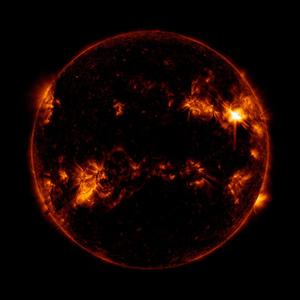
Solar flare
Pie de foto: This image shows the mid-level solar flare that was observed in March 2022 by the Solar Dynamic Observatory (SDO). The SDO observes the Sun activity, hence it shows the regions on the Sun where there is activity. A solar flare is brief brightening on the sun's surface, this particular flare is an M-class, which means that it is a tenth of the size of the most intense flares, namely the X-flares. Solar flares are barely visible with the naked eye, thus the SDO. The image here, is captured in extreme ultravoilet light that was colourized by red in the SDO, the flare appears in the upper of the solar disk.
Crédito: NASA/SDO
enlace de crédito
License: PD Dominio público íconos