Terme du glossaire : Fusion de l'hydrogène
Description : La fusion nucléaire est le terme générique désignant toutes les réactions par lesquelles des noyaux atomiques plus légers entrent en collision et fusionnent pour former un ou plusieurs noyaux atomiques plus lourds. En astronomie, la fusion de l'hydrogène est la réaction de fusion nucléaire qui transforme les noyaux d'hydrogène (chacun constitué d'un seul proton) en noyaux d'hélium 4 (chacun constitué de deux protons et de deux neutrons liés ensemble). Le noyau d'hélium 4 a une masse inférieure à la somme des masses des protons et des neutrons qui le composent. Selon la célèbre formule d'Einstein E=mc2, cette différence de masse correspond à une différence d'énergie. Lorsque les protons et les neutrons fusionnent pour former de l'hélium 4, la quantité d'énergie correspondant à cette différence est libérée. C'est ainsi que la fusion de l'hydrogène sert de source d'énergie aux étoiles dites de la séquence principale, comme notre Soleil. Pendant un certain temps, ces étoiles se trouvent dans un état d'équilibre : la quantité d'énergie libérée par la fusion de l'hydrogène dans leur cœur correspond à l'énergie que ces étoiles brillantes émettent sous forme de lumière et d'autres types de rayonnements électromagnétiques, ainsi que de particules.
La fusion de l'hydrogène se déroule en plusieurs étapes intermédiaires. Pour les étoiles dont la masse est égale ou inférieure à celle de notre Soleil, elle se fait par l'intermédiaire de la chaîne proton-proton (chaîne pp). Dans la version la plus simple de cette chaîne de réactions, deux noyaux d'hydrogène (protons) fusionnent pour donner des noyaux de deutérium (un proton, un neutron chacun), qui fusionnent ensuite avec un noyau d'hydrogène supplémentaire pour donner de l'hélium 3 (deux protons, un neutron). Deux de ces noyaux d'hélium 3 fusionnent pour donner de l'hélium 4 et deux noyaux d'hydrogène restants. Dans les étoiles dont la masse est supérieure à environ 1,3 fois celle de notre Soleil, un processus alternatif appelé cycle carbone-azote-oxygène (CNO) devient la principale méthode de fusion de l'hydrogène en hélium. Sur Terre, les scientifiques ont construit des machines pour créer des réactions de fusion dans l'espoir qu'elles deviennent à l'avenir un moyen viable de produire de l'énergie. La fusion de l'hydrogène ne se produit pas seulement dans les étoiles, mais aussi au début de la phase du Big Bang de notre Univers.
Termes associés :
Voir ce terme dans d'autres langues
Statut du terme et de sa définition : La définition initiale de ce terme en anglais a été aprouvée par un·e spécialiste de la recherche en astronomie et un·e spécialiste de l’éducation La traduction de ce terme et de sa définition n'ont pas encore été aprouvées
Le glossaire multilangue de l'OAE est un projet du Bureau de l'IAU de l'Astronomie pour l'Education (OAE) en collaboration avec le Bureau de l'IAU de diffusion de l'Astronomie (OAO). Les termes et définitions ont été choisis, écrits et relues grâce à un effort collectif de l'OAE, les Centres et les Noeuds de l'OAE, les Coordinateurs Nationaux de l'Astronomie pour l'Education de l'OAE(NAECs) et d'autres volontaires. La liste complète des crédits pour ce projet est disponible ici . Tous les termes du glossaire et leur définition sont déposés sous licence Creative Commons CC BY-4.0 et doivent être créditées au nom de "IAU OAE".
Si vous constatez une erreur dans ce terme ou sa définition, veuillez nous contacter .
Dans d'autres langues
- Arabe: اندماج الهيدروجين
- Allemand: Wasserstoffbrennen
- Anglais: Hydrogen Fusion
- Espagnol: Fusión de hidrógeno
- Italien: Fusione di idrogeno
- Portugais brésilien: Fusão de hidrogênio
- Chinois simplifié: 氢聚变
- Chinois traditionnel: 氫聚變
Diagrammes associés
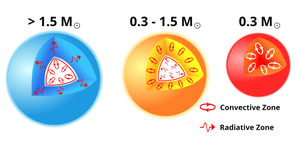
Stellar Structure
Légende : Stars are balls of plasma. For most of a star’s life it burns hydrogen into helium in its core. This phase of a star’s life is known as the main sequence. Burning hydrogen into helium produces heat, that heat travels out of the star’s core eventually reaching the star’s photosphere (often referred to as the “surface” of the star). From here the heat can radiate into space as various forms of electromagnetic radiation. However, how heat travels from the core to the photosphere depends on the star’s mass.
Imagine a parcel of gas rising inside a star. As it rises, it moves into an area of lower pressure, so it cools down and expands. If the parcel is still hotter, and therefore less dense than its surroundings, it keeps moving upward due to buoyancy. Eventually, it will rise far enough to cool and sink back down. This rising and sinking cycle is called convection. Whether convection occurs depends on how quickly temperature changes as you move away from the star’s core. If the temperature in a star drops rapidly, rising parcels of gas are more likely to stay hotter than their surroundings, so convection dominates as the mode of energy transfer in this part of the star. Conversely if the temperature drops more slowly (i.e. if the temperature gradient is small) then heat will mostly be transferred by radiation (photons).
In the most massive main sequence stars (more massive than about 1.5 times the mass of the Sun, seen here on the left), hydrogen is burned into helium using the CNO cycle. This is highly temperature dependent and thus energy production is concentrated near the center of the star. This leads to a larger temperature gradient and thus a convective core. Further out the temperature gradient becomes smaller and heat transport is dominated by radiation. This is called the radiative zone.
For lower mass stars like the Sun (between 0.3 and 1.5 solar masses, seen here in the middle) hydrogen is burned to helium using a different process (the pp chain). This depends less on the internal temperature than the CNO cycle and so energy production is more distributed in the star’s core. This leads to a smaller temperature gradient and thus a radiative core where convection occurs surrounded by a radiative zone. Going further out the gas becomes cool enough for some elements to hang to on some of their electrons, i.e. not being completely ionised. This partially ionised gas is more opaque to photons, trapping heat. This leads to a large temperature gradient and thus convection.
The lowest mass stars (below 0.3 solar masses, seen here on the right) have no radiative zone and are fully convective.
The arrows in the radiative zone are shown as wavy lines heading out of the star. However, a photon’s journey out of a star is much more complex with each individual photon travelling only a short distance before being deflected by some of the charged particles that make up the plasma of the star’s interior. This leads to a long and winding road that takes millennia instead of the few seconds it would take if the photon did not interact with particles in the plasma.
Crédit : Based on a vector diagram by Wikimedia user Д.Ильин which itself is based on a diagram from sun.org
License: CC-BY-4.0 Creative Commons (CC) Attribution 4.0 International (CC BY 4.0) Icônes
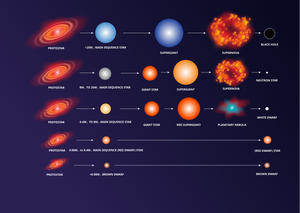
Stellar Evolution
Légende : This diagram shows the life cycle of stars of different masses. The mass of the different types of star increases from bottom to top with time going from left to right.
The life cycle of a star depends on its mass, with lower mass stars have longer lifetimes. All stars form from clouds of gas that collapse under their own gravity. As the star collapses, its core becomes hotter and denser. If the star has a mass greater than 0.08 solar masses (0.08 times the mass of the Sun), the pressure of the star’s mass pushing down on its core creates a high enough core temperature for hydrogen fusion to ignite. This burns hydrogen into helium in the star’s core, providing a heat source to power the star and to stop its core from collapsing further. If the collapsing object has a mass below 0.08 solar masses then it does not ignite hydrogen fusion in its core. It continues to cool and slowly contract. Such substellar objects are known as brown dwarfs, shown here in the lowest row.
After stars have formed, they burn hydrogen in their cores and begin their so-called main sequence phase. The most massive stars (>25 solar masses, shown here at the top) have very high core temperatures and thus burn through their hydrogen fuel more quickly. This means they may only spend a few million years on the main sequence burning hydrogen in their cores. Once the hydrogen in the core is exhausted the star’s core contracts, becomes hotter and helium burning starts in the core. While the core contracts, the outer layers of the star expand and it becomes a supergiant. For the most massive stars strong stellar winds strip off the cooler outer layers, leading to the star being very large and very hot, a blue supergiant. Once helium is exhausted in the core, carbon is burned, and then heavier elements. Eventually the star ends with an iron core. Fusing iron into heavier elements does not generate energy so at this point fusion stops in the core. Once this core of iron is massive enough, it and the surrounding matter suddenly collapses to form a black hole and the outer layers are flung off in a supernova explosion.
Slightly lower mass stars (between 8 and 25 solar masses, seen here second top) evolve in a similar way although they do not have strong enough winds to push their outer layers away and become blue supergiants, instead it evolves into a red supergiant. While such stars also collapse and create supernova explosions. The remnant of the star’s core is not massive enough to collapse into a black hole. Instead, its electrons and protons combine to form neutrons and it is supported by a quantum mechanical effect called neutron degeneracy pressure. This results in the remnant of the star being a tiny neutron star, several solar masses in mass but only a few kilometres across.
For stars similar in mass to the Sun (between 0.4 and 8 solar masses, seen here in the middle row), the star burns hydrogen in its core until the hydrogen in its core is exhausted. At this point a hydrogen burning shell forms around the core. Eventually the core will become hot enough to burn helium into carbon and oxygen. After this the star is left with a carbon and oxygen core surrounded by shells burning helium and hydrogen. These shells are unstable producing thermal pulsations that convulse the star. Eventually these pulsations become so extreme that the star’s outer layers are thrown off. This leaves the carbon and oxygen core as a white dwarf supported by electron degeneracy pressure. The outer layers of the star form what is known as a planetary nebula (which doesn’t actually have anything to do with planets despite the name).
The lowest mass stars (seen here in the second bottom row) are so low in mass that their evolutionary timescales are much longer than the age of the universe. This means that none have evolved beyond the main-sequence. Low mass stars are fully convective meaning material in the core is constantly being mixed with material above. This means that all the hydrogen in the star would eventually be burned in the core, but this will take trillions of years.
Crédit : Danielle Futselaar/IAU OAE
License: CC-BY-4.0 Creative Commons (CC) Attribution 4.0 International (CC BY 4.0) Icônes
Ceci pourrait vous intéresser également









- Ressources
- Moteur de recherche des ressources pédagogiques
- Parcourir les ressources pédagogiques par Sujet
- Parcourir les images
- AstroEdu - Activités en classe
- Grandes Idées - Littéracie en astronomie
- Glossaire
- Rapports de l'OAE
- L'astronomie pour l'Education à travers le monde
- Sélection de ressources externes