Glossary term: Spacecraft
Description: A spacecraft is a vehicle built to travel in outer space. Propulsion is usually via some kind of rocket engine, emitting gas or plasma in one direction in order to accelerate in the opposite direction. Spacecraft that do not carry humans are called uncrewed or robotic spacecraft; examples are various kinds of satellites, space telescopes, or space probes that are used for exploration. Crewed spacecraft, on the other hand, need to provide for the survival of their human occupants, with, for example, a pressurized atmosphere, radiation protection, and a regulated temperature. Spacecraft that can return to Earth are called recoverable; those that can be launched again after recovery, reusable. A spacecraft designed to provide a longer-term home base, e.g. in Earth orbit, is called a space station.
Related Terms:
See this term in other languages
Term and definition status: This term and its definition have been approved by a research astronomer and a teacher
The OAE Multilingual Glossary is a project of the IAU Office of Astronomy for Education (OAE) in collaboration with the IAU Office of Astronomy Outreach (OAO). The terms and definitions were chosen, written and reviewed by a collective effort from the OAE, the OAE Centers and Nodes, the OAE National Astronomy Education Coordinators (NAECs) and other volunteers. You can find a full list of credits here. All glossary terms and their definitions are released under a Creative Commons CC BY-4.0 license and should be credited to "IAU OAE".
If you notice a factual error in this glossary definition then please get in touch.
In Other Languages
- Arabic: المركبة الفضائية
- German: Raumschiff
- Spanish: Nave espacial
- French: Vaisseau spatial
- Italian: Veicolo spaziale
- Brazilian Portuguese: Espaçonave
- Simplified Chinese: 航天器
- Traditional Chinese: 航天器
Related Media
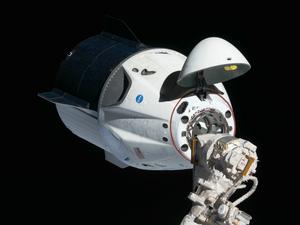
SpaceX crew dragon spacecraft
Caption: The SpaceX Crew Dragon spacecraft is the first Commercial Crew vehicle to visit the International Space Station (ISS). It is pictured with its nose cone open revealing its docking mechanism while approaching the station's Harmony module.
Credit: NASA
License: PD Public Domain icons
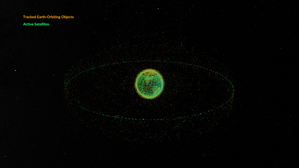
Space debris orbiting the Earth
Caption: This animation shows objects orbiting the Earth. The data date from February 2024 and are taken from space-track.org which maintains a public catalogue of objects tracked by the United States Space Command (USSPACECOM).
At first in this video we see green dots, each representing one of the 31,000 human-made objects orbiting Earth. These include both operational and decommissioned satellites, used rocket stages from space launches, and fragments larger than 10cm created by collisions or explosions. Later in the video, some of the green dots are replace by orange dots, each of these representing one of the 9,300 operational satellites orbiting the Earth. Note that since February 2024 more satellites and rockets have been launched in to space and some objects will have fallen back to Earth, so these numbers will have changed.
We see two main groups of objects. The first are those objects orbiting close to the Earth, objects in low Earth orbit. These include communication satellites (many from the satellite constellations used to provide satellite internet services), Earth observation satellites, military satellites, two operational space stations and other objects such as rocket stages and other debris.
More distant from Earth we see a thin ring of satellites. These are in geostationary orbit. This is a special orbit where the orbital period matches the rotation period of the Earth. This means that a satellite in geostationary orbit stays above the same point on the equator and, when observed from the side of the Earth facing the satellite, will appear to stay at a position on the sky that does not change over time. Because of this, geostationary orbit is used by many communications satellites as a satellite dish on Earth used to receive or transmit a signal to that satellite can point in a fixed direction and does not need to dynamically track the satellite. Geostationary orbit is also used by weather observation satellites.
Credit: NASA's Scientific Visualization Studio
credit link
License: PD Public Domain icons