词条 超新星
描述: 超新星是一种大规模的恒星爆发。超新星会短暂地成为星系中迄今为止最明亮的天体,然后在几年的时间里逐渐消失。产生超新星的途径主要有两种。第一种(Ia 型)是双星系统中白矮星从伴星吸收物质。一旦白矮星的质量超过 1.4 个太阳质量(钱德拉塞卡极限)或表面积累了足够多的氦,白矮星就会失去稳定性而爆炸,不留下任何残余物。形成超新星(II 型)的另一个主要途径是质量大于 8 个太阳质量的恒星的演化。在这种恒星演化的末期,它会发生爆炸,形成一颗中子星或(对于质量最大的恒星)恒星级黑洞。
超新星是许多化学元素的来源,尤其是那些比镁重的元素。
相关词条
用其他语言查看该词条
词条和定义状态: 该术语的英文原始定义已通过天文研究人员和教师的审核 该术语及其定义的译文仍待审核
OAE多语言词汇表是由国际天文学联合会(IAU) 天文教育办公室(OAE) 和 国际天文学联合会(IAU) 天文推广办公室(OAO)合作的项目。. 术语和定义由 OAE中心, OAE 国家天文教育协调员(NAECs) 以及其他志愿者共同选择、撰写和审阅。您可以在 找到完整的致谢列表。所有词汇表术语及其定义均根据 Creative Commons CC BY-4.0许可证发布 且版权归属于 “IAU OAE”。
如果您发现此词汇术语或定义中的事实或翻译错误, 请向 发邮件 联系.
其他语言版本
- 阿拉伯语: الانفجار الاعظم
- 德语: Supernova
- 英语: Supernova
- 西班牙语: Supernova
- 波斯语: ابرنواختر
- 法语: Supernova
- 意大利语: Supernova
- 日语: 超新星 (外部链接)
- 巴西葡萄牙语: Supernova
- 繁体中文: 超新星
相关媒体
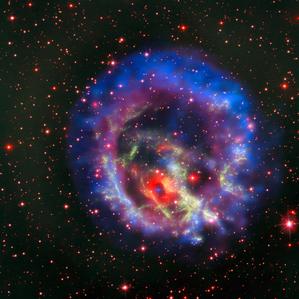
大质量恒星的死亡
图注: 用地球上和太空中的望远镜拍摄到的邻近小麦哲伦云星系中一颗中子星的多波段图像。中子星(在这里被看作是被红色环包围的蓝色斑点)是大质量恒星引力坍缩、压缩和爆炸的最终产物,被嵌入其超新星残余物(绿色)中。
来源: ESO/NASA, ESA and Hubble Heritage Team (STScI/AURA)/F.Vogt et al.
来源链接

Remnant of SN 1006
图注: This image shows the remnant of the supernova SN 1006. This was probably the result of a white dwarf that accreted so much material from a binary companion star that the white dwarf exploded (this is called a Type 1a supernova by astronomers). This explosion happened several thousand years ago, however it took time for the light from this event to reach Earth, only arriving in the year 1006. This bright explosion was noticed by observers across the Earth and its appearance was noted in the records of many different societies.
Here we see the effect that supernova has had on its surroundings in the galaxy. The force of the explosion has blown a huge bubble in the surrounding interstellar gas with a hot shockwave at its edge. The image appears to be a simple color picture but it actually represents light far beyond what our eye can see. The blue is X-ray data from NASA's Chandra X-ray Observatory, the yellow and orange are data from optical telescopes and the red is detections in radio waves from the Very Large Array and the Green Bank Telescope. The bright blue of the outer shell shows the gas there is very hot and that the explosion produced energetic shock waves.
来源: X-ray: NASA/CXC/Rutgers/G.Cassam-Chenai, Hughes et al.; Radio: NRAO/AUI/NSF/GBT/VLA/Dyer, Maddalena & Cornwell; Optical: Middlebury College/F.Winkler, NOAO/AURA/NSF/CTIO Schmidt & DSS
来源链接
License: PD 公共领域 图标
相关图表
Stellar Evolution
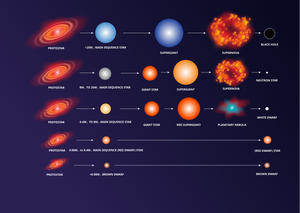
图注: This diagram shows the life cycle of stars of different masses. The mass of the different types of star increases from bottom to top with time going from left to right.
The life cycle of a star depends on its mass, with lower mass stars have longer lifetimes. All stars form from clouds of gas that collapse under their own gravity. As the star collapses, its core becomes hotter and denser. If the star has a mass greater than 0.08 solar masses (0.08 times the mass of the Sun), the pressure of the star’s mass pushing down on its core creates a high enough core temperature for hydrogen fusion to ignite. This burns hydrogen into helium in the star’s core, providing a heat source to power the star and to stop its core from collapsing further. If the collapsing object has a mass below 0.08 solar masses then it does not ignite hydrogen fusion in its core. It continues to cool and slowly contract. Such substellar objects are known as brown dwarfs, shown here in the lowest row.
After stars have formed, they burn hydrogen in their cores and begin their so-called main sequence phase. The most massive stars (>25 solar masses, shown here at the top) have very high core temperatures and thus burn through their hydrogen fuel more quickly. This means they may only spend a few million years on the main sequence burning hydrogen in their cores. Once the hydrogen in the core is exhausted the star’s core contracts, becomes hotter and helium burning starts in the core. While the core contracts, the outer layers of the star expand and it becomes a supergiant. For the most massive stars strong stellar winds strip off the cooler outer layers, leading to the star being very large and very hot, a blue supergiant. Once helium is exhausted in the core, carbon is burned, and then heavier elements. Eventually the star ends with an iron core. Fusing iron into heavier elements does not generate energy so at this point fusion stops in the core. Once this core of iron is massive enough, it and the surrounding matter suddenly collapses to form a black hole and the outer layers are flung off in a supernova explosion.
Slightly lower mass stars (between 8 and 25 solar masses, seen here second top) evolve in a similar way although they do not have strong enough winds to push their outer layers away and become blue supergiants, instead it evolves into a red supergiant. While such stars also collapse and create supernova explosions. The remnant of the star’s core is not massive enough to collapse into a black hole. Instead, its electrons and protons combine to form neutrons and it is supported by a quantum mechanical effect called neutron degeneracy pressure. This results in the remnant of the star being a tiny neutron star, several solar masses in mass but only a few kilometres across.
For stars similar in mass to the Sun (between 0.4 and 8 solar masses, seen here in the middle row), the star burns hydrogen in its core until the hydrogen in its core is exhausted. At this point a hydrogen burning shell forms around the core. Eventually the core will become hot enough to burn helium into carbon and oxygen. After this the star is left with a carbon and oxygen core surrounded by shells burning helium and hydrogen. These shells are unstable producing thermal pulsations that convulse the star. Eventually these pulsations become so extreme that the star’s outer layers are thrown off. This leaves the carbon and oxygen core as a white dwarf supported by electron degeneracy pressure. The outer layers of the star form what is known as a planetary nebula (which doesn’t actually have anything to do with planets despite the name).
The lowest mass stars (seen here in the second bottom row) are so low in mass that their evolutionary timescales are much longer than the age of the universe. This means that none have evolved beyond the main-sequence. Low mass stars are fully convective meaning material in the core is constantly being mixed with material above. This means that all the hydrogen in the star would eventually be burned in the core, but this will take trillions of years.
来源: Danielle Futselaar/IAU OAE