Glossary term: 反射鏡
Description: 反射鏡是一種從其表面反射光線的光學設備。凸面鏡能使光束髮散,而凹面鏡則能使光束會聚。凹面鏡可以經過塑形,從而使平行光束聚焦到一點。大多數現代望遠鏡都使用大型凹面鏡作為主要集光區。
天文望遠鏡中使用的大多數反射鏡的主體都是由玻璃製成的。鏡體有時使用的其他材料包括陶瓷和金屬。鏡體需要經過研磨(或塑形)並拋光,如果材料本身不具有反射性,則會在表面塗上一層薄薄的金屬塗層。鋁是最常見的塗層材料,而金或銀也是可選擇的塗層材料。
對於直徑超過6米的望遠鏡來說,鑄造並支撐如此巨大的玻璃反射鏡非常困難。因此,如今世界上最大的一些望遠鏡使用了許多較小的反射鏡,這些反射鏡排列在一起,就像一面巨大的反射鏡一樣聚焦光線。
Related Terms:
See this term in other languages
Term and definition status: The original definition of this term in English have been approved by a research astronomer and a teacher The translation of this term and its definition is still awaiting approval
This is an automated transliteration of the simplified Chinese translation of this term
The OAE Multilingual Glossary is a project of the IAU Office of Astronomy for Education (OAE) in collaboration with the IAU Office of Astronomy Outreach (OAO). The terms and definitions were chosen, written and reviewed by a collective effort from the OAE, the OAE Centers and Nodes, the OAE National Astronomy Education Coordinators (NAECs) and other volunteers. You can find a full list of credits here. All glossary terms and their definitions are released under a Creative Commons CC BY-4.0 license and should be credited to "IAU OAE".
If you notice a factual or translation error in this glossary term or definition then please get in touch.
Related Media
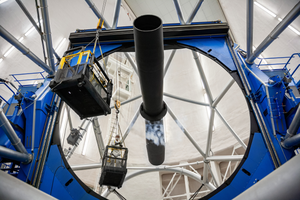
Gemini South's primary mirror and telescope structure
Caption: This is the primary mirror and supporting structure of a large optical telescope at the Gemini South Observatory in Chile. The primary mirror is the largest and most important mirror in a reflecting telescope: its gently curved surface gathers light from faint stars, galaxies, and nebulae and reflects that light to a focal point. At this focal point light is either fed directly in to an instrument to record spectra and images or redirected to such an instrument by a series of further mirrors. The sturdy metal framework around the primary mirros keeps the mirror precisely aligned and protected while the telescope moves to track objects across the sky.
In telescopes that use mirrors instead of lenses, such as this one, the mirror is what collects and focuses the light from distant celestial objects. Larger mirrors can capture more light, allowing astronomers to see fainter and more distant objects. A larger primary mirror can also take sharper images of the sky, but this is often negated by the blurring effect of the Earth's atmopshere. A primary mirror must be perfectly smooth to tolerances of fractions of a wavelength of light so that it produces sharp, clear images. We can think of the primary mirror as the “eye” of the telescope that looks out into space, with its shape and support enabling powerful astronomical observations.
Credit: International Gemini Observatory/NOIRLab/NSF/AURA/M. Paredes
credit link
License: CC-BY-4.0 Creative Commons 姓名標示 4.0 國際 (CC BY 4.0) icons







.jpg)
