Término del glosario: Espejo
Descripción: Un espejo es un dispositivo óptico que refleja la luz desde su superficie. Los espejos convexos dispersan los haces de luz, mientras que los espejos cóncavos los concentran. Los espejos cóncavos pueden diseñarse para enfocar haces de luz paralelos en un punto. La mayoría de los telescopios modernos utilizan grandes espejos cóncavos como superficie colectora principal.
El cuerpo principal de la mayoría de los espejos utilizados en los telescopios astronómicos está fabricado en vidrio. Otros materiales que a veces se utilizan para el cuerpo del espejo son la cerámica y los metales. El cuerpo del espejo se lija (o se le da otra forma) y se pule, y si el material no es ya reflectante, se aplica un fino recubrimiento metálico a la superficie. El aluminio es el material de recubrimiento más habitual, aunque el oro o la plata son alternativas.
En el caso de los telescopios de más de unos seis metros de diámetro, resulta difícil fundir y soportar espejos de cristal de tal envergadura. Por ello, algunos de los telescopios más grandes del mundo utilizan actualmente numerosos espejos más pequeños que se disponen juntos para enfocar la luz como si se tratara de un único espejo gigante.
Términos relacionados:
Ver este término en otros idiomas
Estado del término y la definición: La definición original de este término en inglés ha sido aprobada por unastrónomo o astrónoma investigadora y un docente La traducción de este término y su definición aún están pendientes de aprobación
El Glosario multilingüe de la OAE es un proyecto de la Oficina de Astronomía para la Educación de la UAI (OAE) en colaboración con la Oficina de Divulgación de Astronomía de la UAI (OAO). Los términos y definiciones fueron seleccionados, redactados y revisados gracias al esfuerzo colectivo de la OAE, los Centros y Nodos de la OAE, los Coordinadores Nacionales de Educación Astronómica (NAECs) y otros voluntarios. Puedes encontrar una lista completa de créditos aquí. Todos los términos del glosario y sus definiciones se publican bajo la licencia Creative Commons CC BY-4.0 y deben atribuirse a la "IAU OAE".
Si detectas algún error de contenido o de traducción en este término del glosario o en ladefinición, ponte en contacto con nosotros.
Contenidos relacionados
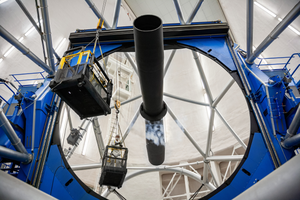
Gemini South's primary mirror and telescope structure
Pie de foto: This is the primary mirror and supporting structure of a large optical telescope at the Gemini South Observatory in Chile. The primary mirror is the largest and most important mirror in a reflecting telescope: its gently curved surface gathers light from faint stars, galaxies, and nebulae and reflects that light to a focal point. At this focal point light is either fed directly in to an instrument to record spectra and images or redirected to such an instrument by a series of further mirrors. The sturdy metal framework around the primary mirros keeps the mirror precisely aligned and protected while the telescope moves to track objects across the sky.
In telescopes that use mirrors instead of lenses, such as this one, the mirror is what collects and focuses the light from distant celestial objects. Larger mirrors can capture more light, allowing astronomers to see fainter and more distant objects. A larger primary mirror can also take sharper images of the sky, but this is often negated by the blurring effect of the Earth's atmopshere. A primary mirror must be perfectly smooth to tolerances of fractions of a wavelength of light so that it produces sharp, clear images. We can think of the primary mirror as the “eye” of the telescope that looks out into space, with its shape and support enabling powerful astronomical observations.
Crédito: International Gemini Observatory/NOIRLab/NSF/AURA/M. Paredes
enlace de crédito
License: CC-BY-4.0 Creative Commons Reconocimiento 4.0 Internacional (CC BY 4.0) íconos







.jpg)