Término del glosario: Sol
Descripción: El Sol es la estrella más cercana a la Tierra. Para los astrónomos, es una estrella de tipo «G2V». Esto significa que el Sol es una estrella de la secuencia principal con una temperatura típica («temperatura efectiva») de 5 800 kelvin (K). Las estrellas de la secuencia principal son estables, ya que la energía liberada por la fusión del hidrógeno en su núcleo equilibra la fuerza centrífuga debida a la gravedad. El Sol nos parece blanco a simple vista, ya que emite mucha luz en todo el espectro visible. Cuando se encuentra más bajo en el cielo, el aumento de la extinción atmosférica puede hacer que el Sol parezca amarillo o naranja, de ahí que se suela representar como amarillo. Las estrellas varían desde las que son más de 1 000 veces más brillantes que el Sol hasta las que son unas 1 000 veces más tenues, pero las más brillantes son relativamente raras: el Sol es más brillante (y más pesado) que la mayoría (quizás alrededor del 85 %) de las estrellas de la Galaxia.
Para los astrónomos, el Sol resulta interesante debido a su proximidad, lo que significa que su superficie puede observarse con mayor detalle, lo que permite estudiar sus estructuras y fenómenos. Por ejemplo, los estudios detallados de la actividad solar, relacionada con los campos magnéticos del Sol, pueden incluir: manchas solares (zonas más frías), erupciones solares (destellos brillantes de corta duración) e incluso eyecciones de masa coronal (partículas con carga eléctrica expulsadas del Sol). Los físicos también han detectado partículas elementales conocidas como neutrinos procedentes del núcleo del Sol; esto constituye una prueba directa de los procesos de fusión nuclear. El elemento helio se detectó por primera vez en el espectro solar, de ahí su nombre, que proviene de Helios (el dios del Sol en la mitología griega).
Términos relacionados:
- Secuencia principal
- Fusión nuclear
- Llamarada solar
- Estrella
- Mancha solar
- Temperatura efectiva
- Campo magnético
- neutrino
- Eyección de masa coronal (CME)
Ver este término en otros idiomas
Estado del término y la definición: La definición original de este término en inglés ha sido aprobada por unastrónomo o astrónoma investigadora y un docente La traducción de este término y su definición aún están pendientes de aprobación
El Glosario multilingüe de la OAE es un proyecto de la Oficina de Astronomía para la Educación de la UAI (OAE) en colaboración con la Oficina de Divulgación de Astronomía de la UAI (OAO). Los términos y definiciones fueron seleccionados, redactados y revisados gracias al esfuerzo colectivo de la OAE, los Centros y Nodos de la OAE, los Coordinadores Nacionales de Educación Astronómica (NAECs) y otros voluntarios. Puedes encontrar una lista completa de créditos aquí. Todos los términos del glosario y sus definiciones se publican bajo la licencia Creative Commons CC BY-4.0 y deben atribuirse a la "IAU OAE".
Si detectas algún error de contenido o de traducción en este término del glosario o en ladefinición, ponte en contacto con nosotros.
Contenidos relacionados
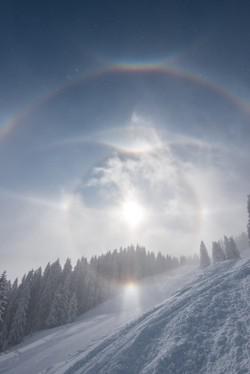
Winter Haloes, by Thomas Gigl, Germany
Pie de foto: Second place in the 2021 IAU OAE Astrophotography Contest, category Sun/Moon haloes.
Captured in Jochberg located in the famous Austrian ski-region of Tirol, this image shows multiple features related to ice halos, which are a more common appearance around the sun, due to its brightness, than the moon. External and internal reflection of sun rays from ice crystal faces and within different types of ice crystals lead to these halo related phenomena. The 22° halo encircles the sun, with two bright spots at the edge called Sundogs, Parhelia or Mock Suns observed to the left and right at the same height as the sun. The horizontal white band called the parhelic circle, named after the sun god Helios, passes through the sun and the Sundogs at the same angular elevation. An Upper tangent arc, a suncave parry arc and a lower tangent arc are also seen touching the top and bottom of the 22° halo. An upside down rainbow like arc or the circumzenithal arc is seen touching the bright supralateral arc, both of which are less frequently observed.
Crédito: Thomas Gigl/IAU OAE
License: CC-BY-4.0 Creative Commons Reconocimiento 4.0 Internacional (CC BY 4.0) íconos
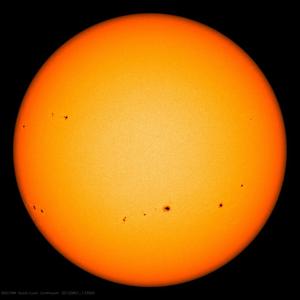
Sunspots
Pie de foto: In this image the sun peppered with groups of sunspots over almost nine days between July and August 2012. The sunspots seen in this image have been sources of the solar flares and coronal mass ejections (CME). In this image particulary, the sun is approaching solar maximum in its cycle (solar cycle), where we see many spots forming along the suns' equator. These sunspots and activity are seen in the southern hemisphere, before then most of the activity was on the northern hemisphere.
Crédito: NASA/SDO/HMI
enlace de crédito
License: PD Dominio público íconos
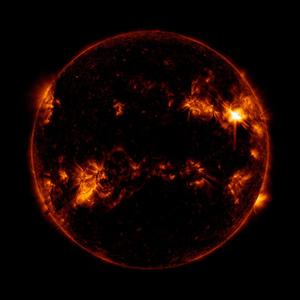
Solar flare
Pie de foto: This image shows the mid-level solar flare that was observed in March 2022 by the Solar Dynamic Observatory (SDO). The SDO observes the Sun activity, hence it shows the regions on the Sun where there is activity. A solar flare is brief brightening on the sun's surface, this particular flare is an M-class, which means that it is a tenth of the size of the most intense flares, namely the X-flares. Solar flares are barely visible with the naked eye, thus the SDO. The image here, is captured in extreme ultravoilet light that was colourized by red in the SDO, the flare appears in the upper of the solar disk.
Crédito: NASA/SDO
enlace de crédito
License: PD Dominio público íconos

H-alpha image of the Sun's chromosphere
Pie de foto: This false-color image was captured with a 10-cm telescope at the Big Bear Solar Observatory (BBSO) in the United States in July 2002. It depicts the full disk of the Sun using the H-alpha emission line of hydrogen. When observed in this spectral line, the Sun's chromosphere appears particularly prominent due to hydrogen atoms emitting light at the specific wavelength. This emission produces a distinctive red color, making features such as spicules (jets of plasma that look hair-like) and plage (bright patches in the chromosphere) highly visible. Several small solar prominences can be seen protruding from the edge of the solar disk. When prominences (also known as filaments) cross the face of the disk they appear as dark threads caused by the cooler material in the prominence absorbing light. The chromosphere is also visible in the violet part of the solar spectrum due to ionized calcium showing emissions in these wavelengths.
Crédito: Big Bear Solar Observatory (BBSO)/New Jersey Institut of Technology (NJIT)
enlace de crédito
License: PD Dominio público íconos

Close-up view of a sunspot
Pie de foto: This image of a sunspot was taken by the Daniel K Inouye Solar Telescope (DKIST), operated by the U.S. National Science Foundation. It was taken only in light with a wavelength of 530 nanometers, within the greenish-yellow part of the visible spectrum.
The picture reveals the detail of the spot's structure and the Sun’s photosphere. The dark central region, known as the umbra, is surrounded by a lighter area called the penumbra with radially elongated features stretching towards the umbra. Note that the umbra and penumbra here are not the same as the umbra and penumbra that occur during an eclipse.
The sunspot measures approximately 5000 kilometres in diameter, roughly equivalent to the east-west span of China. While the umbra appears black, it is actually hot and bright. It only appears dark because it is a few thousand kelvin cooler than the surrounding solar photosphere. Surrounding the sunspot, granulation patterns of plasma are visible on the photospheric surface of the Sun.
Crédito: NSO/NSF/AURA
enlace de crédito
License: CC-BY-4.0 Creative Commons Reconocimiento 4.0 Internacional (CC BY 4.0) íconos
Diagramas relacionados
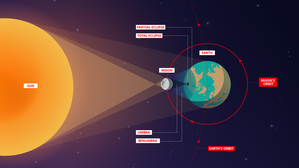
Total Solar Eclipse
Pie de foto: This not to scale diagram shows what happens during a total solar eclipse. The Moon orbits the Earth, but its orbit is slightly tilted with respect to the Earth’s orbit around the Sun. During the new moon lunar phase, the Moon lies between the Earth and the Sun, but due to the Moon’s tilted orbit around the Earth, the Moon normally lies above or below the Sun at this point. However twice a year the Moon’s orbit lines up in such a way that the Moon can lie in a direct line between the Earth and Sun. During each of these periods (each of which last roughly a month) solar (and lunar) eclipses can occur. The Moon is about 400 times smaller than the Sun, but is 400 times closer to the Earth than the Sun. Hence the Sun and Moon have approximately the same angular size when viewed from the Earth. This means that it is possible for the Moon to completely cover the Sun when viewed from Earth. This is known as a total solar eclipse.
Here we see a schematic of such and eclipse. The Moon casts a shadow on the Earth known as the umbra. This is a roughly circular shadow a few hundred kilometres across although its shape can be severely distorted when the eclipse is at the edge of the illuminated part of the Earth. Any region within the umbra will see the Moon completely cover the Sun and thus will experience a total solar eclipse. Outside of the umbra there are regions where the Moon will cover part of the Sun. This partial shadow is known as the penumbra. Regions in the penumbra will experience a partial solar eclipse.
An eclipse is a dynamic event with the Moon moving in its orbit and the Earth rotating. Hence the umbra and penumbra move across the Earth’s surface together. The path the umbra takes across the Earth is known as the path of totality. Let’s consider one particular region that lies in the path of totality: except in rare cases where an eclipse begins at sunrise, a region that experiences totality will first see the Moon cover part of the Sun and gradually move across Sun until it is totally covered. From outside the Earth this would appear as the penumbra moving over this particular region followed by the umbra moving over this region. Once the Moon moves so that it no longer completely covers the Sun, totality ends and the umbra moves away from this particular region. The Moon will continue to uncover the Sun until (unless the Sun sets before the end of the eclipse) the Sun is completely uncovered. From outside the Earth this would appear as the umbra moving away from our particular region and the edge of the penumbra approaching and eventually passing over the region.
Outside of the path or totality there is a much broader region that will lie in the penumbra but will be missed by the umbra. Such regions will not experience a total solar eclipse during this event, only a partial solar eclipse.
Crédito: Aneta Margraf/IAU OAE
License: CC-BY-4.0 Creative Commons Reconocimiento 4.0 Internacional (CC BY 4.0) íconos
Actividades relacionadas
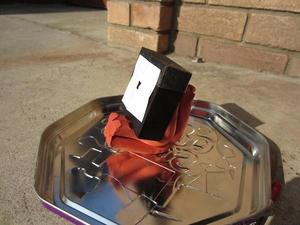
Measure the Solar Diameter
astroEDU educational activity (links to astroEDU website) Description: Hands-on activity to measure the Sun by using household materials.
License: CC-BY-4.0 Creative Commons Reconocimiento 4.0 Internacional (CC BY 4.0) íconos
Etiquetas:
Hands-on
, Scales
, Observing
, Measurement
Rango de edades:
12-14
, 14-16
, 16-19
, 19+
Nivel educativo:
Educación secundaria
Áreas de aprendizaje:
Aprendizaje basado en la investigación estructurada
Costos:
Bajo coste
Tamaño del grupo:
Grupo
Competencias:
Comunicar información
, Elaborar explicaciones
, Utilizar las matemáticas y el pensamiento computacional
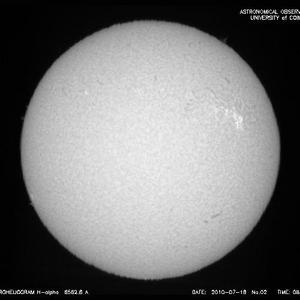
Counting Sunspots
astroEDU educational activity (links to astroEDU website) Description: Counting the Sunspots using real solar images and data.
License: CC-BY-4.0 Creative Commons Reconocimiento 4.0 Internacional (CC BY 4.0) íconos
Etiquetas:
Hands-on
, Sunspots
, Data analysis
Rango de edades:
16-19
Áreas de aprendizaje:
Basado en la observación
Costos:
Bajo coste
Duración:
1 hora
Tamaño del grupo:
Grupo
Competencias:
Analizar e interpretar datos
, Elaborar explicaciones
, Utilizar las matemáticas y el pensamiento computacional
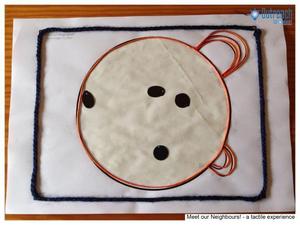
Meet Our Neighbours: Sun
astroEDU educational activity (links to astroEDU website) Description: Explore the tactile version of our star; the Sun with household materials.
License: CC-BY-4.0 Creative Commons Reconocimiento 4.0 Internacional (CC BY 4.0) íconos
Etiquetas:
Hands-on
, Model
, Sunspots
, Visually Impaired
, Tactile
Rango de edades:
6-8
, 8-10
, 10-12
Nivel educativo:
Educación secundaria
, Primaria
, Secondary
Áreas de aprendizaje:
Clase interactiva
, Modelización
Costos:
Bajo coste
Duración:
1 hora
Tamaño del grupo:
Grupo
Competencias:
Analizar e interpretar datos
, Desarrollar y utilizar modelos
Build a Safe Sun Viewer
astroEDU educational activity (links to astroEDU website) Description: Build a safe Sun viewer using cheap household items and learn why it is dangerous to look directly at the Sun, even briefly.
License: CC-BY-4.0 Creative Commons Reconocimiento 4.0 Internacional (CC BY 4.0) íconos
Etiquetas:
Hands-on
, Safety
Rango de edades:
6-8
, 8-10
, 10-12
Nivel educativo:
Primaria
, Secondary
Áreas de aprendizaje:
Modelización
, Basado en la observación
Costos:
Bajo coste
Tamaño del grupo:
Grupo
Competencias:
Planificar y llevar a cabo investigaciones
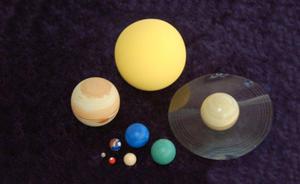
Solar System Model
astroEDU educational activity (links to astroEDU website) Description: Make a model of the Solar System planets using household materials.
License: CC-BY-4.0 Creative Commons Reconocimiento 4.0 Internacional (CC BY 4.0) íconos
Etiquetas:
Hands-on
, Model
, Planets
Rango de edades:
4-6
, 6-8
, 8-10
Nivel educativo:
Educación infantil
, Primaria
Áreas de aprendizaje:
Modelización
Costos:
Bajo coste
Duración:
30 minutos
Tamaño del grupo:
Grupo
Competencias:
Analizar e interpretar datos
, Plantear preguntas
, Comunicar información
, Desarrollar y utilizar modelos