This page describes a video Jupiter Moons Movie2, by Nicolas Hurez, Paul-Antoine Matrangolo, and Carl Pennypacker, United States of America
Baixar este arquivo do Zenodo ( vídeo 890.47 kB)
Registro deste arquivo no Zenodo
Legenda do vídeo:
Second place in the 2021 IAU OAE Astrophotography Contest, category Galilean moons.
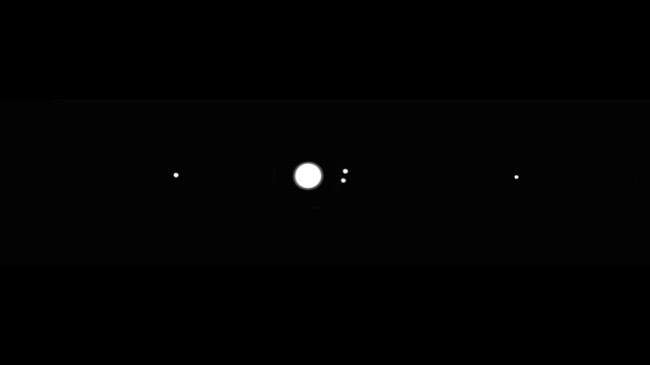
This sequence shows the orbit of the four Galilean moons around the planet Jupiter. Almost two entire orbits of the innermost moon, Io, can be seen, with the other moons (Europa and Ganymede, but in particular Callisto) being further away, orbiting noticeably slower. The images were obtained in 2018 with the Las Cumbres Global Observatory at different locations on Earth, allowing a continuous sequence of images over approximately half a week without gaps during the day. With clear skies and over the course of several nights, the motion of the Galilean moons can also be observed with binoculars (ideally steady your elbows on a surface).
Role até as legendas em outros idiomas
Crédito do vídeo: Nicolas Hurez, Paul-Antoine Matrangolo and Carl Pennypacker/IAU OAE
DOI: 10.5281/zenodo.5291803
Termos relacionados do glossário:
Gigante gasoso
, Io
, Júpiter
, Luas
, Planeta
, Planetas Externos
, Satélites Galileanos
, Órbita
Categorias
Sistema Solar
Licença do vídeo: Creative Commons Atribuição 4.0 Internacional (CC BY 4.0) Creative Commons Atribuição 4.0 Internacional (CC BY 4.0) ícones
As legendas dos arquivos de mídia apresentadas no site da OAE foram escritas, traduzidas e revisadas por meio de um esforço coletivo da OAE, dos Centros e Nós da OAE, dos Coordenadores Nacionais de Educação em Astronomia (NAECs) da OAE e de outros voluntários. Você pode encontrar uma lista completa dos créditos do nosso projeto de tradução aqui. Todas as legendas dos arquivos de mídia são disponibilizadas sob uma licença Creative Commons CC BY-4.0 e devem ser creditadas à "IAU OAE". Os próprios arquivos de mídia podem ter licenças diferentes (veja acima) e devem ser creditados conforme indicado acima em "crédito".
Se você notar algum erro factual nesta legenda ou algum erro em qualquer uma de suas traduções, por favor entre em contato.
Legendas em diferentes idiomas:
Legenda do vídeo: ২০২১ আইএইউ ওএই অ্যাস্ট্রোফটোগ্রাফি প্রতিযোগিতায় দ্বিতীয় স্থান, ক্যাটাগরি গ্যালিলিয়ান চাঁদ।
এই ক্রমটি বৃহস্পতি গ্রহের চারপাশে চারটি গ্যালিলিয়ান চাঁদের কক্ষপথ দেখায়। অভ্যন্তরীণ চাঁদ, আইও-এর প্রায় দুটি সম্পূর্ণ কক্ষপথ দেখা যায়, অন্য চাঁদগুলি (ইউরোপা এবং গ্যানিমিড, তবে বিশেষত ক্যালিস্টো) আরও দূরে, লক্ষণীয়ভাবে ধীর গতিতে প্রদক্ষিণ করে। ছবিগুলি ২০১৮ সালে লাস কামব্রেস গ্লোবাল অবজারভেটরির সাথে পৃথিবীর বিভিন্ন স্থানে প্রাপ্ত করা হয়েছিল, যা দিনের বেলা ফাঁক ছাড়া প্রায় অর্ধ সপ্তাহ ধরে চিত্রগুলির একটি ক্রমাগত ক্রম অনুমতি দেয়। পরিষ্কার আকাশের সাথে এবং বেশ কিছু রাতের মধ্যে, গ্যালিলিয়ান চাঁদের গতিও দূরবীনের সাহায্যে পর্যবেক্ষণ করা যেতে পারে (আদর্শভাবে আপনার কনুই একটি পৃষ্ঠে স্থির রাখুন)।
Crédito do vídeo: নিকোলাস হুরেজ, পল-অ্যান্টোইন ম্যাট্রাঙ্গোলো এবং কার্ল পেনিপ্যাকার/আইএইউ ওএই
Termos relacionados do glossário: Galilean Satellites , Gas Giant , Io , Jupiter , Moons , Orbit , Outer Planets , Planet Status da tradução da legenda: Ainda não aprovado por um revisor
Tradutores da legenda: Raktim Mukherjee
Legenda do vídeo: Zweiter Platz beim IAU OAE Astrophotography Contest 2021, Kategorie Galileische Monde.
Diese Sequenz zeigt den Umlauf der vier Galileischen Monde um den Planeten Jupiter. Vom innersten Mond, Io, sind fast zwei komplette Umläufe zu sehen, während die anderen Monde (Europa und Ganymed, vor allem aber Callisto) weiter vom Planeten entfernt sind und deutlich langsamer umlaufen. Die Bilder wurden 2018 mit dem Las Cumbres Global Observatory an verschiedenen Standorten auf der Erde aufgenommen, was eine kontinuierliche Bildfolge über etwa eine halbe Woche ohne Lücken während des Tages ermöglichte. Bei klarem Himmel und über mehrere Nächte hinweg kann die Bewegung der Galileischen Monde auch mit einem Fernglas beobachtet werden (idealerweise mit den Ellbogen auf einer Unterlage aufstützen).
Crédito do vídeo: Nicolas Hurez, Paul-Antoine Matrangolo und Carl Pennypacker/IAU OAE
Termos relacionados do glossário: Galileische Satelliten , Gasriese , Io , Jupiter , Monde , Planet , Umlaufbahn , Äußere Planeten Status da tradução da legenda: Ainda não aprovado por um revisor
Tradutores da legenda: Simon Kraus
Legenda do vídeo: Second place in the 2021 IAU OAE Astrophotography Contest, category Galilean moons.
This sequence shows the orbit of the four Galilean moons around the planet Jupiter. Almost two entire orbits of the innermost moon, Io, can be seen, with the other moons (Europa and Ganymede, but in particular Callisto) being further away, orbiting noticeably slower. The images were obtained in 2018 with the Las Cumbres Global Observatory at different locations on Earth, allowing a continuous sequence of images over approximately half a week without gaps during the day. With clear skies and over the course of several nights, the motion of the Galilean moons can also be observed with binoculars (ideally steady your elbows on a surface).
Crédito do vídeo: Nicolas Hurez, Paul-Antoine Matrangolo and Carl Pennypacker/IAU OAE
Termos relacionados do glossário: Galilean Satellites , Gas Giant , Io , Jupiter , Moons , Orbit , Outer Planets , Planet
Legenda do vídeo: Deuxième place au concours d'astrophotographie 2021 de l'UAI OAE, catégorie Lunes galiléennes.
Cette séquence montre l'orbite des quatre lunes galiléennes autour de la planète Jupiter. Les images ont été obtenues en 2018 avec l'observatoire mondial Las Cumbres à différents endroits de la Terre, ce qui a permis une séquence continue d'images sur environ une demi-semaine, sans interruption pendant la journée. Avec un ciel clair et au cours de plusieurs nuits, le mouvement des lunes galiléennes peut également être observé avec des jumelles (idéalement en stabilisant vos coudes sur une surface).
Crédito do vídeo: Nicolas Hurez, Paul-Antoine Matrangolo et Carl Pennypacker/IAU OAE
Termos relacionados do glossário: Géantes gazeuses , Io , Jupiter , Lunes , Orbite , Planète , Planètes extérieures , Satellites galiléens Status da tradução da legenda: Ainda não aprovado por um revisor
Tradutores da legenda: Olivier Bonneton
Legenda do vídeo: Secondo posto al concorso di astrofotografia IAU OAE 2021, categoria Lune Galileiane.
Questa sequenza mostra l'orbita delle quattro Lune Galileiane intorno al pianeta Giove. Si possono vedere quasi due intere orbite della luna più interna, Io, mentre le altre lune (Europa e Ganimede, ma in particolare Callisto) sono più lontane e sensibilmente più lente. Le immagini sono state ottenute nel 2018 con il Las Cumbres Global Observatory in diverse località della Terra, consentendo una sequenza continua di immagini nell'arco di circa mezza settimana senza intervalli durante il giorno. In caso di cielo sereno e nel corso di diverse notti, il moto delle Lune Galileiane può essere osservato anche con un binocolo (l'ideale è tenere i gomiti su una superficie).
Crédito do vídeo: Nicolas Hurez, Paul-Antoine Matrangolo and Carl Pennypacker/IAU OAE
Termos relacionados do glossário: Gigante gassoso , Giove , Io , Lune , Orbita , Pianeta , Pianeti esterni , Satelliti galileiani Status da tradução da legenda: Aprovado por um revisor
Tradutores da legenda: Giuliana Giobbi, Valentina La Parola
Revisores da legenda: Rodolfo Canestrari
Legenda do vídeo: 2021 年国际天文学联合会 OAE 天体摄影比赛伽利略卫星类第二名。
这组照片展示了四颗伽利略卫星围绕木星运行的轨道。从中几乎可以看到最内侧的卫星木卫一艾奥的两个完整轨道,其他卫星(木卫二欧罗巴和木卫三加尼美得,尤其是木卫四卡利斯托)距离较远,运行速度明显较慢。这些图像是在2018年由Las Cumbres全球天文台在地球上不同地点拍摄的,因此可以在大约半个星期内连续拍摄一系列图像,白天也没有间隙。在天空晴朗的条件下,连续几个夜晚,也可以用双筒望远镜观测到伽利略卫星的运动(最好将手肘稳稳地放在地面上)。
Crédito do vídeo: Nicolas Hurez,Paul-Antoine Matrangolo 和 Carl Pennypacker/IAU OAE
Termos relacionados do glossário: 伽利略卫星 , 卫星 , 外行星 , 木卫一,音译为艾奥 , 木星 , 气态巨行星 , 行星 , 轨道 Status da tradução da legenda: Ainda não aprovado por um revisor
Tradutores da legenda: Hu Xueying
Legenda do vídeo: 2021 年國際天文學聯合會 OAE 天體攝影比賽伽利略衛星類第二名。
這組照片展示了四顆伽利略衛星圍繞木星運行的軌道。從中幾乎可以看到最內側的衛星木衛一艾奧的兩個完整軌道,其他衛星(木衛二歐羅巴和木衛三加尼美得,尤其是木衛四卡利斯托)距離較遠,運行速度明顯較慢。這些圖像是在2018年由Las Cumbres全球天文臺在地球上不同地點拍攝的,因此可以在大約半個星期內連續拍攝一系列圖像,白天也沒有間隙。在天空晴朗的條件下,連續幾個夜晚,也可以用雙筒望遠鏡觀測到伽利略衛星的運動(最好將手肘穩穩地放在地面上)。
Crédito do vídeo: Nicolas Hurez,Paul-Antoine Matrangolo 和 Carl Pennypacker/IAU OAE
Termos relacionados do glossário: 伽利略衛星 , 外行星 , 木星 , 木衛一,音譯為艾奧 , 氣態巨行星 , 行星 , 衛星 , 軌道 Status da tradução da legenda: Ainda não aprovado por um revisor
Tradutores da legenda: Uma transliteração automatizada a partir da tradução em chinês simplificado por - Hu Xueying